Scattered notes are where French grammar goes to die. You jot the passé composé rule in a notebook, the subjunctive triggers in a phone note, and the gender exceptions on a sticky note that's now gone. A single Notion database fixes that — one searchable home for every rule, free to copy and built to grow.
This starter template gives you the structure and a seeded set of essential rules. You bring the duplicate button.
What's in the template
The template is one Notion database, Grammar Rules, pre-loaded with the rules every learner needs in their first year. Each entry is a row with consistent fields, which is what makes the whole thing searchable and filterable later.
Each rule includes:
- Rule — the name (e.g. "Passé composé with être")
- Category — Verbs, Articles, Pronouns, Agreement, Sentence structure
- Tense / Mood — present, imparfait, subjunctive, conditional, etc.
- The rule in one line — the core idea, stated plainly
- Examples — two or three sentences showing it in use
- Exceptions — the gotchas, because French is mostly gotchas
- Difficulty — Easy / Medium / Hard
- Mastery — Not started / Learning / Solid
The essential rules it ships with
The seeded entries cover the high-frequency rules that unlock the most sentences:
Articles and gender
- Definite vs. indefinite vs. partitive articles, and when each applies
- The common gender endings (
-tion,-té→ feminine;-age,-ment→ masculine) and the exceptions worth memorizing
Verbs
- Present tense of
être,avoir,aller,faire - Passé composé with
avoirand withêtre(the agreement rule) - Imparfait vs. passé composé — when to use which
- Futur proche vs. futur simple
Pronouns
- Direct vs. indirect object pronouns and their word order
yandenand what they replace
Agreement
- Adjective agreement in gender and number
- Past participle agreement with
êtreand with preceding direct objects
How to actually use it
A database is only useful if you build habits around it. Here are the three that matter.
1. Capture every mistake as a row
When you get a sentence wrong — in a lesson, an app, a conversation — find the rule it broke and open that row. Don't have it yet? Add it. Over a few weeks your database becomes a personalized map of your weak spots, not a generic textbook.
2. Build a "weak spots" view
Create a filtered view: Mastery = "Learning" OR Difficulty = "Hard". This is your study queue. Instead of wondering what to review, you open one view and work top to bottom.
3. Search before you ask
Next time you're unsure whether it's je suis allé or j'ai allé, search "être" in the database. Because every rule has consistent fields, search actually finds things — which is the whole point of putting them in Notion instead of a notebook.
Why a starter template beats building from scratch
You could build this database yourself. Most people don't, because the blank-database problem is real: you stare at an empty table, can't decide on fields, and give up. A starter template removes that friction. The schema is decided, the first 20+ rules are filled in, and you're immediately in "add and refine" mode instead of "design from zero" mode.
The fields are also chosen deliberately. Difficulty and Mastery as separate properties let you filter for "hard rules I haven't mastered" — the exact intersection worth your study time. Category and Tense / Mood give you two independent ways to slice the data, so you can review all the subjunctive rules one day and all the pronoun rules the next.
How to extend it
The template is a foundation, not a ceiling. As you advance:
- Add a Conjugation relation. Create a second database of verbs and link each rule to the verbs it governs. Now clicking "être" shows every être-verb you've logged.
- Add a Source field. Note where you first met each rule — a lesson, a book, a video — so you can revisit the explanation that worked for you.
- Add a Last reviewed date. Combine it with a filtered view (
Last reviewedmore than 14 days ago) for instant spaced repetition.
Copy it and start today
Duplicate the template into your own Notion workspace, then do one thing: add the last grammar mistake you remember making as a new row. That single entry turns a generic reference into your grammar system — and you'll keep coming back to it because it's about your French, not someone else's syllabus.
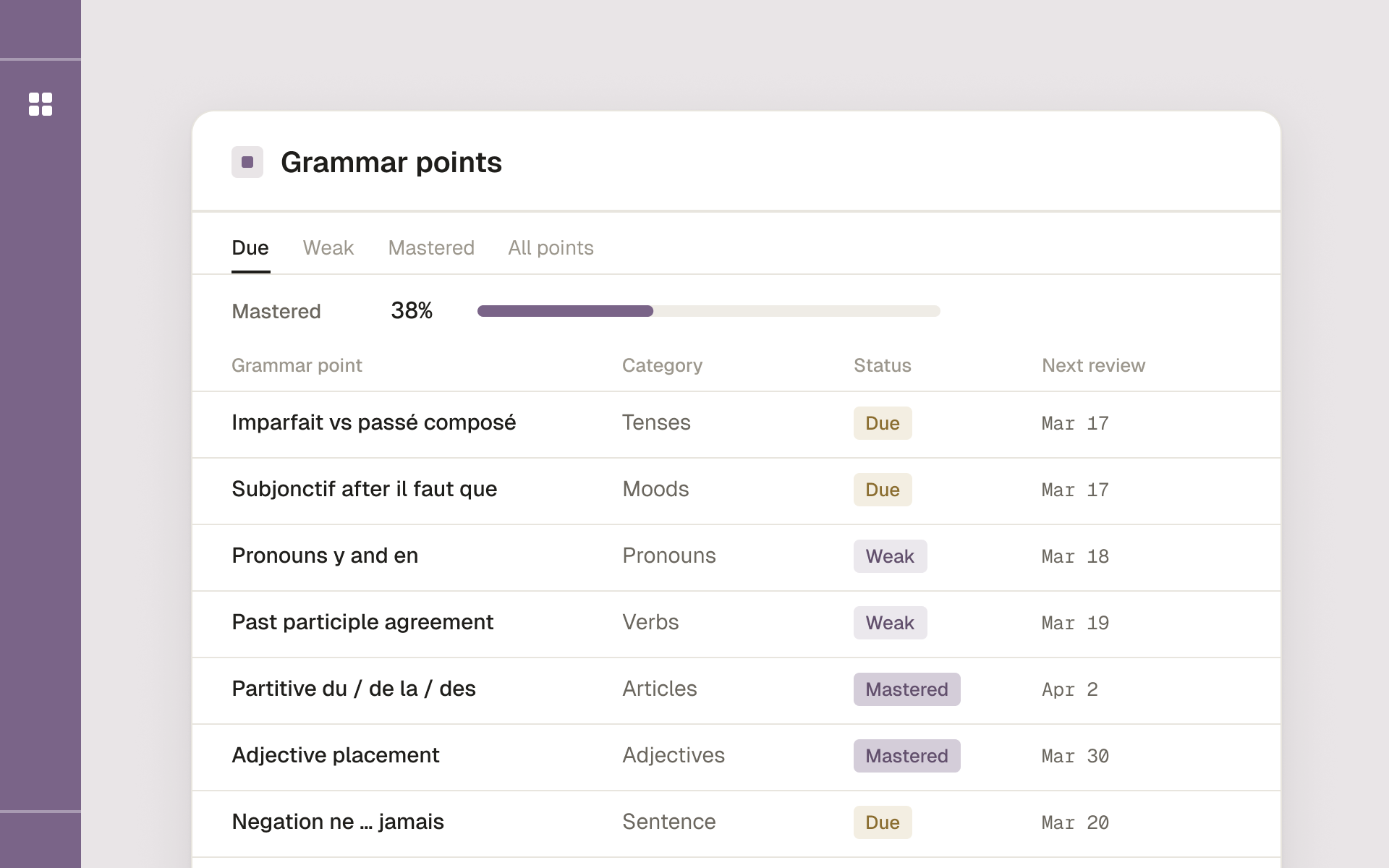
French grammar rules, patterns and tricky cases in one trackable Notion system.