
Last updated: 11 October 2026 · By Zoya K
Most advice on learning Spanish is a list of apps. This guide gives you a method instead: four parts that each do a different job, a grammar order taken from the official Instituto Cervantes curriculum, and a 12-week plan you can start this week. I learned English and French as an adult, and the structure below is what I'd want handed to me on day one.
What is the best way to learn Spanish?
For most adults the best way to learn Spanish is a combination of four things: daily listening and reading you can mostly understand, grammar studied in a fixed order, speaking with a person every week, and a short daily review of vocabulary. Apps can cover the review part well, but on their own they rarely cover speaking or deep grammar.
Each part has a different job. Input builds your feel for the language. Grammar explains what you are hearing. Speaking turns passive knowledge into something you can use under pressure. Review keeps new words from fading before you meet them again.
| Part | What it does | Tool type | Minutes a day |
|---|---|---|---|
| Input (listening and reading) | Acquisition: you absorb words and patterns in context | Learner podcasts, graded readers, then native video and articles | 20–25 |
| Grammar map | Understanding: you know why a sentence is built the way it is | A grammar framework or textbook that follows a level order | 10–15 |
| Speaking | Output: you practice producing Spanish and get feedback | Tutor, language exchange, shadowing | 10 (plus one longer weekly session) |
| Review | Memory: words and forms stay available | Spaced repetition app or a review database | 10 |
The minutes are a starting point for a 45–60 minute day, not a rule. If you only have 30 minutes, keep all four parts and shrink each one. Dropping a whole part is what usually stalls adult learners: lots of app streaks and no conversation, or lots of grammar and no listening.
A useful test for any routine: if you missed a week, could you restart it on Monday without a catch-up marathon? Fixed slots, such as a podcast on the commute and ten minutes of review after lunch, pass that test better than a vague goal of "an hour a day."
How long does it take to learn Spanish?
The U.S. Foreign Service Institute puts Spanish in Category I, languages close to English, and lists 30 weeks of full-time training to reach professional working proficiency in speaking and listening (ILR 3). A typical week there is 23 hours in class and 17 hours of self-study. Self-learners at an hour a day should plan in years.
The numbers come from the U.S. Department of State, which groups Category I as "Languages close to English" at "24-30 weeks (552-690 class hours)," and lists "Spanish (30 weeks)." The target is "an integrated score of 3 (Speaking + Listening) on the Interagency Language Roundtable (ILR) scale," and "a typical week is 23 hours per week in class and 17 hours of self-study."
Do the math and that is roughly 40 hours a week for 30 weeks, around 1,200 hours with expert teachers and a full-time schedule. An adult studying an hour a day, six days a week, logs about 310 hours a year. That doesn't mean you need years to say anything useful. You can order food, ask directions and hold a slow conversation long before professional level. It does mean "fluent in 3 months" claims describe something much smaller than what the FSI measures.
For a longer look at language hours and what changes them, see how long it takes to learn a language.
Step 1: How do you get daily Spanish input you can understand?
Daily input means listening to or reading Spanish every day at a level where you follow most of it without translating. Start with learner podcasts and graded readers written for beginners, then move to native content as it gets easier. Input is where most of your vocabulary and your feel for word order will come from.
Comprehensible input is language you can understand from context even when you don't know every word. Material that is far too hard teaches very little, because you spend the whole time decoding. Material that is slightly above your level is where the learning happens.
A practical progression:
- Weeks 1–4: slow learner podcasts, beginner graded readers, children's videos with Spanish subtitles.
- Weeks 5–8: podcasts for intermediate learners, short news written in simple Spanish, YouTube channels made for learners.
- Weeks 9–12: one native show or podcast on a topic you already like, with Spanish subtitles.
Mix two kinds of reading. Intensive reading means working slowly through a short text, looking up words and noting grammar. Extensive reading means reading a lot of easy text quickly for the story, without stopping. Intensive reading teaches you new things; extensive reading makes them automatic. A good week has some of both.
Pick one variety of Spanish to listen to most at the start, from Spain or Latin America, so the accent stays consistent. You can widen it later. The full explanation of why this works is in our guide to comprehensible input.
Step 2: What order should you learn Spanish grammar in?
Instead of watching random grammar videos, follow a sequence. The Instituto Cervantes Plan curricular defines what belongs at each level (A1–A2, B1–B2, C1–C2) and orders grammar from nouns and articles to subordinate clauses. Use it as a free, official checklist, and study each topic in the order it appears.
The Plan curricular del Instituto Cervantes is the reference curriculum the Instituto Cervantes publishes for teaching Spanish. It includes inventories for grammar, pronunciation, spelling, functions and vocabulary areas at each level pair. The A1–A2 grammar inventory has 15 sections: the noun, the adjective, the article, demonstratives, possessives, quantifiers, the pronoun, the adverb, the verb, the noun phrase, the adjective phrase, the verb phrase, the simple sentence, coordinated clauses and subordinate clauses.

The inventory is useful for the most common beginner question: which tenses first? In the A1 column for indicative tenses, only the present tense appears: regular verbs plus the irregulars ser, estar, haber and ir. The A2 column adds the common irregular presents, the pretérito imperfecto (era, tenía), the pretérito indefinido (fui, hice), the pretérito perfecto (he estado), and the imperative, which has no A1 entry. Verb phrases such as ir a + infinitive, tener que and estar + gerund also sit in the A2 column.
So the honest order for a beginner is: present tense first and well, then the past tenses and commands. The future simple, the conditional and the subjunctive do not appear in the A1–A2 tense lists at all. The 12-week plan below follows exactly that order.
Two tips for using the inventory:
- Don't read it front to back like a textbook. It's written for teachers, in Spanish. Use it as a checklist: when you finish a topic in your course, find it in the inventory and tick it off.
- Keep your own map. Write each topic down with two or three example sentences you understand. That map becomes your personal grammar reference and the thing you review.
One grammar framework in seven sections (alphabet, pronunciation, word formation, parts of speech, tenses, sentence, punctuation) that you fill with Spanish as you work through the A1–A2 inventory, and it works on the Notion free plan.

A Spanish-specific version, the Spanish Grammar Notion Template ($9), is coming soon. Join the waitlist below and we'll email you when it's ready.
Step 3: How often should you speak Spanish when learning alone?
Speaking improves with practice and feedback, so plan for it from the first weeks instead of waiting until you "feel ready." Tutors, language exchanges and shadowing all count. For self-learners, one real conversation a week plus a few minutes of daily shadowing is a realistic minimum that still moves you forward.
Shadowing means playing a short audio clip and repeating it out loud right after the speaker, copying the rhythm and sounds. It costs nothing, and it trains your mouth while you are still too new for conversation.
| Option | Cost type | Best for | Watch out for |
|---|---|---|---|
| Paid online tutor | Paid per lesson | Structured correction, beginners who need patience | Lessons that turn into the tutor talking |
| Language exchange partner | Freeyou teach your language back | Natural conversation from A2 onward | Little correction; scheduling drops off |
| Conversation group or meetup | Freeor low cost | Listening to several speakers, confidence | Less speaking time per person |
| Shadowing | Free | Pronunciation and rhythm, daily practice | No feedback on your own sentences |
| Talking to yourself or recording voice notes | Free | Finding gaps in what you can say | Mistakes can stick without a listener |
In a weekly session, bring something to talk about: three questions you prepared, a short story about your week, or the podcast episode you listened to. Ask your partner to correct the one or two mistakes that matter most, not every slip. Write those corrections down; they go straight into your review.
If you're looking for apps and services that cover speaking better than a typical course app, see our list of Duolingo alternatives.
Step 4: How do you remember Spanish vocabulary?
Use spaced repetition: review each word or phrase at growing intervals, just before you would forget it. A spaced repetition app such as Anki schedules this for you, so ten minutes a day keeps hundreds of words available. Add words you met in your input and speaking sessions, not random frequency lists alone.
What to put into review:
- Words and short phrases from your podcasts and readers, with the sentence you found them in.
- Corrections from your speaking sessions. These are your personal weak spots.
- Verb forms you keep getting wrong, as short example sentences (Ayer fui al cine.) rather than bare conjugation tables.
Keep cards small. One word or one pattern per card is easier to review than a paragraph. When a card keeps failing, rewrite it with a clearer example instead of drilling it harder.
How to set up spaced repetition and when a Notion review system fits better is covered in spaced repetition: Anki vs Notion. For collecting words with context before they become cards, see the vocabulary notebook guide. If you want your grammar topics and review in one Notion workspace, our older deep-dive on a Notion grammar system with spaced repetition walks through the setup.
A 12-week Spanish self-study plan for adults
The plan assumes 45–60 minutes a day, six days a week. Weeks 1–4 cover sounds, the present tense and core vocabulary. Weeks 5–8 cover the past tenses and longer input. Weeks 9–12 add commands, more conversation and native content. Grammar follows the order of the Instituto Cervantes A1–A2 inventory. Adjust the pace to your week.
| Week | Input | Grammar topic (PCIC A1–A2) | Speaking | Review | Minutes/day |
|---|---|---|---|---|---|
| 1 | Learner podcast, 10 min; alphabet and sound videos | Pronunciation and spelling; nouns: gender and number | Shadow 5 min a day | Set up your review deck; 10 new words a day | 45 |
| 2 | Learner podcast; first graded reader | Articles; adjective agreement | Shadowing; introduce yourself in a voice note | Daily review; add phrases from input | 45 |
| 3 | Same podcast, new episodes; reader chapters | Present tense of regular verbs (A1) | First tutor or exchange session (30 min) | Daily review; verbs as sentences | 50 |
| 4 | Podcast + children's video with Spanish subtitles | Present of ser, estar, haber, ir (A1); demonstratives, possessives | Weekly session: talk about your day | Daily review; catch-up day for missed cards | 50 |
| 5 | Intermediate learner podcast; extensive reading 10 min | Common irregular presents; ir a + infinitive, tener que (A2) | Weekly session: plans for next week | Add corrections from your session | 55 |
| 6 | Short news in simple Spanish | Pretérito perfecto (A2): he comido, he estado | Weekly session: what you have done this week | Daily review | 55 |
| 7 | Learner YouTube channel; reader | Pretérito indefinido (A2): regular forms, ser, ir, tener, hacer | Weekly session: tell a story about last weekend | Daily review; past forms as sentences | 60 |
| 8 | Longer podcast episodes (15–20 min) | Pretérito imperfecto (A2): descriptions and habits in the past | Weekly session: describe your childhood home | Daily review; prune cards you know cold | 60 |
| 9 | One native podcast or show on a topic you like, Spanish subtitles | Imperative (A2): tú and usted, common irregulars (di, haz, pon, sal) | Two sessions this week, or one plus a meetup | Daily review | 60 |
| 10 | Native content + intensive reading of one short article | Object pronouns with verbs (Cómpralo, Lo voy a ver) | Weekly session: give directions or instructions | Daily review; add pronoun sentences | 60 |
| 11 | Native content; extensive reading 15 min | Estar + gerund (A2); simple sentence and coordination with y, pero, o | Weekly session: retell an episode you watched | Daily review | 60 |
| 12 | Your favorite native source, no new materials | Review week: tick off your A1–A2 checklist, mark weak topics | Record a 3-minute monologue and compare with week 2 | Clear the backlog; plan the next 12 weeks (B1–B2) | 45 |
Notes on the plan:
- Six days, not seven. The free day is your buffer. If you miss a day, use it to catch up instead of doubling the next session.
- Grammar weeks are targets, not deadlines. If the indefinido and imperfecto feel blurry by week 8, that's normal. Keep going and give the contrast a second pass in your next 12 weeks.
- Speaking starts in week 3. It will feel early. That's the point.
- Week 12 is deliberately light. Comparing your week 2 and week 12 voice notes is the clearest progress check you'll get without a test.
After week 12, you'll still be working at the A1–A2 level for a while. The next step is the B1–B2 inventory of the same curriculum.
Is Duolingo good for learning Spanish?
Duolingo is free and good for building a daily habit and basic vocabulary. On its own it gives little speaking practice with real people, little long-form listening or reading, and little explicit grammar. Use it as one part of the plan, most likely the review slot, rather than the whole plan.
Duolingo describes itself as "100% free, fun, and scientifically proven to work." The free and fun parts are easy to see. The streak and short lessons are genuinely good at getting people to open the app every day, which is half the battle for adults with jobs.
Where it falls short, in our assessment, is in the other three parts of the method. Short exercise sentences aren't the same as 20 minutes of a podcast you follow. Tapping word tiles isn't the same as building a sentence out loud while someone waits. And the grammar explanations are light compared with a structured order like the Plan curricular. If you like Duolingo, keep it for 10 minutes a day and add the rest of the plan around it.
FAQ
What is the best way to learn Spanish as an adult?
Combine four parts every week: daily input you understand, grammar in a fixed order, weekly speaking with a person, and short daily vocabulary review. Adults usually stall when one of the four is missing.
Can I learn fluent Spanish in 3 months?
Not to professional level. The U.S. Foreign Service Institute's full-time Spanish course takes 30 weeks to reach ILR 3 in speaking and listening. Basic conversation in three months is realistic with daily study, but there's no official figure for it.
How can I learn Spanish fast?
Study every day, cover all four parts (input, grammar, speaking, review), and start speaking in the first weeks. Speed comes from total hours and consistency more than from any single app.
Is Spanish hard for English speakers?
It's one of the easier languages for English speakers. The FSI puts Spanish in Category I, "Languages close to English," its shortest training group.
Is Duolingo actually good for Spanish?
It's good for habit and vocabulary, and it's free. On its own it gives little speaking practice, long input or explicit grammar, so add those parts around it.
What's the best order to learn Spanish grammar?
Follow a level framework such as the Instituto Cervantes Plan curricular (A1–A2, then B1–B2, then C1–C2). In its A1–A2 grammar inventory, the present tense is at A1, and the past tenses and the imperative are at A2.
How many people speak Spanish?
According to the Instituto Cervantes 2025 yearbook, Spanish has a community of more than 630 million potential speakers and, for the first time, over 500 million speakers with native command.
What is the 80/20 rule for Spanish?
It's an informal heuristic, not a research finding: focus first on the most frequent words and structures, because they cover most of everyday speech. In practice that means core verbs, the present tense and high-frequency vocabulary before rare words and advanced tenses.
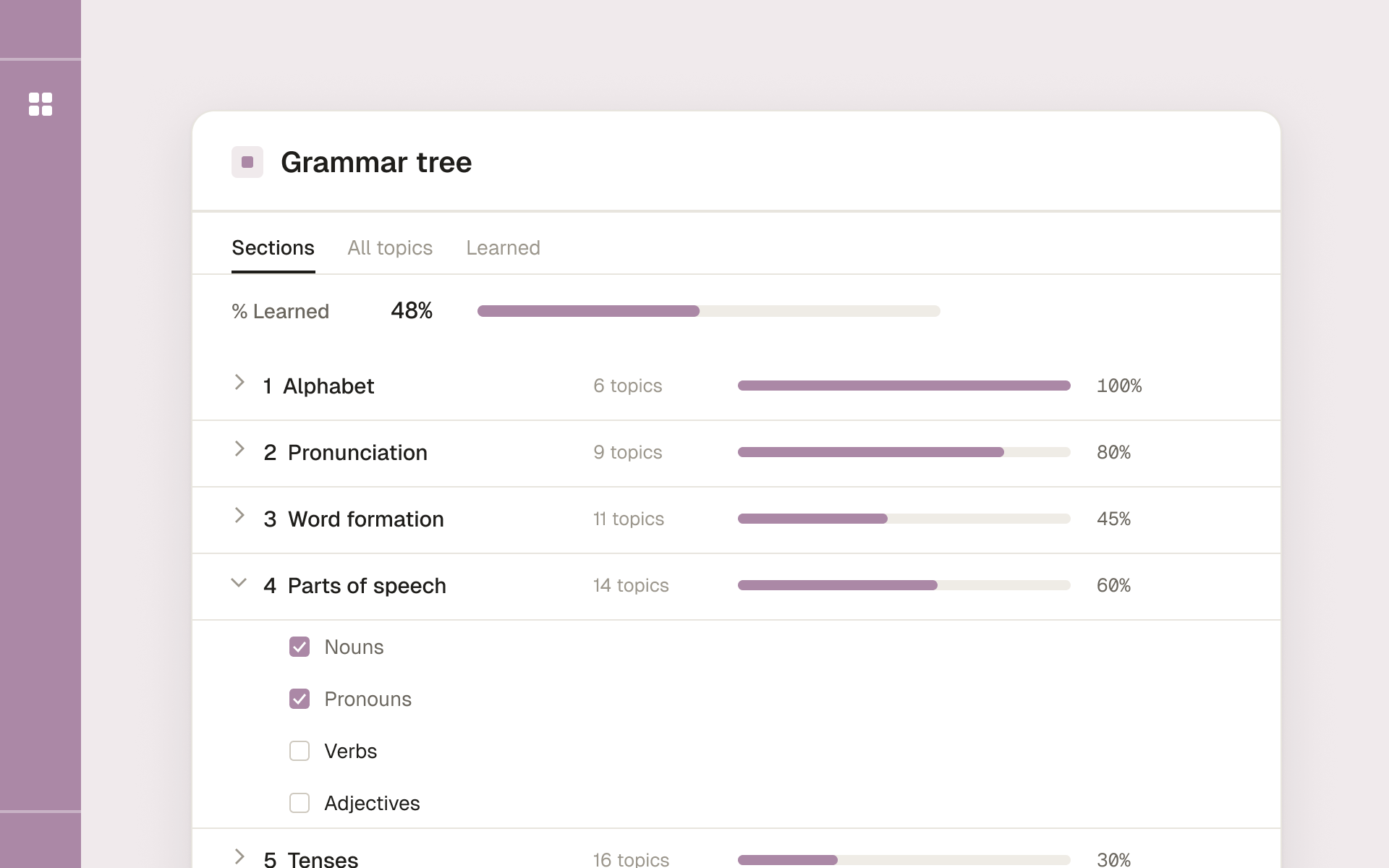
One grammar framework for any language, organized into seven sections from alphabet to punctuation.