Last updated: 11 October 2026 · By Zoya K
Comprehensible input is one of the most quoted ideas in language learning, and one of the most stretched. This guide goes back to what Stephen Krashen actually wrote, with page numbers, shows where researchers disagree, and turns the idea into a way to pick material and a routine you can run alone.
What is comprehensible input?
Comprehensible input is spoken or written language whose message you can understand, even though it contains some words or structures you don't know yet. Stephen Krashen made it the center of his input hypothesis: in his view, we acquire a language by understanding messages, with context and background knowledge filling the gaps that our vocabulary and grammar can't.
Definition: comprehensible input is language you understand mostly from meaning and context, pitched slightly above what you can already produce.
The key word is "understand." Krashen wrote that we can follow language that is a little beyond our level because "we also use context, our knowledge of the world, our extra-linguistic information to help us understand language directed at us" (Krashen, Principles and Practice in Second Language Acquisition, p. 21).
A simple example: a beginner watches a video where a speaker points at pictures and says, slowly, "The cat is on the table. Now the cat is under the table." The learner may not know "under," but the picture makes it obvious. The message gets through, and a new form comes along with it.
The idea is one of five hypotheses in Krashen's model, first published in 1977 according to Wikipedia's summary and developed in his books of 1982 and 1985.
| Hypothesis | What it says, in one line |
|---|---|
| Acquisition–learning | Adults develop a language in two separate ways: subconscious acquisition and conscious learning. |
| Natural order | Grammatical structures tend to be acquired in a predictable order. |
| Monitor | Consciously learned rules mainly work as an editor that checks output. |
| Input | We acquire by understanding messages that contain structures slightly beyond our level. |
| Affective filter | Anxiety, low motivation and low self-confidence can block input from being acquired. |
What does "i + 1" mean?
In Krashen's notation, i stands for your current level of competence and i + 1 for the next stage. He called understanding input that contains i + 1 "a necessary (but not sufficient) condition" for acquisition. He also argued that you don't need to aim at i + 1 deliberately: if you understand enough input, it is already there.
Here is the full sentence from the 1982 book, page 21:
Two parts of that sentence get lost in most retellings.
"Not sufficient." Krashen said understanding input is required, and he left room for other conditions. Comprehensible input sold as a complete method is a stronger claim than the one in the book.
"Focussed on the meaning." Input counts when your attention is on what is being said. Reading a story for the plot is the target activity. Translating it line by line is closer to study.
On page 22 he adds the practical consequence: "When communication is successful, when the input is understood and there is enough of it, i + 1 will be provided automatically." So you don't need material that introduces exactly one new structure. Enough material you mostly understand will contain the next steps.

The same page holds the most debated claim: "speaking fluency cannot be taught directly. Rather, it 'emerges' over time, on its own." Later researchers pushed back on this one (see the research section below).
Acquisition vs. learning: why does it matter for self-study?
Krashen separates acquisition, a subconscious process similar to how children pick up their first language, from learning, which is conscious knowledge of rules. He argued that input drives acquisition. For a self-learner, the practical reading is this: grammar study helps you check and understand, while input builds the "feel" for the language.
In his words, "language acquisition is a subconscious process," and learning means "conscious knowledge of a second language, knowing the rules, being aware of them, and being able to talk about them" (Krashen 1982, p. 10).
| Acquisition | Learning | |
|---|---|---|
| What it is | Picking up a language while using it for communication | Knowing about a language: rules, terms, explanations |
| Awareness | Mostly subconscious | Conscious |
| Self-study takeaway | Make this the bulk of your time | Use it to check and make sense of what you noticed |
The strict separation is also one of the most criticized parts of the theory. Wikipedia's overview notes that critics say the model assumes a division between acquisition and learning "that has not been proven to exist." A sensible middle position: spend most of your time on input, and use grammar to answer the questions it raises.
What is the affective filter?
The affective filter is Krashen's term for emotional factors that can stop input from being acquired even when it is understood. He groups them into three categories: motivation, self-confidence and anxiety, and credits the concept to Dulay and Burt (1977) (Krashen 1982, p. 30–31). For self-study, the takeaway is modest: material you enjoy, at a level that doesn't make you tense, is easier to keep up with.
Does comprehensible input work? What the research says, and where it's criticized
The input hypothesis has shaped language teaching for decades, but it is a hypothesis, not a proven law. Critics argue its key terms are hard to test, and Merrill Swain proposed that learners also need to produce language, not only understand it. Many current approaches combine a lot of input with speaking practice and feedback.
Three lines of critique come up most often.
Testability. Barry McLaughlin's 1978 paper "The monitor model: Some methodological considerations" (Language Learning, 28(2)) is the classic early critique. As Wikipedia summarizes the later debate, researchers argued the theory "lacks testability, is conceptually ambiguous, and exaggerates the role of 'comprehensible input'." In practice, it is hard to measure a learner's "i," so it is hard to prove what counts as i + 1.
Output. Merrill Swain's 1985 chapter on "comprehensible output" (in Input in Second Language Acquisition, Newbury House) started a competing line of work. The comprehensible output hypothesis holds that trying to speak or write makes learners notice gaps between what they want to say and what they can say. Swain did not claim output is responsible for most acquisition, only that under some conditions it helps in ways input alone does not.
Other critics. Gregg (1984) and White (1987), both in Applied Linguistics, also challenged the model; White's paper is titled "Against comprehensible input."
| Claim | What Krashen wrote (1982) | Critique | Source |
|---|---|---|---|
| Understanding input drives acquisition | Input containing i + 1 is "a necessary (but not sufficient) condition" (p. 21) | "i" and "i + 1" are hard to define and measure, so the claim is hard to test | McLaughlin 1978, Language Learning 28(2); summary on Wikipedia |
| You don't need to target i + 1 | With enough understood input, "i + 1 will be provided automatically" (p. 22) | Hard to verify for the same reason; it is a prediction, not a measured result | Same as above |
| Speaking emerges on its own | "speaking fluency cannot be taught directly" (p. 22) | Producing language can push learners to notice gaps and test guesses | Swain 1985; comprehensible output hypothesis |
| Acquisition and learning are separate | Acquisition is "a subconscious process"; learning is "conscious knowledge" (p. 10) | The separation "has not been proven to exist" | Wikipedia, Input hypothesis |
For a self-learner, the safe reading is: lots of input you understand, plus some speaking or writing with feedback.
A note on numbers: you will see exact percentages quoted for how much input you should understand. Krashen's book gives none, and we could not trace the popular figures to a primary source. There is no single official percentage. Following the message is the better test.
How do you find comprehensible input at your level?
Good input is material where you can follow the story without translating every line. For beginners, that means content made for learners: picture-supported stories, graded readers, slow podcasts. As you progress, move to native content on topics you already know. Test any piece with a quick retell: if you can say what happened, it fits.
The CEFR levels (A1 to C2) below are rough labels; adjust with the retell test.
| Level | Material that usually works | How to check it's comprehensible |
|---|---|---|
| A1 | Picture-supported videos made for learners, children's picture books, teachers describing images | You can point to what is happening on screen or page |
| A2 | Graded readers at the lowest levels, slow podcasts for learners, simple vlogs with subtitles in the target language | You can retell the gist in a few words, even in your own language |
| B1 | Graded readers at higher levels, learner podcasts at natural speed, YouTube channels on everyday topics | You can retell the main events in order |
| B2 | Native TV series you've seen in your own language, podcasts on your hobbies, news on stories you already know | You can retell the story and one or two details |
| C1 | Native content on most topics, novels, long interviews | You can summarize the argument and say what you think of it |
| C2 | Anything, including fast speech, humor, regional accents and specialist texts | You catch tone, jokes and implied meaning, not only content |
The 2-minute retell test
After a short video or chapter, set a two-minute timer and say out loud (or write) what happened. Don't look anything up first.
- Easy, with a few new words: good fit. Keep going.
- Outline only, key turns missed: workable. Go through it once more, then move on.
- Couldn't say what it was about: too hard for now. Drop a level or pick a familiar topic.
- Every word known: little new in it. Mix in something harder.

A concrete scenario: an A2 Spanish learner who follows football tries a native podcast about last night's match and can retell who won and why. A native podcast about tax law leaves them lost. Same level, different background knowledge. Topic familiarity is one of the easiest dials to turn.
What does a simple daily comprehensible-input routine look like?
A sustainable routine pairs one listening block and one reading block at your level, plus a short review of words you noticed. Keep the difficulty where you understand the gist. Add speaking once a week, since input alone may not be enough for output. Adjust the minutes to your schedule; consistency matters more than length.
A sample week for about 30 minutes a day (Sunday off). It shows a structure, not a promised result.
| Day | Listening | Reading | Extra |
|---|---|---|---|
| Monday | 15 min learner podcast | 15 min graded reader | 5 min: note 3–5 words or phrases you noticed |
| Tuesday | 15 min video on a familiar topic | 15 min graded reader | 2-minute retell of the video |
| Wednesday | 15 min podcast (repeat Monday's episode) | 15 min article on a topic you know | 5 min: look up one grammar point that kept coming up |
| Thursday | 15 min new video | 15 min graded reader | Review your noted words |
| Friday | 20 min series episode with target-language subtitles | 10 min reader | 2-minute retell of the episode |
| Saturday | Optional: replay a favorite episode | None | 20–30 min speaking with a tutor or exchange partner, or recording yourself retelling the week's stories. Note what you wanted to say and couldn't |
A few rules make the routine hold up.
- Choose material you'd watch anyway. Interest keeps you going and, in Krashen's terms, keeps the affective filter low.
- Re-listen and re-read. A second pass often makes a half-understood piece comprehensible.
- Note, don't drill, during input. Jot words down and keep going; study in the review slot.
- Use grammar as a reference. When a pattern keeps appearing, look it up, file it, and go back to input.
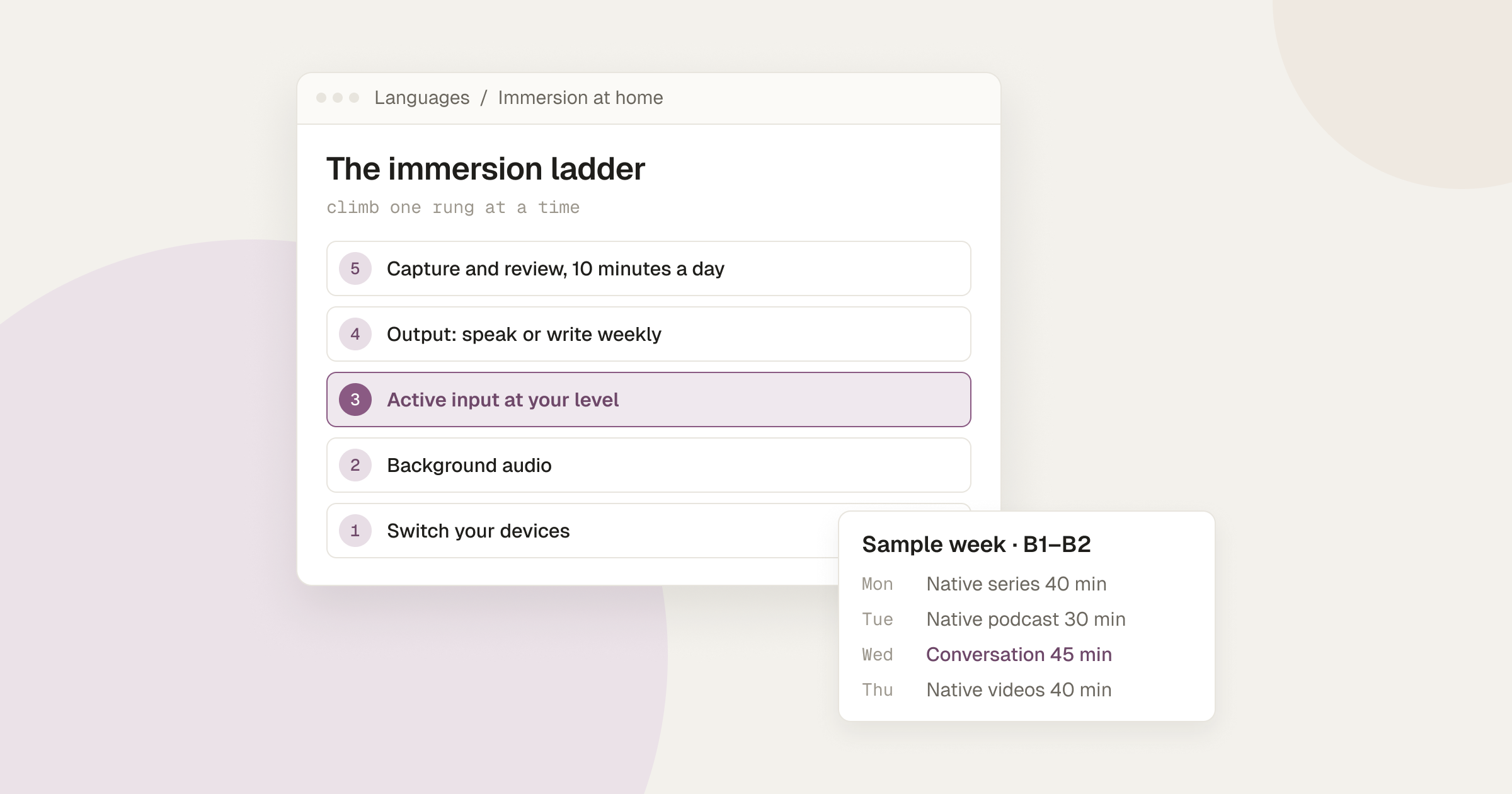
To keep the words you note, see spaced repetition for language learning or our Notion grammar and spaced repetition setup. For more input across your day, see language immersion at home.
A place to file the grammar you notice in input, organized into seven sections from alphabet to punctuation, and it works on the Notion free plan.

How do you use comprehensible input for Spanish and French?
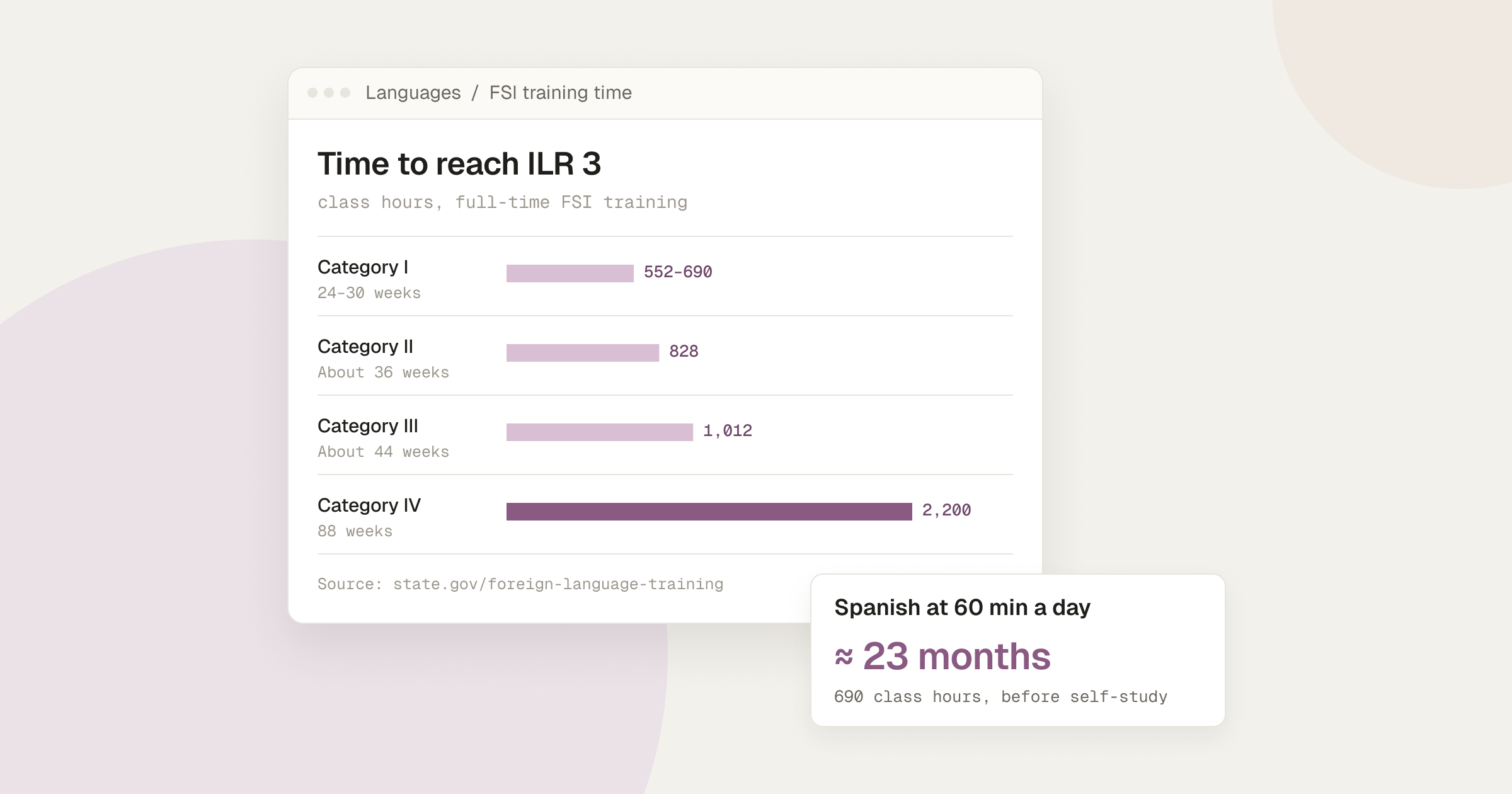
Spanish and French both have a large supply of learner content: graded readers, learner podcasts and channels that teach through stories and pictures. The U.S. Foreign Service Institute puts both in Category I and lists 30 weeks of training for each. Start with learner material, then move to native content on topics you know.
The FSI timelines are for full-time students (it describes a typical week as 23 hours in class plus 17 hours of self-study) aiming at level 3 in speaking and listening on the ILR scale, so treat them as a comparison between languages, not a schedule for a self-learner. For more on what affects timing, see how long it takes to learn a language.
Spanish. At A1–A2, look for teachers who tell stories with drawings, and slow learner podcasts. At B1, try learner podcasts at natural speed and easy native YouTube. At B2, watch series you've already seen dubbed, since knowing the plot frees attention for the language. Picking one main accent early helps. For a full plan, see the best way to learn Spanish.
French. Written and spoken French differ a lot: many endings are silent, and casual speech drops sounds textbooks keep. Pair reading and listening to the same text early on, with graded readers that have audio or podcasts with transcripts. From B1, native podcasts with transcripts and films with French subtitles do the same job.
I learned English and French as an adult, so this guide is written for self-learners rather than classrooms. Whichever language you pick, the rule is the same: start where you can retell, then nudge the difficulty up.
FAQ
What is a comprehensible input example?
A beginner watching a learner video where a speaker describes pictures: the images carry the meaning the words don't yet. Krashen wrote that we understand language beyond our level by using "context, our knowledge of the world, our extra-linguistic information" (1982, p. 21).
Who came up with comprehensible input?
Linguist Stephen Krashen, as part of his input hypothesis. It was first published in 1977 and developed in his books Principles and Practice in Second Language Acquisition (1982) and The Input Hypothesis (1985).
What does i + 1 mean in Krashen's theory?
i is your current level and i + 1 the next stage. Krashen argued that with enough understood input, i + 1 is "provided automatically," so you don't need to target it.
Is comprehensible input enough to become fluent?
Krashen himself called it "a necessary (but not sufficient) condition" (1982, p. 21). Merrill Swain (1985) argued that producing language also matters, so many learners combine plenty of input with speaking and feedback.
How much of the input should I understand?
There is no single official percentage, and Krashen did not give one. Aim to follow the main message: if you can retell what happened in two minutes, the material is at a workable level.
What is the affective filter?
Krashen's term for anxiety, low motivation or low self-confidence blocking understood input from being acquired (1982, p. 30–31; the concept is from Dulay and Burt, 1977).
Does Krashen say speaking can't be taught?
He wrote that "speaking fluency cannot be taught directly" and that it "emerges" over time (1982, p. 22). That is his claim; output researchers such as Swain argue speaking practice also helps.
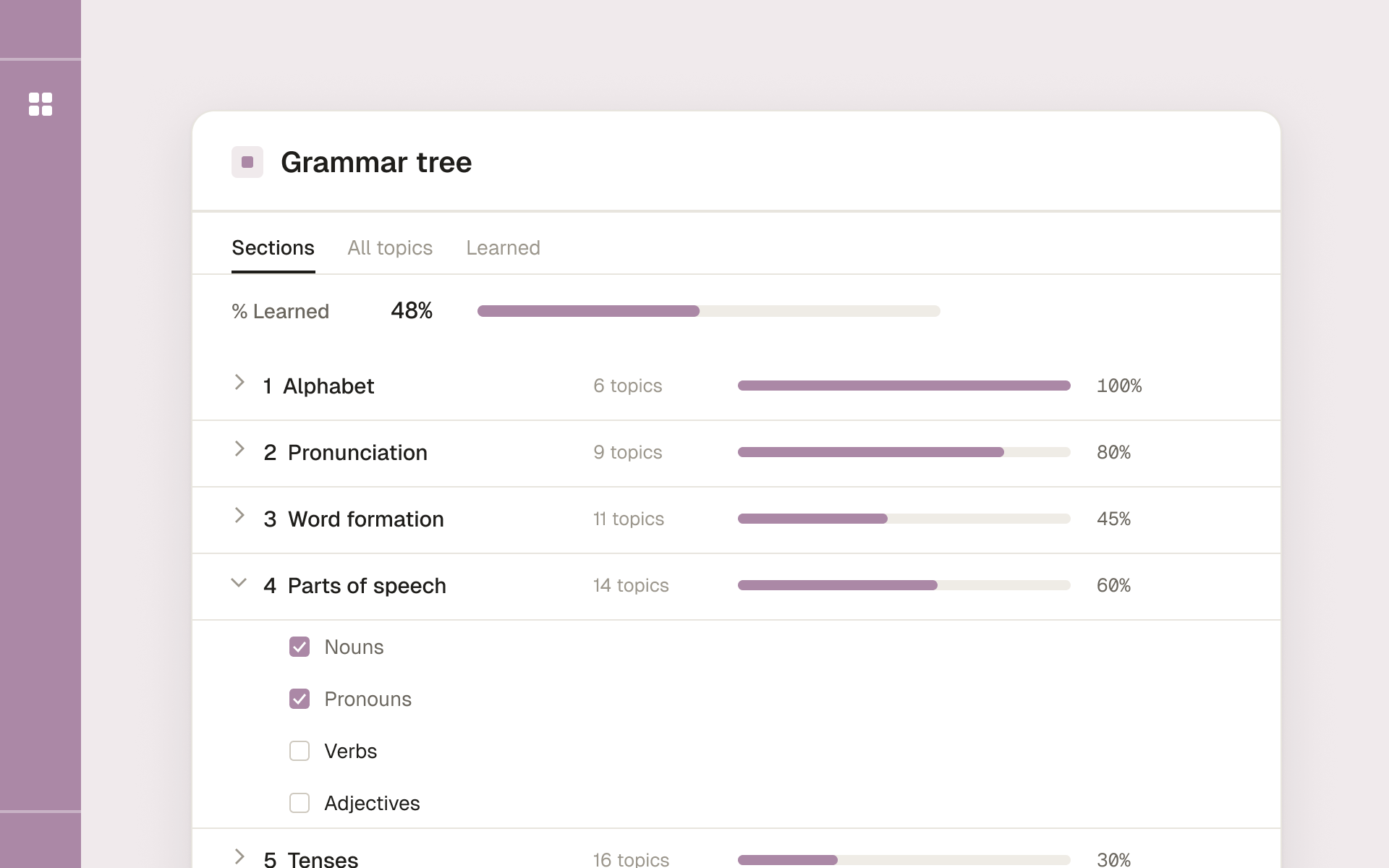
One grammar framework for any language, organized into seven sections from alphabet to punctuation.