Last updated: 11 October 2026 · By Zoya K · FSI data checked on 11 October 2026
The honest answer depends on three things: which language, what you mean by "learned," and how many minutes a day you can give it. This guide uses the current official figures from the U.S. Foreign Service Institute and turns them into months at 30, 60 or 120 minutes a day, with the arithmetic shown.
How long does it take to learn a language? The short answer
For English speakers, the U.S. Foreign Service Institute (FSI) expects 24 to 30 weeks of full-time training, or 552 to 690 class hours, for languages like Spanish and French. Arabic, Chinese, Japanese and Korean take 88 weeks. That is the time to reach professional-level speaking and listening (ILR 3), with self-study on top of class every week.
Here are the four FSI categories at a glance, quoted from the current FSI page on state.gov:
| FSI category | Training time | Class hours | Examples |
|---|---|---|---|
| Category I | 24–30 weeks | 552–690 | Spanish, French, Italian, Portuguese, Dutch |
| Category II | About 36 weeks | 828 | German, Indonesian, Swahili |
| Category III | About 44 weeks | 1,012 | Russian, Polish, Turkish, Hindi, Greek |
| Category IV | 88 weeks | 2,200 | Arabic, Mandarin, Cantonese, Japanese, Korean |
Many popular answers, including some AI summaries, still quote older figures such as "600–750 hours" for Category I. Those numbers are not on the current official page. If you see them, check the date of the source.
What are the FSI language difficulty categories?
FSI groups languages into four categories by how long its students usually take to reach ILR 3 in speaking and listening. The times assume a typical week of 23 hours in class plus 17 hours of self-study. FSI also says the real time varies with each learner's natural ability, prior language-learning experience and classroom time.
In FSI's own words, the timelines "indicate the time usually expected for a student to reach an integrated score of 3 (Speaking + Listening) on the Interagency Language Roundtable (ILR) scale, though the actual time can vary based on several factors, including the language learner's natural ability, prior language-learning experience, and time spent in the classroom" (state.gov).
The full language lists, with FSI's labels:
| Category | FSI label | Languages |
|---|---|---|
| I | "Languages close to English" | Danish, Dutch, Italian, Norwegian, Portuguese, Romanian, Swedish (24 weeks each); French, Spanish (30 weeks each) |
| II | No label | German, Haitian Creole, Indonesian, Malay, Swahili |
| III | "Hard languages," with "significant linguistic and/or cultural differences from English" | Albanian, Amharic, Armenian, Azerbaijani, Bengali, Bulgarian, Burmese, Czech, Dari, Estonian, Farsi, Finnish, Georgian, Greek, Hebrew, Hindi, Hungarian, Kazakh, Khmer, Kurdish, Kyrgyz, Lao, Latvian, Lithuanian, Macedonian, Mongolian, Nepali, Polish, Russian, Serbo-Croatian, Slovak, Slovenian, Tajiki, Thai, Turkish, Turkmen, Ukrainian, Urdu, Uzbek, Vietnamese. FSI adds: "This list is not exhaustive." |
| IV | "Super-hard languages," "exceptionally difficult for native English speakers" | Arabic, Chinese (Cantonese), Chinese (Mandarin), Japanese, Korean |
A footnote on the numbers. The class hours for Categories I to III equal the weeks multiplied by 23 class hours (for example, 36 × 23 = 828). Category IV breaks that pattern: 88 weeks × 23 hours is 2,024, while the page says "2200 class hours." FSI doesn't explain the gap, so this guide quotes 2,200 as published and uses it in the calculator below.
What level do those hours get you to?
ILR 3, called "General Professional Proficiency," means you can speak accurately enough to take part effectively in most formal and informal conversations on practical, social and professional topics. That is far beyond getting by on holiday. If your goal is ordering food or small talk, you need much less time than the FSI figures.
The ILR scale defines Speaking 3 as being "able to speak the language with sufficient structural accuracy and vocabulary to participate effectively in most formal and informal conversations in practical, social and professional topics."
The ILR speaking levels, by their official titles:
- 0: No Proficiency
- 0+: Memorized Proficiency
- 1: Elementary Proficiency
- 2: Limited Working Proficiency
- 3: General Professional Proficiency
- 4: Advanced Professional Proficiency
- 5: Functionally Native Proficiency
(The scale also has plus levels at 1+, 2+, 3+ and 4+.)

People often ask how ILR levels line up with CEFR levels like B2 or C1. There is no official conversion that this guide could verify, so it doesn't offer one. Treat ILR 3 as "can work in the language," and judge your own goal against that.
How many hours a day, and how many months, will it take you?
Divide the hours by your daily study time. FSI's class hours are only part of the effort, because its students also self-study 17 hours a week. The table below converts both the class hours and the full weekly load into months at 30, 60 and 120 minutes a day, every day.
"Class hours" are the hours FSI publishes. "Full load" is this guide's own calculation from FSI's figures: weeks × 40 hours (23 in class + 17 self-study). For Category I that is 24–30 weeks × 40 = 960–1,200 hours.
The formula:
months = total hours ÷ (minutes per day ÷ 60) ÷ 30.4| Category | Hours | 30 min/day | 60 min/day | 120 min/day |
|---|---|---|---|---|
| I, class hours | 552–690 | 36–45 months | 18–23 months | 9–11 months |
| I, full load | 960–1,200 | 63–79 months | 32–39 months | 16–20 months |
| II, class hours | 828 | 54 months | 27 months | 14 months |
| II, full load | 1,440 | 95 months | 47 months | 24 months |
| III, class hours | 1,012 | 66 months | 33 months | 17 months |
| III, full load | 1,760 | 116 months | 58 months | 29 months |
| IV, class hours | 2,200 | 145 months | 72 months | 36 months |
| IV, full load | 3,520 | 231 months | 116 months | 58 months |
Read the table as an upper reference, not a sentence. FSI students learn full time with trained teachers and small classes, which you probably don't have. On the other hand, you may not need ILR 3. A learner aiming at comfortable travel conversation can stop much earlier on the same path.

A quick way to use it: pick your category, pick the column closest to your real daily time (not your ideal one), and look at both rows. The truth for most self-taught adults sits somewhere between them.
How long does it take to learn Spanish?
Spanish is FSI Category I, listed at 30 weeks of training, which works out to 690 class hours. At one focused hour a day, the class hours alone take about 23 months, close to two years. Count FSI's self-study time as well and the full load is 1,200 hours, or roughly three years at that pace.
At two hours a day, the class-hour figure shrinks to about 11 months. That is the most realistic "fast" scenario for someone with a job, and it still assumes daily study with very few missed days.
Spanish is not quicker than the other Category I languages in FSI's list. Italian, Portuguese and Dutch are listed at 24 weeks, while Spanish and French sit at 30. For a practical route through the language, see the best way to learn Spanish.
How long does it take to learn French?
French is also Category I at 30 weeks, so the numbers match Spanish: 690 class hours, or about 23 months at an hour a day before self-study. I learned English and French as an adult, and the FSI timeline is a fair reminder that both are long projects, not a summer course.
Is German harder than Spanish?
By FSI's measure, yes, a little. German is in Category II at about 36 weeks (828 class hours), compared with 30 weeks for Spanish. At an hour a day that is roughly 27 months of class hours for German versus 23 for Spanish.
What is the hardest language to learn for English speakers?
In FSI's data, the slowest languages for English speakers are Category IV, which FSI calls "Super-hard languages": Arabic, Cantonese, Mandarin, Japanese and Korean. Each takes 88 weeks of full-time training and 2,200 class hours, about three to four times longer than Spanish or French.
FSI describes this group as "exceptionally difficult for native English speakers." The usual reasons are new writing systems, sounds that English doesn't have, and grammar and vocabulary with little overlap with English. FSI itself doesn't list the reasons, so treat them as general context.
Category III is the large middle group: 40 named languages at about 44 weeks, including Russian, Greek, Hebrew, Hindi, Turkish and Vietnamese. Remember that FSI says this list "is not exhaustive," so a language missing from the page isn't necessarily easy.
What actually changes your timeline?
FSI names three factors that change the time: natural ability, prior language-learning experience, and time spent in class. For a self-taught adult, the factor you control most is consistent daily time. The FSI hours only add up if the hours really happen, week after week, without long gaps.
1. Daily time, protected. The calculator shows how much the minutes matter: moving from 30 to 60 minutes a day halves the calendar time. Take a learner with 20 minutes at lunch and a 30-minute commute. Using both every weekday already puts them near the 60-minute column.
2. Prior experience. FSI lists it as a factor. A second Romance language after Spanish usually feels faster than the first, because study habits and many grammar ideas carry over.
3. Lots of understandable input. Listening and reading material you mostly understand fills the "self-study" part of FSI's week. See comprehensible input for what that looks like and language immersion at home for ways to build it into a normal day.
4. A grammar map. Knowing which parts of the grammar you've covered (sounds, word formation, tenses, sentence order) stops you from studying the same easy topics on repeat. A notebook, spreadsheet or Notion page works.
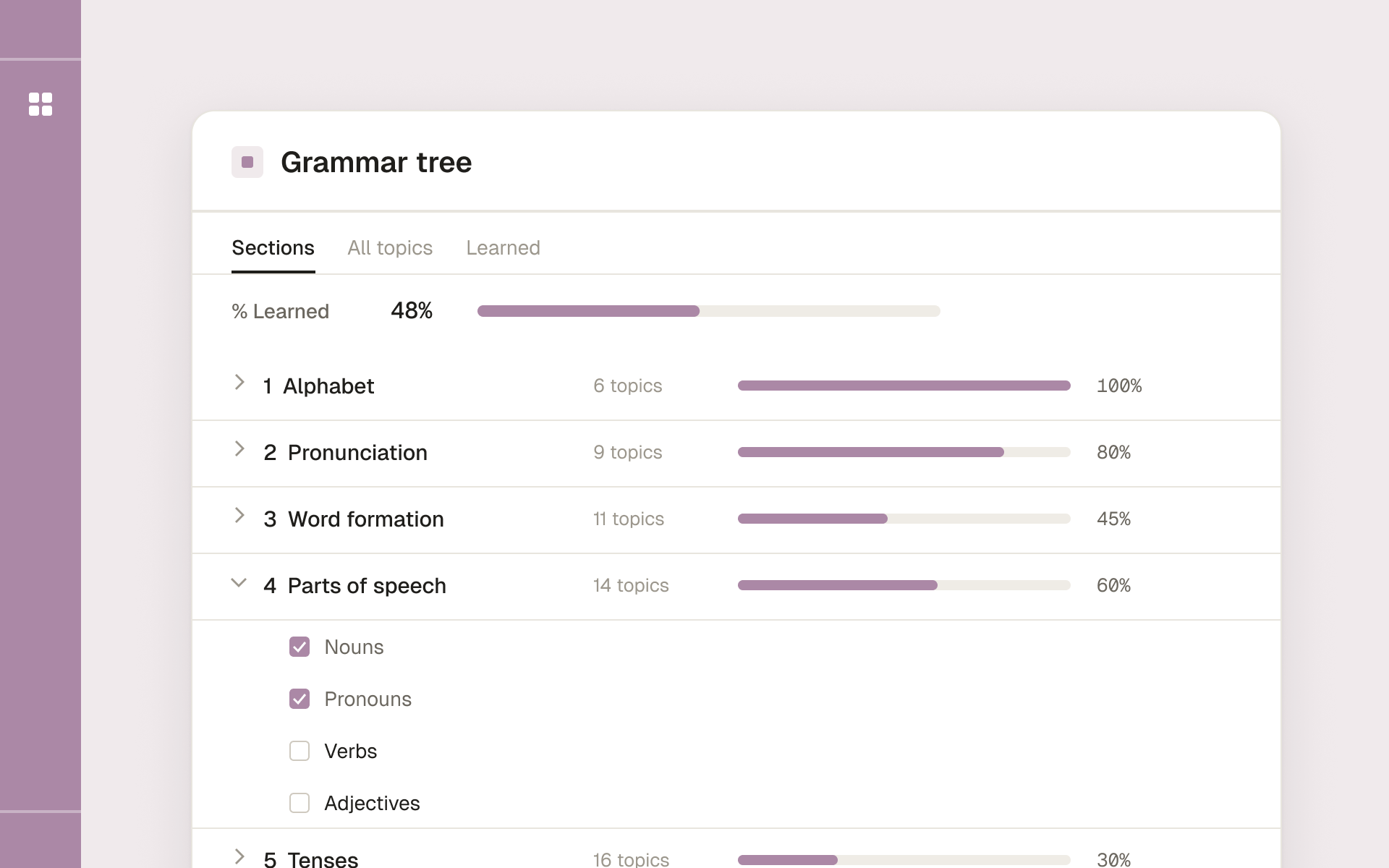
One grammar framework for any language, seven sections from alphabet to punctuation, useful for tracking which parts of a new language you have covered.
5. Review on a schedule. Vocabulary fades unless you revisit it. Spaced repetition tools time those reviews for you; compare the options in Anki vs Notion for spaced repetition, or see the Notion grammar and spaced repetition setup for a step-by-step build.
6. A clear goal. "Fluent" is vague. Decide whether you want ILR 3-style work proficiency or comfortable conversation, then pick the matching row in the table.

FAQ
How many hours does it take to learn a language?
According to FSI, English speakers need 552–690 class hours for Category I languages like Spanish, up to 2,200 class hours for Category IV languages like Japanese. That is to reach ILR 3, and FSI students also self-study 17 hours a week on top of class.
How long does it take to learn Spanish?
FSI lists Spanish at 30 weeks of full-time training (Category I), which equals 690 class hours. At one hour a day that is about 23 months of class hours alone.
How long does it take to learn a new language at one hour a day?
Using FSI class hours, about 18–23 months for Category I, 27 months for German and other Category II languages, 33 months for Category III and about 72 months for Category IV. Including FSI's self-study time makes each figure longer.
What is the hardest language to learn for English speakers?
FSI's Category IV "Super-hard languages": Arabic, Chinese (Cantonese and Mandarin), Japanese and Korean, each at 88 weeks of training.
Is German harder than Spanish?
In FSI's data, yes. German is Category II at about 36 weeks (828 class hours), while Spanish is Category I at 30 weeks.
How long does it take to learn French?
French is FSI Category I at 30 weeks, the same as Spanish, so about 690 class hours to reach ILR 3.
What does "fluent" mean in FSI terms?
FSI's timelines target ILR 3 in speaking and listening. The ILR scale calls Speaking 3 "General Professional Proficiency": taking part effectively in most formal and informal conversations on practical, social and professional topics.
Can I learn a language in 3 months?
Not to FSI's ILR 3 level at normal daily study: three months at two hours a day is about 180 hours, well below the 552-hour minimum. Smaller goals like basic travel phrases take less time, but there is no official hour figure for them.
Why do other sites say 600–750 hours?
Those are older figures. The current FSI page lists 552–690 class hours for Category I, 828 for Category II, 1,012 for Category III and 2,200 for Category IV.