Last updated: 11 October 2026 · By Zoya K
You don't need a plane ticket to live partly in another language. You need a few settings changed, a steady supply of input you can actually follow, and a weekly habit of speaking or writing. This guide gives you the order to do it in, a sample week for each level, and an honest note on what immersion alone won't fix.
What is language immersion?
Language immersion means using the target language as the medium for real activities, such as watching, reading, talking and getting things done, instead of only studying it as a school subject. In schools it means teaching subjects like math or science in a second language. At home it means moving parts of your daily routine into that language.
Wikipedia's entry on language immersion defines it as "a technique used in bilingual language education in which two languages are used for instruction in a variety of topics, including maths, science, or social studies."
Full (total) immersion is the strongest version: in school programs, students spend 100% of the school day in their second language. At home it usually means an evening or weekend block in nothing but the target language.
At-home immersion is the version this guide covers: you keep your life where it is and change the language of selected parts of it, like your phone, your evening series or your commute podcast.
Can you learn a language just by immersion?
Immersion builds comprehension well, but on its own it often leaves gaps in speaking and accuracy. Research on Canadian French immersion programs found that students understood French very well yet did not fully reach native-like speaking and writing. The practical answer is to pair immersion with some grammar study and regular output.
The Canadian programs are the best-known case. According to the Wikipedia summary of the research, immersion students "did not quite reach native-like proficiency in spoken and written French," even after years of school taught largely in French. Their English did not suffer: "by Grade 5, there was no difference between their scores and the scores of students who were instructed only in English."
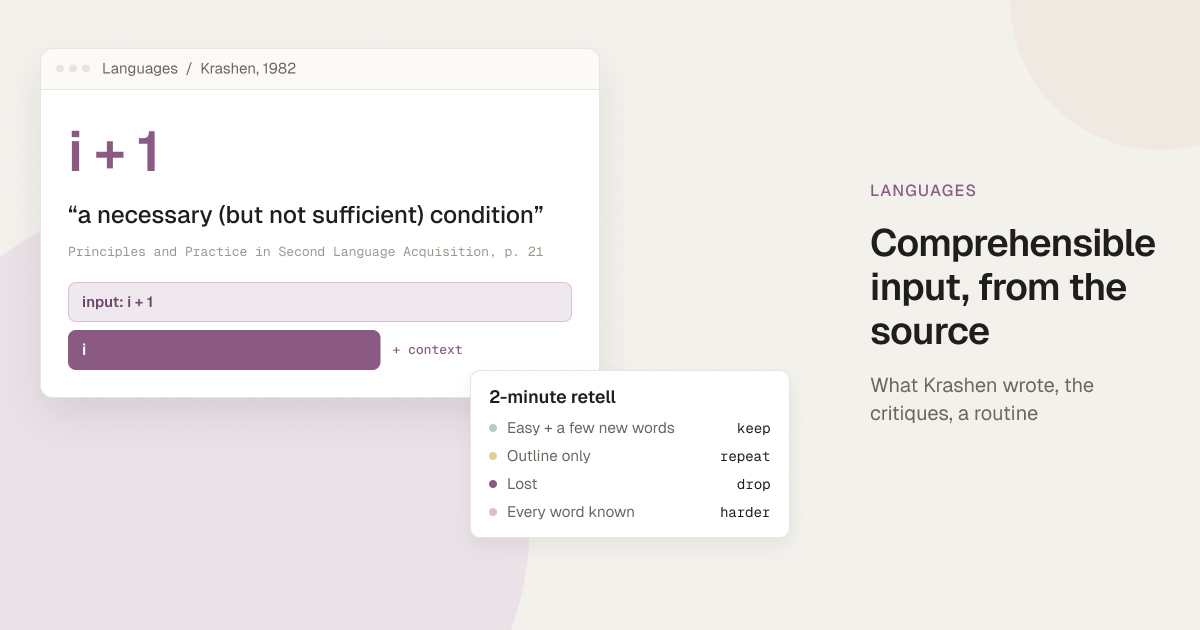
Two cautions: this is school research on children, not adults at home, and the debate about how much grammar teaching helps is not settled. Stephen Krashen's input hypothesis, laid out in Principles and Practice in Second Language Acquisition (1982), argues that acquisition happens when the learner understands input, where "'understand' means that the acquirer is focussed on the meaning and not the form of the message." Other researchers give more weight to output and correction. For planning a week, you don't need to pick a side: get lots of understandable input and add speaking or writing. More on the input side in our guide to comprehensible input.
The at-home immersion ladder (5 steps)
Start with changes that cost no willpower, like switching your device language. Then add listening you can follow, then reading and viewing at your level. After that come weekly speaking or writing, and a short daily review of what you caught. Each rung builds on the one below it, so climb in order rather than all at once.

Step 1: Switch your devices
Changing the interface language is a one-time effort that gives you small daily reading: menus, notifications, buttons. You already know where everything is, so context does the translating.
- iPhone. Per Apple's support guide: open Settings, tap General, tap Language & Region, then tap Add Language and select the language. Note the path first so you can switch back.
- Netflix. Per the Netflix Help Center: start playing a show, tap or click the screen (or press the arrow keys on a TV remote), and select "Audio & Subtitles." "You can choose from the languages shown or select Other to see all language options." One catch for offline viewing: "For downloads, Netflix shows the 2 most relevant languages."

Step 2: Add background audio
Podcasts, radio and music get your ear used to the rhythm of the language. Keep expectations modest: if you can't follow what's said, by Krashen's definition above that isn't the input that drives acquisition. Treat it as a supplement for chores and commutes.
Step 3: Active input at your level
This is the main engine. Active input means you're paying attention and following the meaning: a learner podcast, a graded reader, a YouTube channel made for learners, then native content on topics you already know well. A rough test: if you can follow the gist without pausing every few seconds, the level is right.
Move up in this order: learner content, then native content on familiar topics (a cooking show, a sport you follow, a series you've already seen in your own language), then native content on anything. Rewatching is fine; you'll catch words you missed the first time.
Step 4: Speak or write every week
Input fills the tank; output shows you where the leaks are. Pick at least one regular slot:
- a language exchange partner (you trade half the time in each language);
- a paid tutor for a weekly conversation;
- a short journal entry, three to five sentences about your day;
- narrating what you're doing aloud while cooking or cleaning.
Narrating chores shows you fast which everyday words you're missing. Write those down for the next step.
Step 5: Capture and review
Most of what immersion throws at you slips away unless you catch it. Keep one place to drop new words and phrases with the sentence you found them in, then review them with spaced repetition. Our comparison of spaced repetition tools covers Anki vs Notion, and the vocabulary notebook guide shows what to put on each entry. If you want to run reviews inside Notion, here is the Notion grammar and spaced repetition setup.
Grammar you meet in the wild needs a home too: when you notice a new tense in a show, file it under the right topic so it connects to what you already know.
Gives the grammar you notice during immersion a fixed place in seven sections, from alphabet to punctuation, and works on the Notion free plan.
A weekly immersion plan by level
Beginners need mostly learner-made input and short sessions. Intermediates can shift to native media on familiar topics and add a weekly conversation. Advanced learners can run most of their media diet in the language. The table shows a sample week built on about 60 minutes a day; scale the minutes to your real schedule.
| Day | A1–A2 (beginner) | B1–B2 (intermediate) | C1+ (advanced) |
|---|---|---|---|
| Mon | Learner podcast 20 min · course or grammar 25 min · review 15 min | Native series, familiar genre 40 min · review 20 min | Native series or film 45 min · review 15 min |
| Tue | Graded reader 20 min · grammar 25 min · review 15 min | Native podcast 30 min · grammar from what you heard 15 min · review 15 min | News article or book chapter 40 min · write a summary 20 min |
| Wed | Learner videos 30 min · narrate a chore aloud 10 min · review 20 min | Conversation (exchange or tutor) 45 min · review 15 min | Conversation 45 min · review 15 min |
| Thu | Learner podcast 20 min · grammar 25 min · review 15 min | Native videos on a hobby 40 min · review 20 min | Podcast on an unfamiliar topic 45 min · review 15 min |
| Fri | Rewatch a learner video 25 min · journal 3 sentences 15 min · review 20 min | Graded or simple native book 30 min · journal 15 min · review 15 min | Native book 40 min · journal 20 min |
| Sat | Kids' show or easy series with target-language subtitles 45 min · review 15 min | Film with target-language subtitles 60 min | "Language-only" block: 2 hours of everything in the language |
| Sun | Rest, or 15 min review only | Weekly check: what was too hard, what was too easy 15 min | Weekly check and plan 15 min |
Device language stays on all week, and background audio comes on top of these minutes. If you only have 20 minutes, keep the proportions: most of the time on input you understand, a few minutes on review, and one output slot a week.
Picture a learner at A2 with a 25-minute commute and 30 free minutes in the evening. The commute becomes the learner podcast, the evening alternates grammar and review, and Saturday morning is the easy-series session. No new free time needed.
Track it in a Notion page, a spreadsheet or on paper. What matters is seeing by Sunday which days actually happened.
Immersion at home vs. immersion abroad
Living abroad forces you to use the language for daily needs, from groceries to paperwork. At home you have to create that pressure yourself. In return, at home you control the difficulty and keep a steady routine, and you avoid a common trap abroad: falling back on English with other foreigners and friendly locals.
| Factor | At home | Abroad |
|---|---|---|
| Pressure to use the language | You create it with schedules and commitments | Built in for shopping, transport, paperwork |
| Difficulty of input | You choose content at your level | Real-world speed from day one |
| Speaking practice | Has to be booked: exchange partner, tutor | Happens in daily errands |
| Routine | Easy to keep a fixed daily plan | Often disrupted by travel and logistics |
| Fallback to English | Always available, needs discipline | Still common in expat circles and tourist areas |
| Cost | Mostly subscriptions and tutor time you choose | Travel, housing, possibly a program fee |
Common immersion mistakes
The usual mistakes are content that is far too hard, background noise mistaken for study, no speaking at all, and nothing captured for review. Each looks like progress, because you're spending hours with the language, while the parts that move you forward get skipped.
- Starting with native content you can't follow. If you understand almost nothing, drop back to learner material.
- Counting background audio as study time. It's useful, but it belongs on top of your active minutes.
- Never speaking or writing. The Canadian immersion results are the warning here: strong comprehension doesn't automatically turn into accurate speech. Book the weekly conversation even if it feels early.
- Not capturing anything. Without a notebook and a review habit, the same words surprise you every week.
- Changing everything on day one. Climb the ladder one rung at a time.
- Ignoring grammar completely. A short, regular look at how the language works makes input easier to understand.
How long until immersion pays off?
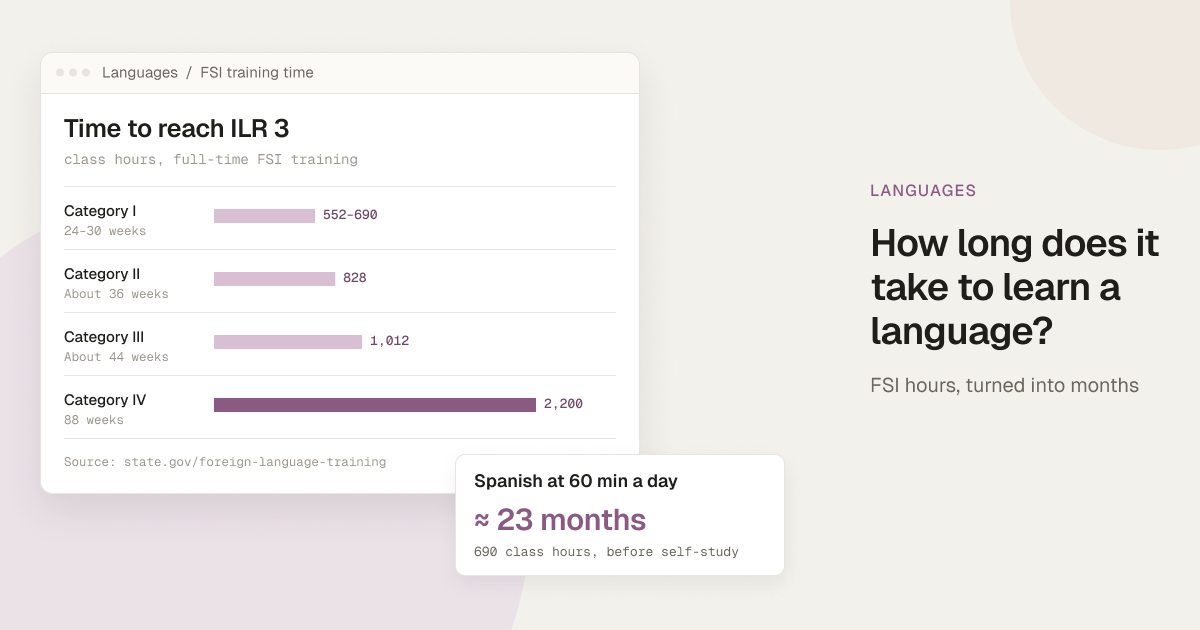
There is no official figure for immersion alone. For reference, the US Foreign Service Institute expects its full-time students to reach professional working level in Spanish or French in about 30 weeks, with roughly 23 class hours plus 17 hours of self-study per week. Home immersion at an hour a day covers a small fraction of that.
The State Department's Foreign Service Institute lists French and Spanish at 30 weeks in its easiest category for English speakers, and describes "a typical week" as "23 hours per week in class and 17 hours of self-study." The target is a score of 3 on the Interagency Language Roundtable scale for speaking and listening, and the page itself notes the actual time can vary with ability, prior experience and time spent in class.

Read those numbers as scale, not a forecast: 30 weeks at 40 hours is about 1,200 hours of focused work. At home, measure smaller wins instead, like the first episode you follow without subtitles in your own language or the first 20-minute conversation. For a fuller look at timelines, see how long it takes to learn a language.
I learned English and French as an adult, and the plan above is built for that reality: a steady hour most days is easier to keep up than a heroic weekend followed by two silent weeks.
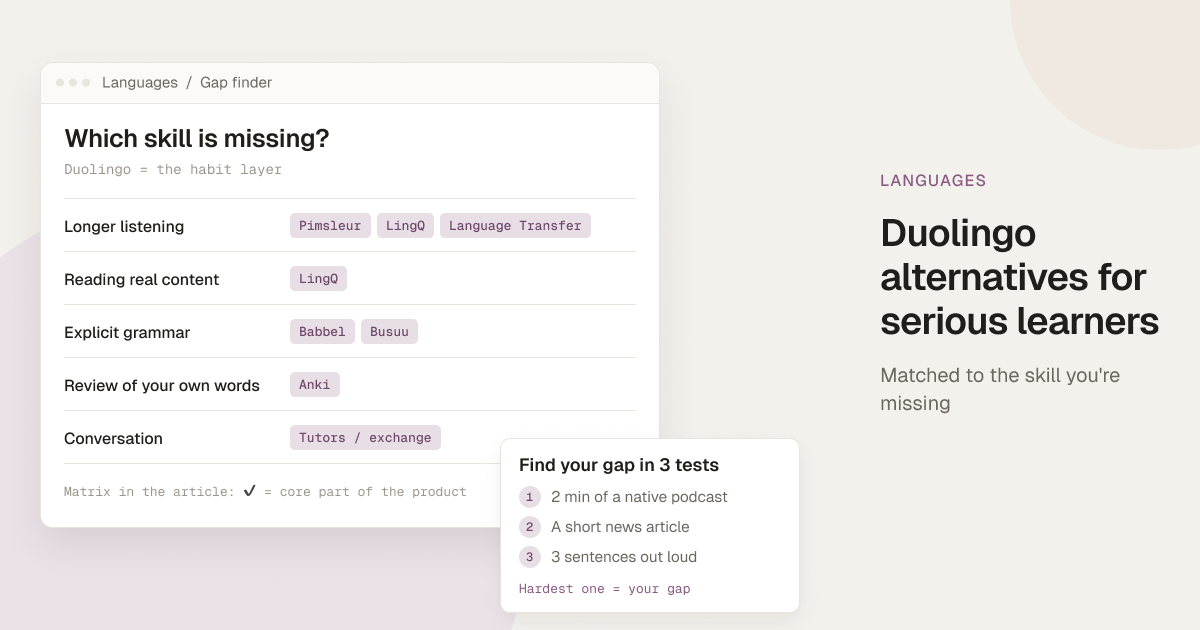
If you're choosing tools for the input and practice parts, our guides to the best way to learn Spanish and Duolingo alternatives go deeper.
FAQ
Is it possible to learn a language just by immersion?
Comprehension, largely yes, if the input is at your level and you get enough of it. Speaking and writing accuracy often lag without output and feedback, which is what research on Canadian French immersion students showed. Add weekly speaking or writing and some grammar study.
How do I immerse myself in a language at home?
Switch your devices to the language, consume input you can follow every day, speak or write at least once a week, and review the words and grammar you capture.
What is full immersion?
Full immersion means using only the target language for a period or setting. In school programs, total immersion means students spend 100% of the school day in their second language; at home it usually means a block of time with no English at all.
How do I learn a language with immersion if I'm a beginner?
Start with learner-made podcasts, videos and graded readers, keep sessions short, and pair them with a beginner course. Move to native content once you can follow learner material without constant pausing.
How do I change Netflix audio and subtitles?
Start playing a title, tap or click the screen (or use the arrow keys on a TV), and select "Audio & Subtitles." Choose from the languages shown or select "Other" to see all options. Downloads only show the two most relevant languages.
How do I change my iPhone language?
Open Settings, tap General, tap Language & Region, then tap Add Language and select the language you're learning.
Does background listening count as immersion?
It helps you get used to the sound of the language, but understanding is what drives acquisition in Krashen's input hypothesis. Count it as a bonus on top of active listening and reading, not as your main practice.
What is the 80/20 or 15-30-15 rule in language learning?
These are popular rules of thumb shared online, without an official or research source behind them. A simpler guide: spend most of your time on input you understand, a little on review, and some every week on speaking or writing.
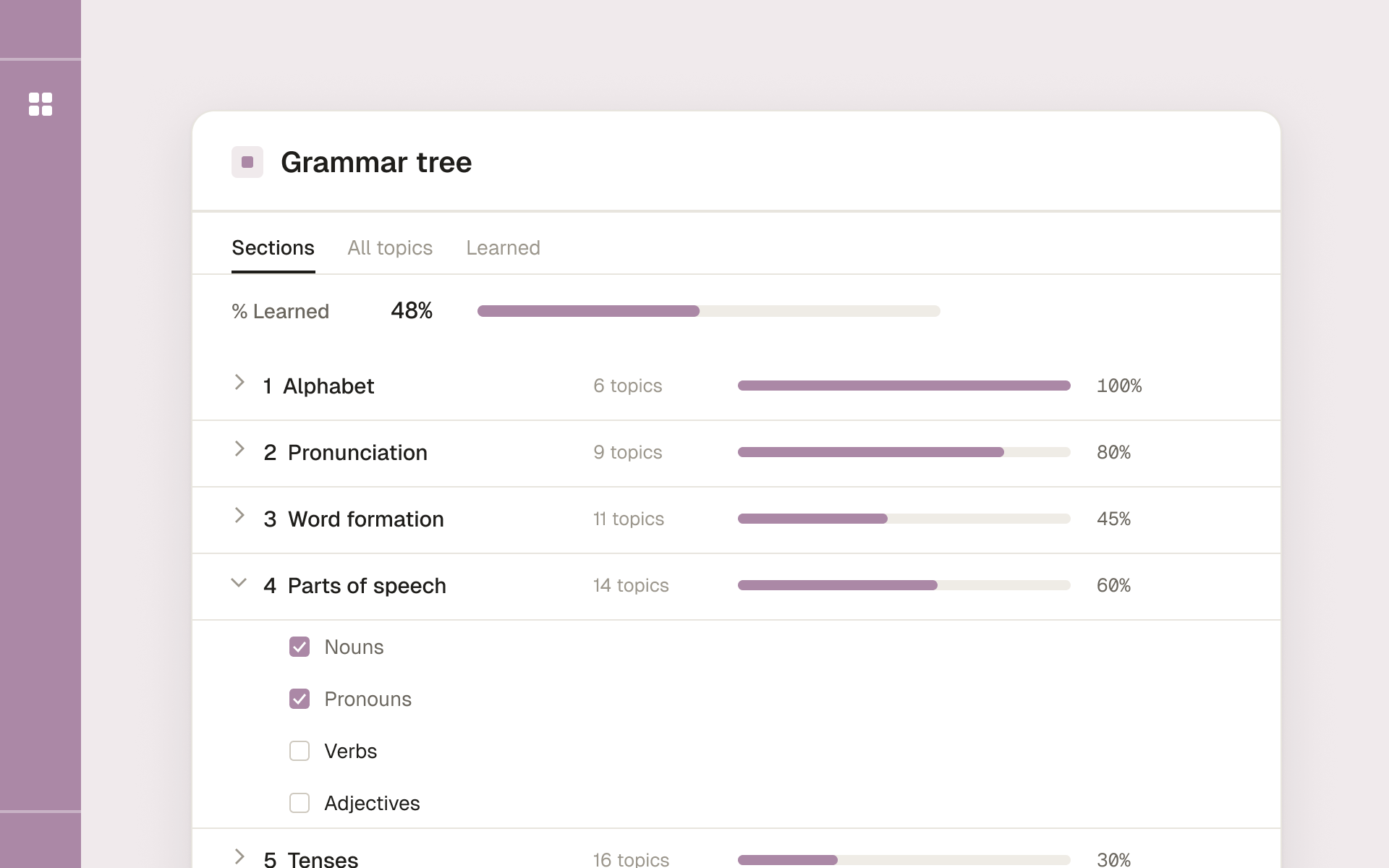
One grammar framework for any language, organized into seven sections from alphabet to punctuation.