Last updated: 11 October 2026 · By Zoya K · Prices checked on 11 October 2026
Duolingo is good at one thing most apps fail at: getting you to open it every day. If you've kept a long streak and still can't follow a podcast or hold a short conversation, the fix is usually not a different game-like app but a tool aimed at the specific skill Duolingo leaves thin. This guide sorts the alternatives by that missing skill, with prices taken from each vendor's own page.
Is there a better option than Duolingo?
It depends on what's missing for you. Duolingo is free and good at building a daily habit and basic vocabulary. Learners who stall usually lack one of five things: longer listening, reading real content, explicit grammar, review of their own words, or conversation with people. The better option is the tool that fills your particular gap.
A quick way to find your gap is to test yourself on something outside the app. Play a two-minute native podcast clip. Read a short news article. Try to say three sentences about your weekend out loud. Whichever of those feels hardest points to the category below you need first.
The matrix shows which tool covers which gap. A ✔ means the gap is a core part of the product, not a side feature.
| Gap | Pimsleur | Babbel | Busuu | LingQ | Anki | Language Transfer | Tutors / exchange |
|---|---|---|---|---|---|---|---|
| Speaking out loud | ✔ | partial | partial | — | — | ✔ | ✔ |
| Longer listening | ✔ | partial | partial | ✔ | — | ✔ | ✔ |
| Reading real content | — | — | — | ✔ | — | — | partial |
| Explicit grammar | — | ✔ | ✔ | — | — | ✔ | partial |
| Review of your own words | — | partial | partial | ✔ | ✔ | — | — |
| Conversation with people | — | — | partial | — | — | — | ✔ |

Duolingo alternatives at a glance (prices checked)
The table compares the main options by what they're best for, whether there's a free option, and the starting price shown on each vendor's own US page on 11 October 2026. Prices change with promotions and country, so treat them as a snapshot. Where no US-dollar price was visible, we link the page instead.
| Tool | Best for | Free option | Paid price (source, checked 11 Oct 2026) |
|---|---|---|---|
| Duolingo | Daily habit, basic vocabulary | Yes, the full course | Super offers a 1-week free trial; price shown in the app (duolingo.com/super) |
| Pimsleur | Speaking and listening, audio-first | Trial only | Subscription; see pimsleur.com/pricing |
| Babbel | Structured lessons with grammar explained | No | $8.95/month on the 12-month plan ($107.40 billed yearly); Lifetime $299.99 one-time (my.babbel.com/en/prices) |
| Busuu | Structured lessons plus feedback from fluent speakers | Yes, Free plan | Premium and Premium Plus; see busuu.com/en/premium-plans |
| LingQ | Reading and listening to real content | Yes, capped at 20 saved words and 5 imports | Premium $14.99/month monthly, $10/month on 12 months, $8.99/month on 24 months (LingQ blog) |
| Anki | Reviewing your own vocabulary | Yes: desktop, Android and sync | AnkiMobile for iOS $24.99 one-time (App Store) |
| Language Transfer | Freeaudio courses that make you build sentences | Yes, all of it | Donations only (languagetransfer.org) |
| italki, Preply | Lessons with a human tutor | No | Tutors set their own rates, so there's no single price |
| Tandem, HelloTalk | Language exchange with native speakers | Yes | Freeto start; check the app for paid options |
If you want the cheapest serious setup, jump to the $0 stack further down. If you're willing to pay for one thing, pay for the gap you found above, not for a second habit app.
Best for speaking and listening: Pimsleur
Pimsleur is an audio-first course built around speaking: you listen to lessons and answer out loud, aiming for an accent close to a native speaker's. It suits people who learn by ear, commute a lot, or freeze when they have to speak. It's weak for reading and writing, and it covers fewer topics than a text app.
Pimsleur's own pitch is about time: "Give us 30 minutes a day," according to its pricing page. The point is producing sentences out loud, not just recognizing them, which is the reverse of tapping word tiles.
Who it's for: a learner with a 30-minute commute and an upcoming trip, who needs to order, ask directions and handle small talk.
Who it's not for: someone who wants to read novels or pass a written exam. You'll need another tool for reading and for grammar you can look up.
Price: Pimsleur sells subscriptions. The amount wasn't visible to us in US dollars on the pricing page today, so check it there before buying.
Best for structured lessons: Babbel and Busuu
Babbel and Busuu are the two apps most often compared with Duolingo. Both give you a fixed lesson path with grammar explained in plain language, which is what many Duolingo users say they miss. Babbel is paid-only. Busuu has a free plan, and its paid tiers add more practice and feedback tools.
Babbel
Babbel's lessons follow a set course path with grammar explained along the way, closer to a textbook than a game. On Babbel's prices page on 11 October 2026, the 12-month plan was $8.95 a month ($107.40 charged every 12 months) and Lifetime was $299.99 as a one-time payment. Babbel shows these against a "reference price," so the discount you see depends on the day.
Is Babbel better than Duolingo? It's different. Babbel is paid and more structured; Duolingo is free and more game-like. If grammar explanations are your gap, Babbel fills it. If you only need a nudge to practice daily, Duolingo already does that.
Busuu
Busuu's plans page lists three tiers: Free, Premium and Premium Plus. Features named on that page include grammar guides and topic explainers, vocabulary review timed to your progress, speaking practice in real-life scenarios, certificates when you pass a level, and the option to "get tips from fluent speakers" in the community. Which tier includes which feature is shown in the page's comparison grid, so check it there. Busuu offers 14 languages, fewer than Duolingo's 100+ courses.
Prices: Busuu's plan prices weren't displayed to us in US dollars today, so we've left them out.
Best for reading and real content: LingQ
LingQ is built around reading real texts with audio. You import an article, a transcript or an ebook, read it while listening, and save unknown words as "LingQs" for review. The free plan caps you at 20 saved LingQs and 5 imported lessons. Premium is $14.99 a month billed monthly, less on longer plans.
According to LingQ's free vs premium post (published 4 August 2026, re-checked 11 October 2026), Premium costs $10 a month on the 12-month plan and $8.99 a month on the 24-month plan. The same post describes a Premium Plus tier "currently starting around $22.50/month on the annual plan" with extra AI tools. LingQ calls its free plan closer to a demo, and with 20 saved words that's accurate.
LingQ fits learners who have finished the beginner stage and want to move to comprehensible input: lots of reading and listening you can mostly follow. Total beginners usually find it overwhelming, because nearly every word is new.
Best for reviewing your own vocabulary: Anki
Anki is a free, open-source flashcard app that uses spaced repetition. Spaced repetition means you review a card just before you're likely to forget it, so intervals grow as you remember. Anki is free on desktop and Android, with free sync. The iOS app, AnkiMobile, costs $24.99 once.
Anki's site describes it as "a community project" and notes that "AnkiDroid for Android is free and developed by contributors." The free AnkiWeb service syncs your cards between devices. The App Store listing shows AnkiMobile at $24.99 and says it uses "the same SM2 and FSRS scheduling algorithms" as the desktop version.
The difference from Duolingo: in Anki you review the words you met yourself, in your podcast, your book, your conversation. That makes it a strong partner for LingQ, a tutor or any reading habit. The cost is setup time; you make cards or download decks. For a side-by-side with a Notion-based review system, see spaced repetition: Anki vs Notion, and for a full Notion build, the older guide to setting up grammar with spaced repetition in Notion.
Best free audio course: Language Transfer
Language Transfer is a set of free audio courses built on what it calls "The Thinking Method": a teacher explains a pattern, then asks you to build a sentence out loud before hearing the answer. Its site says there are no price tags, no adverts, no sign-ups, and that it runs on donations. It's a strong first step for speaking.
The format is close to Pimsleur's in one way: you produce sentences instead of picking them from a list. The difference is that Language Transfer explains the logic of the language as it goes, so grammar arrives as a reason, not a rule to memorize. Courses are available on languagetransfer.org and in its app; check the site for which languages are covered.
Who it's for: beginners who want to speak early and like understanding why. It's less useful once you're past the basics, since there's no graded reading or long listening.
Best for real conversation: tutors and language exchange
Real conversation comes from people, not apps. Tutor marketplaces such as italki and Preply connect you with paid teachers who set their own rates. Language exchange apps such as Tandem and HelloTalk pair you with native speakers learning your language, so you trade time instead of money. Both fill the speaking gap apps leave.
Language exchange means two learners help each other: half the chat in one language, half in the other. It costs nothing, but it works best when both sides prepare a topic and correct each other gently.
A tutor is the faster route if you're shy or short on time, because the lesson is built around your mistakes. Prices vary by tutor, country and lesson length, so compare a few trial lessons rather than trusting a headline rate.
A practical setup for a learner with three evenings a week: one paid tutor session, one exchange chat, and one evening reviewing the words that came up in both.

The grammar layer every app is missing
Most apps teach grammar in fragments spread across lessons, so you meet the past tense in unit 12 and its exceptions in unit 30. Keeping your own map of the grammar you've met, organized by topic with your own examples, makes any app more useful and shows what you haven't covered yet.
The map can live in a notebook, a spreadsheet or Notion. What matters is the structure: one page per topic (tenses, word order, cases, articles), a one-line rule, two example sentences you collected yourself, and a status such as "met", "practiced", "can use". After a month, gaps are visible at a glance.
I learned English and French as an adult, and grammar is the part apps scatter the most. A map turns scattered lessons into one reference you own.

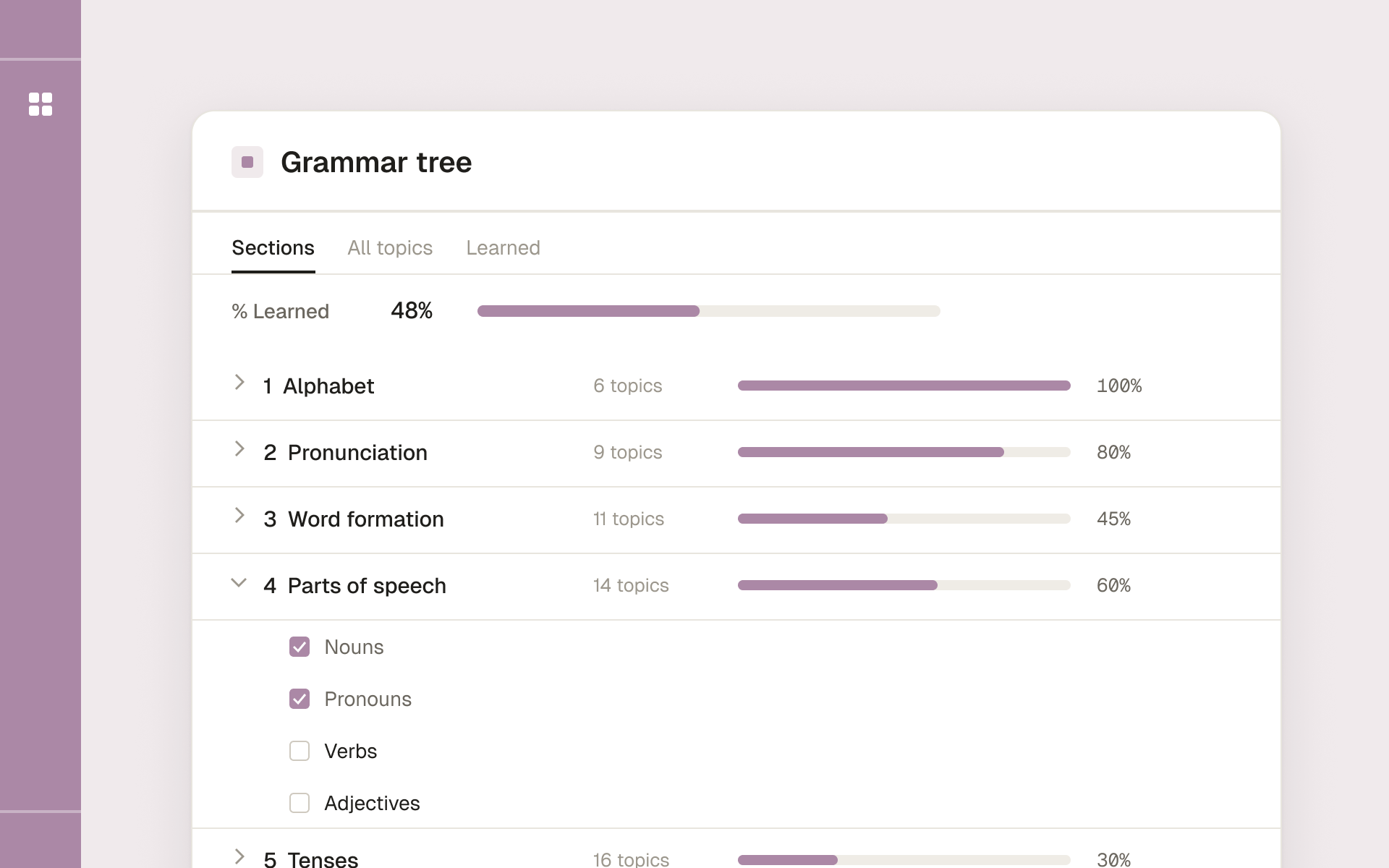
A ready grammar map for any language with seven sections from alphabet to punctuation, works on the Notion free plan, sits on top of whichever app you use.
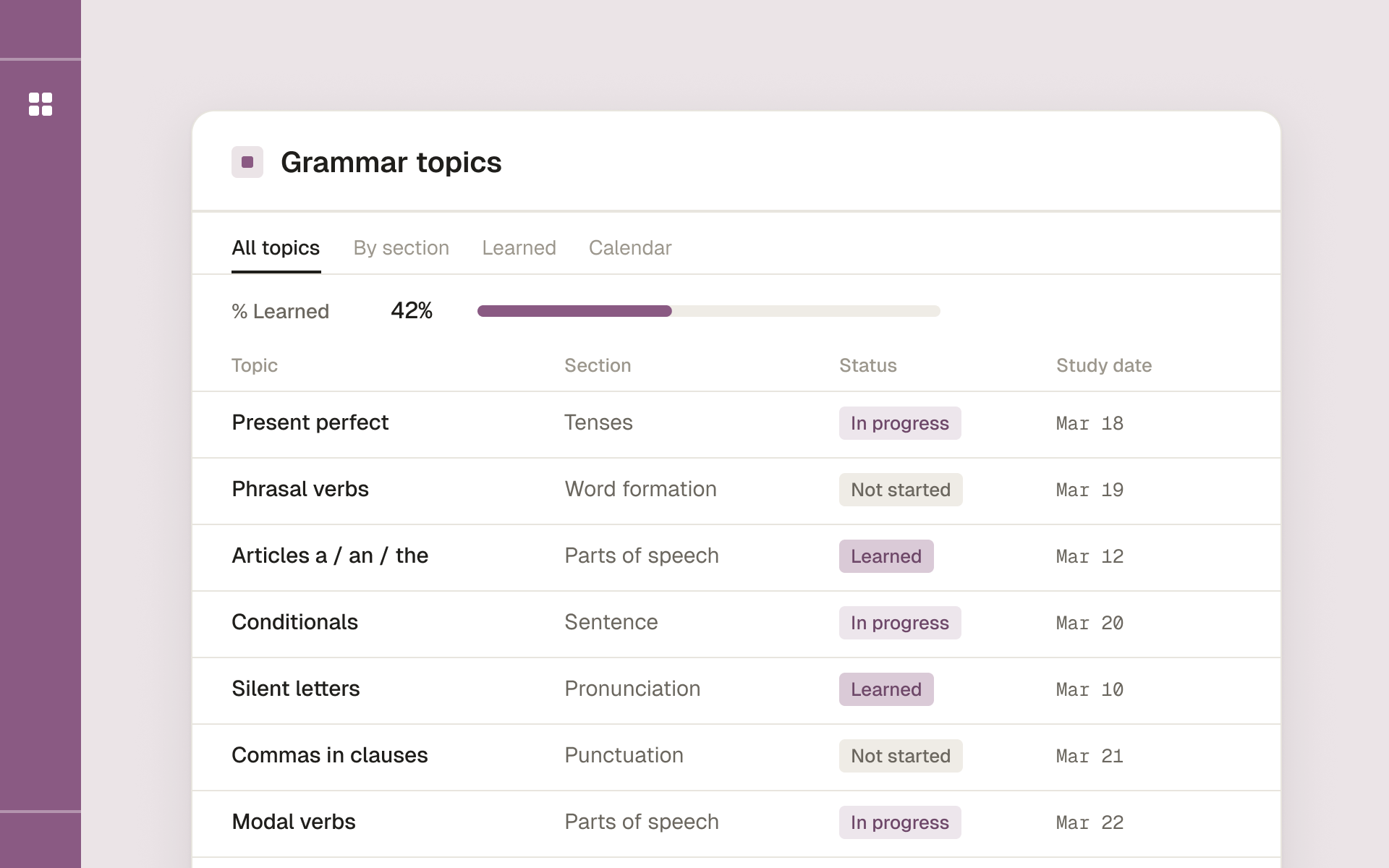
For English learners: grammar topic by topic with exercises and answer keys, study dates and % learned per section.
A $0 stack that replaces Duolingo Super
You can cover most gaps without paying anything. Keep Duolingo's free course for the daily habit, add Anki on desktop or Android for reviewing your own words, Language Transfer for speaking-focused audio, and podcasts or library audiobooks for longer listening. A free language exchange covers conversation.
| Job | Free tool | Time per day |
|---|---|---|
| Daily habit and basic vocabulary | Duolingo (free course) | 10 min |
| Speaking-focused audio | Language Transfer | 15–20 min |
| Review of your own words | Anki desktop or AnkiDroid, AnkiWeb sync | 10 min |
| Longer listening | Podcasts for learners, library audiobooks | 15 min, commute |
| Conversation | Tandem or HelloTalk free tier | 1–2 chats a week |
| Grammar reference | Your own grammar map (paper, spreadsheet or Notion) | 5 min after each lesson |
The trade-off is time spent setting things up. Paid apps bundle these jobs; the free stack makes you the editor. For more ways to surround yourself with the language at no cost, see language immersion at home.
One caution: iPhone users can't get Anki's mobile app for free. They can review on the AnkiWeb site in a browser or on a computer, or pay once for AnkiMobile.
Why do people quit Duolingo?
Common complaints in learner communities are that the game mechanics reward streaks more than depth, that there's little real speaking, and that progress through the path doesn't match being able to follow native speech. These are reported opinions, not measurements, and many learners keep Duolingo as a warm-up alongside other tools.
The question "why do people say not to use Duolingo" usually comes from that mismatch between streak length and actual ability. Duolingo itself sells Super on features like unlimited hearts, no ads, personalized practice and mistakes review, per its Super page, which tells you what the product optimizes for: smooth daily practice.
That's not a flaw if you know it. Treat Duolingo as the habit layer, and add the tool for your gap. If Spanish is your language, the best way to learn Spanish guide shows how these pieces fit for one language, and how long it takes to learn a language sets realistic expectations. English learners can also browse Notion setups for English learners.
FAQ
Is there a better option than Duolingo?
It depends on your gap. Pimsleur or Language Transfer for speaking, LingQ for reading, Babbel or Busuu for explained grammar, Anki for review, and tutors or language exchange for conversation.
Is Babbel actually better than Duolingo?
Babbel is paid and more structured, with grammar explained in each lesson; Duolingo is free and more game-like. Babbel suits learners who want explanations, Duolingo suits those who need a daily habit.
What is the best free Duolingo alternative?
Anki on desktop or Android for reviewing words, Language Transfer for free audio courses, and Busuu's Free plan for structured lessons. Together with a language exchange app, they cover most gaps at no cost.
Which apps are better than Duolingo?
None is better at everything. Apps are better than Duolingo at specific jobs: Pimsleur at speaking, LingQ at reading, Babbel and Busuu at grammar, Anki at review.
Who is Duolingo's main competitor?
Babbel and Busuu are the apps most often compared with Duolingo in reviews and search results. Both offer structured, lesson-based courses.
How much does LingQ cost?
According to LingQ's August 2026 blog post, Premium is $14.99 a month billed monthly, $10 a month on the 12-month plan and $8.99 a month on the 24-month plan. The free plan allows 20 saved words and 5 imported lessons.
Is Anki free?
Yes on desktop, Android (AnkiDroid) and the AnkiWeb sync service. The official iOS app, AnkiMobile, costs $24.99 once on the US App Store (checked 11 October 2026).
Why do people say not to use Duolingo?
Learners often say it rewards streaks over depth and offers little real speaking. Most criticism is about using it alone; as a daily warm-up next to other tools it still works for many people.