Last updated: 13 October 2026 · By Zoya K
A conjugator gives you the form of one verb. This guide shows how the whole French system fits together: the three verb groups, every tense and mood with where you'll actually meet it, how to choose between avoir and être, and charts for the verbs you need first.
I learned French as an adult. This guide is built around the patterns that repeat, not around hundreds of separate tables, and every French example has an English translation in parentheses.
How does French verb conjugation work?
A French verb changes its ending to show who does the action, when it happens, and how the speaker presents it. You take a stem, usually the infinitive minus -er, -ir or -re, and add an ending for one of six subjects. The same few ending patterns repeat across tenses, which is what makes the system learnable.
Lawless French breaks every conjugated form into five pieces of information: person, number, tense, mood and voice. As a beginner you only have to think about the first three. Person and number give you six subjects:
- je (I), tu (you, informal), il / elle / on (he / she / one or "we" in speech)
- nous (we), vous (you, plural or formal), ils / elles (they)
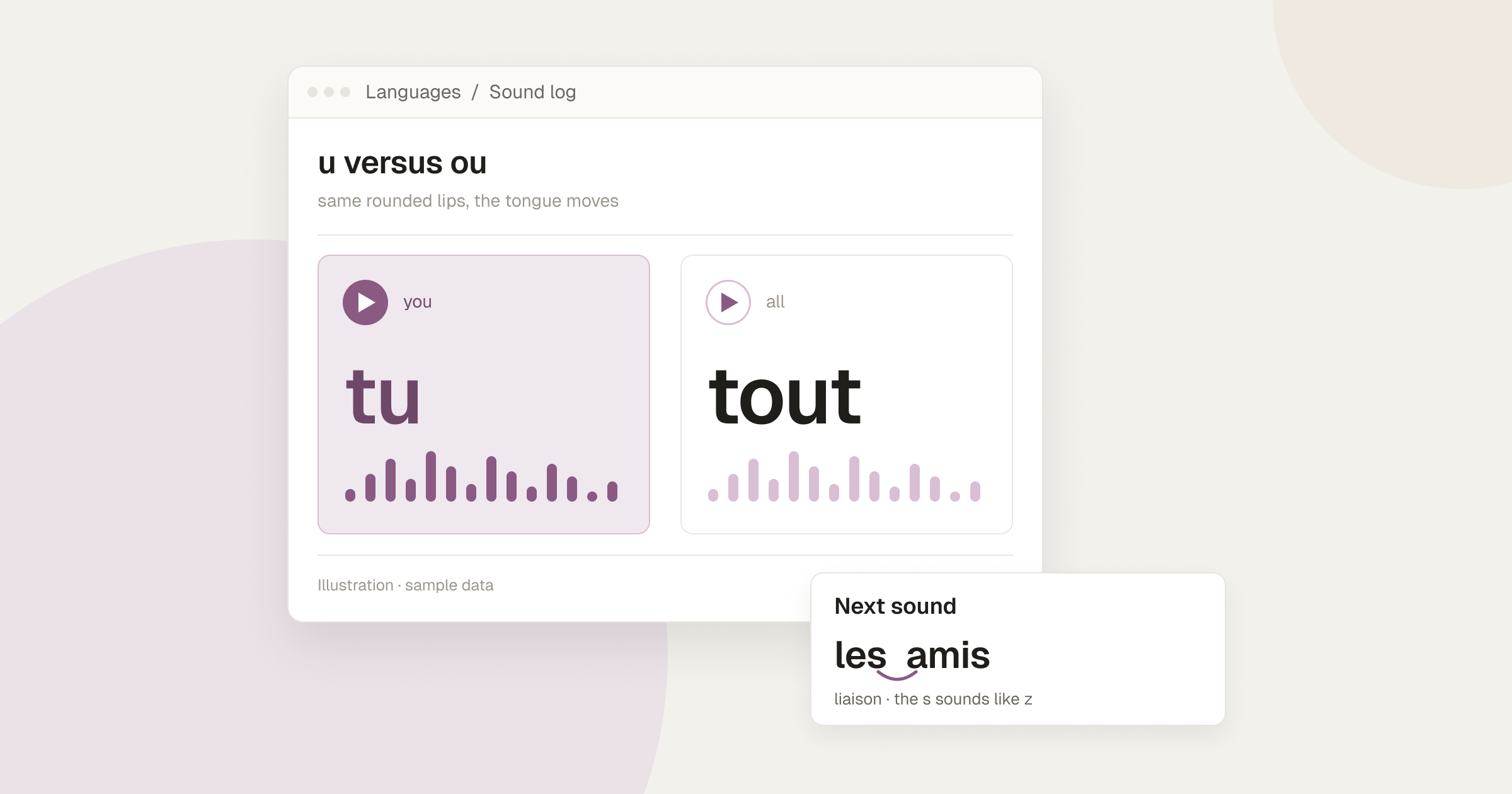
So je parle is "I speak" and nous parlons is "we speak": same stem, parl-, different endings. Most of the ending changes you see on paper are silent. French Today points out that je parle, tu parles, il parle and ils parlent are all pronounced the same way. Only the nous and vous forms sound different. That's one reason to learn conjugations out loud, and our guide to French pronunciation covers the silent letters in detail.
What are the three French verb groups?
French grammar sorts verbs into three groups by infinitive and pattern. The 1st group is regular -er verbs like parler, by far the largest. The 2nd group is -ir verbs that add -iss- in the plural, like finir (nous finissons). The 3rd group holds everything else: -re verbs, -oir verbs, irregular -ir verbs and aller.
- 1st group (-er). Lawless French describes "several thousand verbs that end in -er, the largest category of regular French verbs." Parler, aimer, donner, regarder. The one -er verb that doesn't follow the pattern is aller (to go), so it belongs to the 3rd group.
- 2nd group (-ir with -iss-). Several hundred regular -ir verbs conjugate like finir: choisir, réussir, grandir. The test is the plural: nous finissons, ils finissent. A verb like partir (nous partons) ends in -ir but is 3rd group.
- 3rd group (everything else). Vendre, prendre, voir, pouvoir, partir, venir, aller. Many everyday verbs live here, and many of them are irregular.
English-language textbooks often say "regular -re verbs" for verbs like vendre, attendre and répondre. They do follow a shared pattern, but French grammar files them in the 3rd group. Both labels describe the same verbs.
Here is the present tense for one model verb from each pattern:
| parler (to speak) · 1st group | finir (to finish) · 2nd group | vendre (to sell) · 3rd group | |
|---|---|---|---|
| je | parle | finis | vends |
| tu | parles | finis | vends |
| il / elle / on | parle | finit | vend |
| nous | parlons | finissons | vendons |
| vous | parlez | finissez | vendez |
| ils / elles | parlent | finissent | vendent |

What tenses and moods does French have?
Textbooks list four personal moods: indicative, subjunctive, conditional and imperative, plus the infinitive and the participles. Each simple tense has a compound twin made of avoir or être plus the past participle. In everyday speech you mainly need the present, passé composé, imparfait, future and conditional. A handful of tenses survive only in writing.
The table below is the whole system on one screen, using parler. The pattern comes from Lawless French's chart of simple and compound tenses: "each simple conjugation of avoir serves as the helping verb of a compound conjugation." The literary labels follow Lawless's list of literary tenses and moods.
| Simple form | Example | Compound twin | Example | Where you'll meet it |
|---|---|---|---|---|
| Présent (present) | je parle | Passé composé | j'ai parlé | Speech and writing |
| Imparfait (imperfect) | je parlais | Plus-que-parfait (pluperfect) | j'avais parlé | Speech and writing |
| Futur simple (future) | je parlerai | Futur antérieur (future perfect) | j'aurai parlé | Speech and writing |
| Conditionnel présent | je parlerais | Conditionnel passé | j'aurais parlé | Speech and writing |
| Passé simple | je parlai | Passé antérieur | j'eus parlé | Literary: books, history, journalism |
| Subjonctif présent | que je parle | Subjonctif passé | que j'aie parlé | Speech and writing |
| Subjonctif imparfait | que je parlasse | Subjonctif plus-que-parfait | que j'eusse parlé | Literary only |
| Impératif (imperative) | parle ! | Impératif passé | aie parlé | Present: speech and writing |
| Participe présent | parlant | Participe passé composé | ayant parlé | Speech and writing |
| Infinitif | parler | Infinitif passé | avoir parlé | Speech and writing |
Read the table in pairs. If you know j'avais (the imperfect of avoir), you already know how to build the pluperfect of any avoir verb: j'avais parlé, j'avais fini, j'avais vendu. Eight simple patterns give you the compound ones almost for free.
The literary tenses are worth recognizing even if you never produce them. Lawless notes that the passé simple is "a literary tense and is thus limited to formal writing," and it appears in all fiction, children's books included. In conversation its job is done by the passé composé.

Is the conditional a mood or a tense?
Both answers appear in textbooks. The Office québécois de la langue française notes it was "longtemps présenté comme un mode" (long presented as a mood) and that most linguists and grammarians now treat it as a tense of the indicative. Most English-language courses still call it a mood. The forms are the same either way, so pick your textbook's label and move on.
Which French tenses should you learn first?
Start with the present, then the passé composé and the imparfait for talking about the past, then the future and the conditional. Add the near future (aller + infinitive) early because it's easy and common. The subjunctive comes later, and the literary tenses can wait until you read novels.
Présent: what is happening, what usually happens
The present covers "I speak," "I'm speaking" and "I do speak." The endings for the three patterns are in the table above; the irregular verbs are further down. Je parle français tous les jours. (I speak French every day.)
Passé composé: completed past actions
Conjugate avoir (or être) in the present, then add the past participle: parlé, fini, vendu. Lawless French gives three English equivalents for j'ai visité: "I visited," "I have visited" and "I did visit." J'ai visité le Canada et puis je suis allé aux USA. (I visited Canada and then I went to the US.)
Imparfait: descriptions, habits, background
Take the nous form of the present, drop -ons, and add -ais, -ais, -ait, -ions, -iez, -aient. Lawless points out that être is the only exception, because nous sommes has no -ons to drop; its stem is ét- (j'étais). Use it for "was ...-ing" and "used to": Il pleuvait mais elle avait un parapluie. (It was raining but she had an umbrella.)
Futur simple and futur proche
For the futur simple, add -ai, -as, -a, -ons, -ez, -ont to the infinitive. -Re verbs drop the final e first: vendre → je vendrai. A few common verbs have irregular stems: être → ser-, avoir → aur-, aller → ir-, faire → fer-, pouvoir → pourr-, vouloir → voudr-, venir → viendr-, savoir → saur-. J'irai à la banque demain. (I'll go to the bank tomorrow.)
The futur proche is aller in the present plus an infinitive, the French "going to": Je vais te téléphoner à midi. (I'm going to call you at noon.)
Conditionnel présent: "would"
Use the future stem with the imparfait endings. Lawless confirms that conditional stems are identical to future stems and conditional endings are identical to imperfect endings. Nous voudrions commander maintenant. (We'd like to order now.) Si j'avais des nouvelles, je t'appellerais. (If I had any news, I would call you.)
Here are the three tenses side by side for parler:
| Imparfait | Futur simple | Conditionnel | |
|---|---|---|---|
| je | parlais | parlerai | parlerais |
| tu | parlais | parleras | parlerais |
| il / elle / on | parlait | parlera | parlerait |
| nous | parlions | parlerons | parlerions |
| vous | parliez | parlerez | parleriez |
| ils / elles | parlaient | parleront | parleraient |
Where does the subjunctive fit?
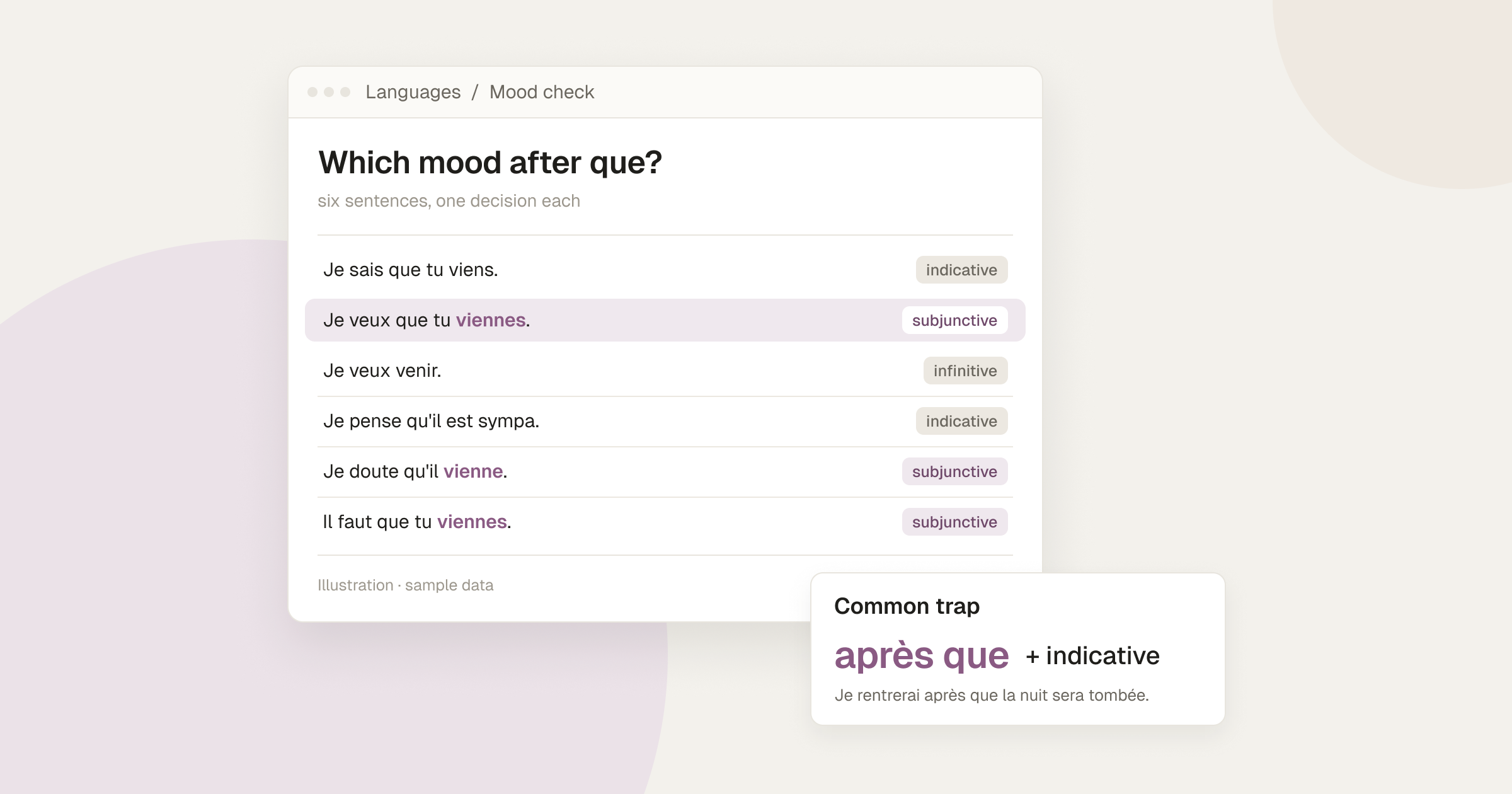
The subjunctive is a separate mood with its own triggers, mostly after que: Il faut que tu viennes. (You have to come.) When to use it and how to form it is covered in the French subjunctive.
Avoir or être: which auxiliary do you use?
Most French verbs build their compound tenses with avoir. Être is used with all pronominal verbs, like se lever, and with about two dozen intransitive verbs of movement or change of state, such as aller, venir, partir, naître and mourir. With être, the past participle agrees with the subject: elle est allée, ils sont partis.
Lawless French puts it plainly: avoir "is the auxiliary for the vast majority of French verbs." The être list is short enough to memorize:
- aller, venir, arriver, partir, entrer, sortir, monter, descendre
- naître, mourir, rester, tomber, retourner, passer
- and their derivatives: devenir, revenir, rentrer, remonter, repartir
- plus every pronominal verb: je me suis levé(e), nous nous sommes assis
Agreement works like adjective agreement: add -e for feminine and -s for plural. Elle est arrivée hier. (She arrived yesterday.) Nous sommes rentrés tard. (We got home late.) With avoir, the participle normally doesn't agree with the subject, but it does agree with a direct object placed before the verb: Il nous a trouvés dans le parc. (He found us in the park.)

Why is it "je suis passé" but "j'ai passé un examen"?
A few être verbs switch to avoir when they take a direct object. Lawless counts eight of them, including monter, descendre, sortir, rentrer, retourner and passer. Without an object you use être: Je suis passé devant la porte. (I went past the door.) With one you use avoir: J'ai passé un examen. (I took an exam.) Elle a sorti la poubelle. (She took the trash out.)
Which irregular verbs should you learn first?
Several everyday verbs are irregular 3rd-group verbs: être, avoir, aller, faire, pouvoir, vouloir, venir and prendre. Learn their present tense as whole charts, together with their past participles. Stem-changing verbs like lever or appeler are milder: they keep regular -er endings but change the stem in four of the six present forms.
| être (to be) | avoir (to have) | aller (to go) | faire (to do, make) | |
|---|---|---|---|---|
| je / j' | suis | ai | vais | fais |
| tu | es | as | vas | fais |
| il / elle / on | est | a | va | fait |
| nous | sommes | avons | allons | faisons |
| vous | êtes | avez | allez | faites |
| ils / elles | sont | ont | vont | font |
| Past participle | été | eu | allé (être) | fait |
| pouvoir (can) | vouloir (to want) | venir (to come) | prendre (to take) | |
|---|---|---|---|---|
| je | peux | veux | viens | prends |
| tu | peux | veux | viens | prends |
| il / elle / on | peut | veut | vient | prend |
| nous | pouvons | voulons | venons | prenons |
| vous | pouvez | voulez | venez | prenez |
| ils / elles | peuvent | veulent | viennent | prennent |
| Past participle | pu | voulu | venu (être) | pris |
Forms checked against the Lawless French verb tables. Notice the pattern inside the irregularity: venir and prendre change their stem in the ils form (viennent, prennent) but keep a shorter stem for nous and vous.
Stem-changing verbs
According to Lawless French, there are "fewer than 100 stem-changing verbs," and their changes reduce to three patterns. The nous and vous forms keep the infinitive's stem; the other four forms change.
- e or é becomes è: lever → je lève, nous levons; acheter → j'achète; préférer → je préfère, nous préférons.
- Doubled consonant: appeler → j'appelle, nous appelons; jeter → je jette.
- y becomes i: envoyer → j'envoie; nettoyer → je nettoie. For -ayer verbs like payer and essayer, the change is optional.

The groups, tense formation and charts above fit on two printable pages:
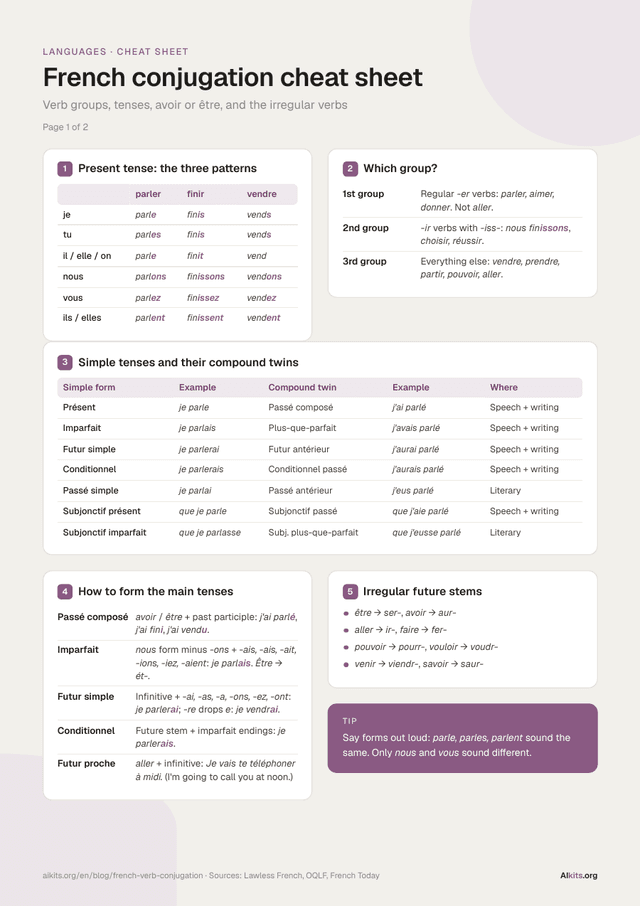
Print it or keep it on your phone. Free, no sign-up.
Download the PDFHow do you learn French conjugations?
Learn verbs with their subject pronouns and say them out loud, since many endings are silent. Start with the present of the most frequent verbs, then the passé composé and the imparfait. Check each form in a conjugator, write one sentence of your own per verb, and review the verb-and-tense pairs you get wrong on a schedule.
A short daily routine:
- Pick five verbs and one tense. Start with the eight irregular verbs above in the present.
- Say every form with its pronoun. Je suis, tu es, il est. French Today recommends drilling all the pronouns and not always in the same order, so you can't run on autopilot.
- Check, don't guess. Look the forms up in a verb table such as Lawless French or Reverso, especially accents and silent endings.
- Write one real sentence per verb. Je prends le bus à huit heures. (I take the bus at eight.) A sentence teaches usage; a table only teaches forms.
- Log your errors. Keep a list of the verb and tense combinations you get wrong and review them first next time. A notebook, a spreadsheet or Notion all work.
Spaced review keeps forms from fading; our comparison of spaced repetition in Anki and Notion shows two ways to set it up, and a vocabulary notebook works for verbs too. Reading and listening to French you mostly understand (comprehensible input) shows the tenses in context. If you're preparing for an immigration exam, see our TCF and TEF Canada preparation guide. For the rest of French grammar in learning order, see our French grammar guide.
We're building a French Grammar Tree for Notion with a conjugation tracker. It's coming soon; join the waitlist to hear when it's ready.
FAQ
What are the French conjugations?
They are the forms a verb takes for its six subjects in each tense and mood. French verbs fall into three groups (-er like parler, -ir with -iss- like finir, and everything else), and each simple tense has a compound twin built with avoir or être.
How many tenses are there in French?
Counted the traditional way, the indicative has eight tenses, the subjunctive four, the conditional two and the imperative two. The passé simple, passé antérieur and the imperfect and pluperfect subjunctive are literary, so everyday French uses far fewer.
What conjugation is "je suis"?
Usually the present tense of être: je suis means "I am." It is also the present tense of suivre (to follow), so je suis can mean "I follow." Context tells you which: je suis prof (I'm a teacher), je suis le guide (I'm following the guide).
Is it "je fais" or "je fait"?
Je fais. Faire is irregular: je fais, tu fais, il fait. The -t ending belongs to il, elle and on.
Is it "je suis passé" or "j'ai passé"?
Both exist, with different meanings. Without a direct object passer takes être: je suis passé devant la porte (I went past the door). With a direct object it takes avoir: j'ai passé un examen (I took an exam).
What is the hardest verb to conjugate in French?
There's no official ranking. Être and avoir are irregular in almost every tense, and aller looks like an -er verb but isn't one. They are everyday verbs, though, so you get plenty of practice.
How do you memorize French conjugations?
Learn a few verbs at a time, say each form out loud with its pronoun, check it in a verb table, write a sentence with it, and review the forms you get wrong on a schedule. Pronunciation matters because many endings are silent.