Last updated: 13 October 2026 · By Zoya K
The French subjunctive has a reputation it doesn't quite deserve. The forms are mostly regular; the hard part is knowing when a sentence needs them. This guide gives you a two-step test, the trigger groups, the verbs that switch mood when you negate them, and the forms, irregular verbs included.
Every French example has an English translation in parentheses. For the indicative tenses (present, passé composé, imparfait and the rest), see our guide to French verb conjugation.
What is the French subjunctive?
The subjunctive (le subjonctif) is a verb mood for things the speaker presents as wished, needed, felt, doubted or not yet real, rather than stated as fact. It almost always appears in a clause after que: Il faut que tu viennes (You have to come). There is no future subjunctive; the present covers the future too.
Lawless French defines it as a mood used in dependent clauses "to indicate some sort of subjectivity, uncertainty, or unreality in the mind of the speaker." Compare two sentences:
- Je sais que tu viens. (I know you're coming.) A fact, so indicative.
- Je veux que tu viennes. (I want you to come.) A wish, so subjunctive.
The second clause is the same idea in both; only the attitude in the main clause changes. And on the future, Lawless is explicit: "There is no future subjunctive in French." Il faut que tu prennes le bus demain. (You'll have to take the bus tomorrow.)
When do you use the subjunctive? The two-step test
Use the subjunctive when two things are true. First, the main clause expresses a wish, an order, an emotion, a judgment, a doubt or a possibility, and it ends in que. Second, the clause after que has a different subject. If the subject is the same, French uses an infinitive instead.
Both conditions come from Lawless French's introduction to the subjunctive:
- The expression must end in que. If it ends in de, you need the infinitive. Il est important que tu fasses tes devoirs. (It's important for you to do your homework.) Il est important de faire tes devoirs. (It's important to do your homework.)
- The two clauses need different subjects. Je veux que tu ailles à la banque. (I want you to go to the bank.) Je veux aller à la banque. (I want to go to the bank.) Never je veux que j'aille.
The second rule is easy to miss and easy to apply: if you'd say "I want to" in English, French wants an infinitive.

Which expressions trigger the subjunctive?
Most triggers fall into four groups: wishes and orders, emotions and judgments, doubt and possibility, and a set of conjunctions such as avant que, pour que and bien que. You don't need hundreds of them. Learn a handful from each group as whole phrases, with one example sentence each, and the pattern becomes automatic.
The lists below are a short selection from Lawless French's trigger lists, which run to dozens of expressions per group.
| Group | Common triggers | Example |
|---|---|---|
| Wishes and orders | vouloir que, souhaiter que, préférer que, demander que, exiger que, il faut que | Je préfère que vous restiez. (I'd rather you stayed.) |
| Emotions and judgments | être content que, avoir peur que, regretter que, il est dommage que, il est important que, il vaut mieux que | Je suis content que tu sois là. (I'm glad you're here.) |
| Doubt and possibility | douter que, il est possible que, il se peut que, il semble que, il n'est pas sûr que | Il est possible qu'il pleuve. (It might rain.) |
| Conjunctions | avant que, pour que, afin que, bien que, quoique, jusqu'à ce que, à moins que, sans que, à condition que | Je t'explique pour que tu comprennes. (I'm explaining so that you understand.) |
Two details from that table catch people. Il semble que takes the subjunctive, but il me semble que ("it seems to me") usually takes the indicative. And the conjunctions follow the same logic as the verbs: Lawless's list of conjunctions contrasts the ones that need the subjunctive with those that "express a simple reality" (parce que, pendant que, depuis que), which don't.
After avant que, à moins que, de peur que and a few others you may also see a ne that doesn't negate anything: Avant que vous ne preniez une décision … (Before you make a decision …). Lawless calls this ne explétif "formal and optional."
Avant que or après que?
Avant que takes the subjunctive; après que takes the indicative. The Académie française explains the difference: avant que implies something that may or may not happen, while après que presents the event as done, so its verb "doit être mis à l'indicatif" (must be in the indicative). Its example: Je rentrerai après que la nuit sera tombée. (I'll come home after night has fallen.) Lawless adds that "so many native speakers mistakenly use the subjunctive" after après que that you'll hear it anyway.

When should you not use the subjunctive?
Don't use it after affirmative verbs of certainty or opinion such as je pense que, je crois que or je sais que, after affirmative espérer, after après que, or when both clauses share a subject. When you negate an opinion verb or turn it into a question, it usually switches to the subjunctive.
Lawless French calls these the variable subjunctive: obviousness, knowledge, certainty, opinion and hope count as "real" to the speaker, so they take the indicative until you negate or question them.
| Expression | Affirmative: indicative | Negative or question: subjunctive |
|---|---|---|
| penser que | Je pense qu'il est sympa. (I think he's nice.) | Je ne pense pas qu'il soit sympa. (I don't think he's nice.) |
| croire que | Je crois qu'elle a raison. (I think she's right.) | Je ne crois pas qu'elle ait raison. (I don't think she's right.) |
| espérer que | J'espère que sa mère viendra. (I hope his mother comes.) | Espères-tu que sa mère vienne ? (Do you hope his mother comes?) |
| être sûr que | Je suis sûr qu'il vient. (I'm sure he's coming.) | Je ne suis pas sûr qu'il vienne. (I'm not sure he's coming.) |
| il est clair que | Il est clair que Luc le sait. (It's clear that Luc knows.) | Il n'est pas clair que Luc le sache. (It's not clear whether Luc knows.) |
Espérer surprises English speakers because "hope" feels like a wish. In French it counts as a confident expectation, so Lawless is direct: "Espérer in the affirmative = no subjunctive."
Two verbs work the other way round. Douter (to doubt) and nier (to deny) take the subjunctive when affirmative and the indicative when negated: Je doute qu'il vienne. (I doubt he'll come.) Je ne doute pas qu'il viendra. (I don't doubt he'll come.)

How do you form the present subjunctive?
Take the ils form of the present tense, drop -ent and add -e, -es, -e, -ions, -iez, -ent: ils finissent gives que je finisse. Verbs with two stems use their nous stem for nous and vous: que nous prenions. For regular -er verbs, the singular and ils forms look exactly like the present indicative.
This is the rule on Lawless French's regular conjugation page, which applies it to all regular verbs and "many irregular verbs."
| parler (ils parlent) | finir (ils finissent) | vendre (ils vendent) | |
|---|---|---|---|
| que je | parle | finisse | vende |
| que tu | parles | finisses | vendes |
| qu'il / elle / on | parle | finisse | vende |
| que nous | parlions | finissions | vendions |
| que vous | parliez | finissiez | vendiez |
| qu'ils / elles | parlent | finissent | vendent |
Notice the nous and vous forms: que nous parlions, que vous parliez. They look like the imparfait, not the present. That is the one place where the subjunctive of a regular verb is visibly different from the present.
Two-stem verbs
Some verbs change their stem in the present tense, and they keep two stems in the subjunctive. Following Lawless's irregular subjunctive page, the ils stem gives je, tu, il and ils, while the nous stem gives nous and vous.
- prendre: ils prennent → que je prenne; nous prenons → que nous prenions
- venir: ils viennent → que je vienne; nous venons → que nous venions
- devoir: ils doivent → que je doive; nous devons → que nous devions
- lever: ils lèvent → que je lève; nous levons → que nous levions

Which verbs are irregular in the subjunctive?
Only a few verbs have their own subjunctive stems. Faire, pouvoir and savoir use one irregular stem; aller and vouloir use two; falloir has a single form, qu'il faille. Avoir and être are irregular in their endings as well. They are everyday verbs, so learn them as whole charts.
| être | avoir | aller | faire | |
|---|---|---|---|---|
| que je / j' | sois | aie | aille | fasse |
| que tu | sois | aies | ailles | fasses |
| qu'il / elle / on | soit | ait | aille | fasse |
| que nous | soyons | ayons | allions | fassions |
| que vous | soyez | ayez | alliez | fassiez |
| qu'ils / elles | soient | aient | aillent | fassent |
| pouvoir | savoir | vouloir | |
|---|---|---|---|
| que je | puisse | sache | veuille |
| que tu | puisses | saches | veuilles |
| qu'il / elle / on | puisse | sache | veuille |
| que nous | puissions | sachions | voulions |
| que vous | puissiez | sachiez | vouliez |
| qu'ils / elles | puissent | sachent | veuillent |
Lawless also counts valoir (que je vaille, que nous valions) in this group.
The two-step test, the triggers and these forms fit on one printable page:
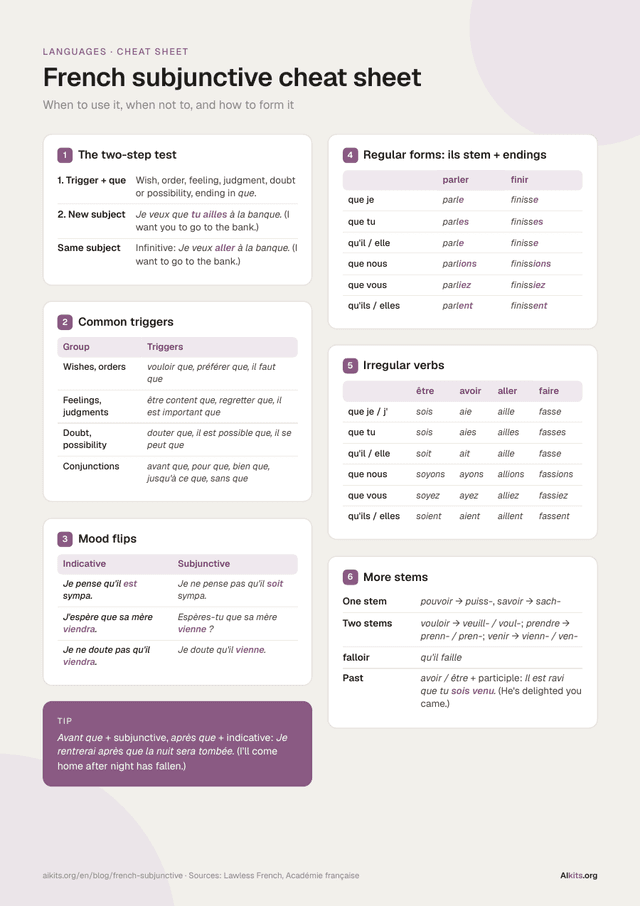
Print it or keep it on your phone. Free, no sign-up.
Download the PDFWhat is the past subjunctive (and the two you only need to read)?
The past subjunctive is avoir or être in the present subjunctive plus the past participle: Il est ravi que tu sois venu à la fête (He's delighted that you came to the party). Use it when the action in the que clause happened earlier. The imperfect and pluperfect subjunctive are literary: learn to recognize them, not to produce them.
The past subjunctive follows the same auxiliary and agreement rules as the passé composé. Je doute qu'il ait fini ses devoirs. (I doubt he's finished his homework.) Je suis contente qu'elle soit partie à l'heure. (I'm glad she left on time.) The first example comes from Lawless's past subjunctive lesson, which notes that the main clause can be in the present or the past: Je doutais qu'il ait fini ses devoirs (I doubted he'd finished his homework).
| Subjunctive tense | Example | Where you'll meet it |
|---|---|---|
| Present | que je parle | Speech and writing |
| Past | que j'aie parlé | Speech and writing |
| Imperfect | que je parlasse | Literary only |
| Pluperfect | que j'eusse parlé | Literary only |
According to Lawless, the imperfect subjunctive is "a literary verb form," and in modern French it's replaced by the present or past subjunctive: Je craignais qu'il fût mort in a novel becomes Je craignais qu'il soit mort (I feared he was dead) in speech.
How do you practice the French subjunctive?
Learn triggers as whole phrases, each with one sentence you wrote yourself, and practice the decision as well as the forms. Mixed sets where you choose between indicative and subjunctive train exactly what breaks in conversation. Keep a short list of the mistakes you make and review those first next time.
A routine you can repeat:
- Pick four triggers, one per group. Il faut que, être content que, douter que, avant que.
- Write one sentence for each. Check the verb form in a conjugator.
- Do a mixed set. Write ten sentences that start with je pense que, je ne pense pas que, j'espère que and je veux que, and decide the mood each time before you write the verb.
- Log what you got wrong and start the next session with those.
Spaced review keeps triggers from fading: see spaced repetition in Anki and Notion. If you're preparing for a French exam, our TCF and TEF Canada guide covers the format. For where the subjunctive sits in the whole of French grammar, see our French grammar guide. Learning Spanish too? See our guide to the Spanish subjunctive.
If you track grammar in Notion, a framework like our Any language Grammar Tree gives triggers and forms a fixed place.
File the triggers in its Sentence section and the subjunctive forms under Tenses, one framework for any language.
FAQ
What is the present subjunctive of aller?
Que j'aille, que tu ailles, qu'il aille, que nous allions, que vous alliez, qu'ils aillent. Aller has two stems: aill- for the singular and ils, all- for nous and vous.
Does "je regrette que" take the subjunctive?
Yes. Regretter que expresses a feeling, so the next verb goes in the subjunctive: Je regrette que tu partes (I'm sorry you're leaving).
What is the rule for the subjunctive in French?
Use it after an expression of wish, emotion, judgment, doubt or possibility that ends in que, when the clause after que has a different subject. With the same subject, use an infinitive: je veux partir, not je veux que je parte.
Do French people actually use the subjunctive?
Yes. The present and past subjunctive are part of everyday speech, after phrases like il faut que and je veux que. Only the imperfect and pluperfect subjunctive are limited to literary writing.
When should you not use the subjunctive in French?
Not after affirmative verbs of certainty or opinion (je pense que, je crois que, je sais que), not after affirmative espérer, not after après que, and not when both clauses have the same subject.
Is there a future subjunctive in French?
No. The present subjunctive covers future events: Il faut que tu prennes le bus demain (You'll have to take the bus tomorrow).
What is the hardest tense to learn in French?
There's no official ranking. With the subjunctive, the decision is usually harder than the forms: Lawless French calls the conjugations "relatively easy" compared with knowing when to use them. Our guide to French verb conjugation shows where every tense fits.
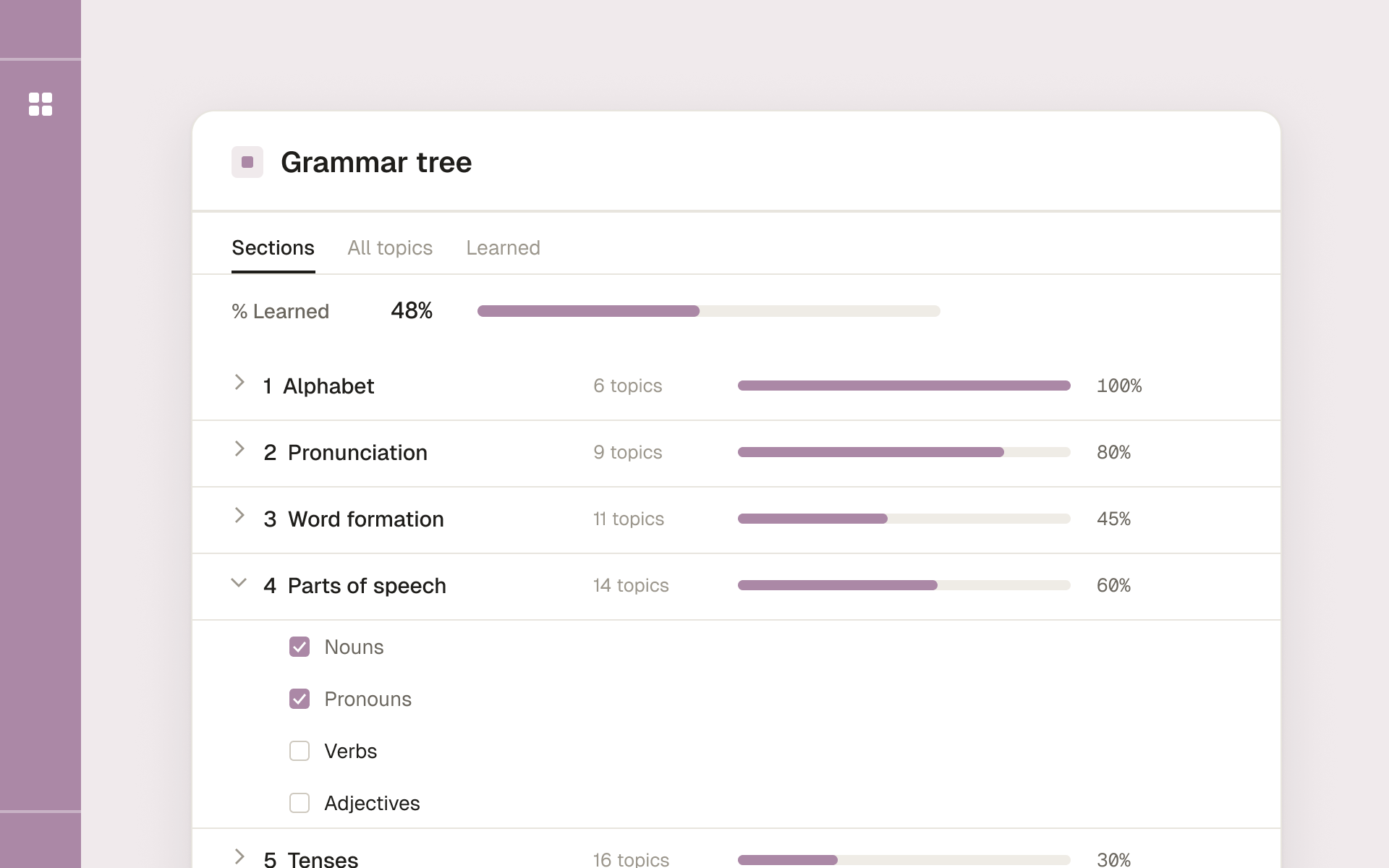
One grammar framework for any language, organized into seven sections from alphabet to punctuation.