Last updated: 13 October 2026 · By Zoya K
A conjugator gives you one verb at a time. This guide shows the patterns behind all of them: the regular endings for -ar, -er and -ir verbs in one chart, the four ways verbs go irregular, every Spanish tense with its official name and CEFR level, and how vos and vosotros fit in. Every form here was checked against the conjugation tables of the Real Academia Española's Diccionario de la lengua española (DLE).
Conjugation means changing a verb's ending to show who acts and when. For a verb that isn't in this guide, look it up in the DLE (the conjugation table is part of each verb entry) or in SpanishDict's conjugator. The patterns below explain what those tables are showing you.
How do you conjugate a Spanish verb?
Remove the -ar, -er or -ir ending from the infinitive and add the ending for the person and tense. Hablar becomes habl-, then hablo ("I speak") or hablé ("I spoke"). The future and conditional are the exception: they add their endings to the whole infinitive, so hablaré ("I will speak"). Then check whether the verb belongs to an irregular group.
In three steps:
- Find the group. The infinitive ends in -ar (hablar, "to speak"), -er (comer, "to eat") or -ir (vivir, "to live"). Each group has its own endings.
- Pick the ending. Choose the person (yo, tú, él…) and the tense, and add the ending from the chart below to the stem: habl + amos = hablamos ("we speak").
- Check for irregularity. If the verb changes its stem (pienso), has a -go yo form (tengo), changes its spelling (busqué) or is fully irregular (soy, voy), use the pattern for that group.

Spanish verb conjugation chart: regular -ar, -er and -ir verbs
One chart covers every regular verb. The three model verbs below show the six persons in the six tenses learners use most: present, preterite, imperfect, future, conditional and present subjunctive. Endings are in bold. Swap the stem and the same endings work for any regular verb: cantar, beber, escribir.
-ar verbs: hablar (to speak)
| Person | Present | Preterite | Imperfect | Future | Conditional | Present subjunctive |
|---|---|---|---|---|---|---|
| yo | hablo | hablé | hablaba | hablaré | hablaría | hable |
| tú | hablas | hablaste | hablabas | hablarás | hablarías | hables |
| él, ella, usted | habla | habló | hablaba | hablará | hablaría | hable |
| nosotros | hablamos | hablamos | hablábamos | hablaremos | hablaríamos | hablemos |
| vosotros | habláis | hablasteis | hablabais | hablaréis | hablaríais | habléis |
| ellos, ustedes | hablan | hablaron | hablaban | hablarán | hablarían | hablen |
-er verbs: comer (to eat)
| Person | Present | Preterite | Imperfect | Future | Conditional | Present subjunctive |
|---|---|---|---|---|---|---|
| yo | como | comí | comía | comeré | comería | coma |
| tú | comes | comiste | comías | comerás | comerías | comas |
| él, ella, usted | come | comió | comía | comerá | comería | coma |
| nosotros | comemos | comimos | comíamos | comeremos | comeríamos | comamos |
| vosotros | coméis | comisteis | comíais | comeréis | comeríais | comáis |
| ellos, ustedes | comen | comieron | comían | comerán | comerían | coman |
-ir verbs: vivir (to live)
| Person | Present | Preterite | Imperfect | Future | Conditional | Present subjunctive |
|---|---|---|---|---|---|---|
| yo | vivo | viví | vivía | viviré | viviría | viva |
| tú | vives | viviste | vivías | vivirás | vivirías | vivas |
| él, ella, usted | vive | vivió | vivía | vivirá | viviría | viva |
| nosotros | vivimos | vivimos | vivíamos | viviremos | viviríamos | vivamos |
| vosotros | vivís | vivisteis | vivíais | viviréis | viviríais | viváis |
| ellos, ustedes | viven | vivieron | vivían | vivirán | vivirían | vivan |
Forms from the DLE entries hablar, comer and vivir.
What each tense does, in one line:
- Present (hablo): now, habits and the near future. Mañana voy al cine ("I'm going to the cinema tomorrow").
- Preterite (hablé): a finished action at a definite point. Fui a su casa ("I went to his house").
- Imperfect (hablaba): background, description and habits in the past. Iba todos los días al colegio ("I went to school every day").
- Future (hablaré): what will happen. Endings go on the full infinitive.
- Conditional (hablaría): "would". Same stem as the future, imperfect-style endings.
- Present subjunctive (hable): after wishes, doubt and events that haven't happened yet. The vowel swaps: -ar verbs take e, -er/-ir verbs take a.
-Er and -ir verbs share most of their endings. They split in the nosotros and vosotros forms of the present (comemos, coméis vs vivimos, vivís), and in the future and conditional, where the infinitive's own vowel stays (comeré, viviré).
All three charts, plus the irregular verbs below, on two printable pages:
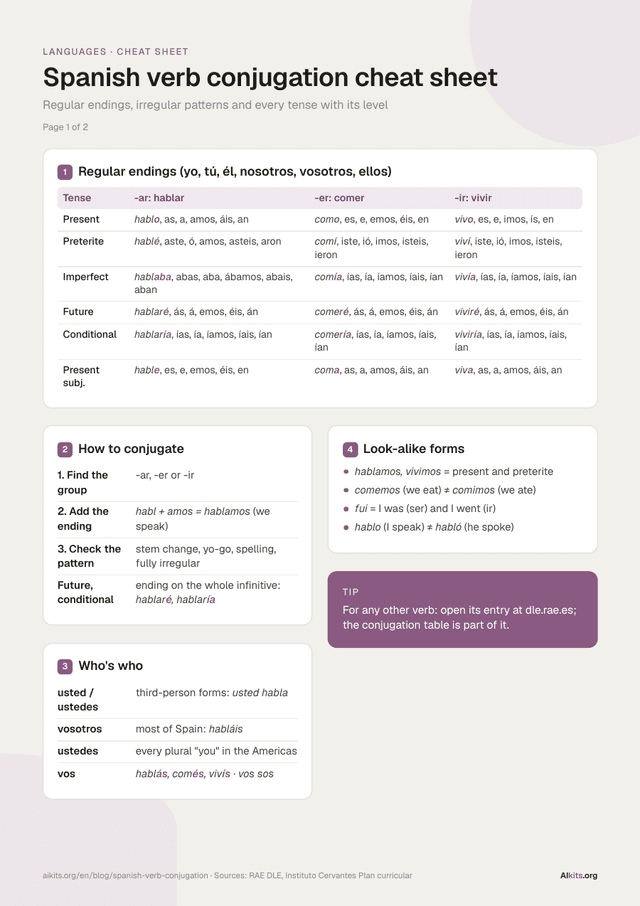
Print it or keep it on your phone. Free, no sign-up.
Download the PDFWho's who: yo, tú, usted, vosotros and vos
Spanish has six persons. Usted and ustedes, the formal "you", take the third-person forms (usted habla). Vosotros, the informal plural "you", is used in most of Spain. In the Americas, the Canary Islands and part of Andalusia, ustedes covers every plural "you". In voseo areas, vos replaces tú with its own forms: hablás, comés, vivís.
The vosotros row is in the charts above because Spain uses it and every textbook teaches it. The RAE's DPD entry on personal pronouns states that "en América, en Canarias y en parte de Andalucía, no se usa el pronombre personal vosotros"; ustedes is used instead. If you're learning Latin American Spanish, learn to recognize vosotros forms and use ustedes yourself.
Vos is a different case. The Instituto Cervantes Plan curricular (PCIC) describes two main voseo patterns in the present: am-ás, com-és, viv-ís (Argentina, Uruguay, Central America and parts of other countries) and am-áis, com-ís, viv-ís (Chile, highland Ecuador and southern Peru, among others). The DLE lists the first pattern next to tú in every table: hablas / hablás, comes / comés, tienes / tenés, puedes / podés. Ser is irregular here as well: vos sos ("you are").
| Person | Who uses it | Verb form | Example |
|---|---|---|---|
| tú | Informal "you", everywhere except where vos replaces it | Second person | ¿Hablas inglés? (Do you speak English?) |
| vos | Informal "you" in voseo areas (Argentina, Uruguay, Central America…) | Own forms | ¿Hablás inglés? (Do you speak English?) |
| usted | Formal "you", everywhere | Third person | ¿Habla usted inglés? (Do you speak English?) |
| vosotros | Informal plural "you", most of Spain | Second person plural | ¿Habláis inglés? (Do you all speak English?) |
| ustedes | Formal plural in Spain; every plural "you" in the Americas | Third person plural | ¿Hablan ustedes inglés? (Do you all speak English?) |
The subject pronoun itself is usually dropped, because the ending already shows the person. "Tengo" alone means "I have". Use yo, tú and the rest to contrast people or to avoid ambiguity.
What are the irregular Spanish verbs?
Most irregular verbs follow one of four patterns. Stem-changing verbs switch a vowel when it's stressed (pensar → pienso). "Yo-go" verbs add -go in the yo form (tener → tengo). Spelling-change verbs alter a letter to keep the sound (buscar → busqué). A short list is fully irregular: ser, ir, estar, haber, saber and dar. Learn the pattern first.
Stem changes in the present
In these verbs the stem vowel changes whenever it carries the stress. That covers yo, tú, él and ellos. The nosotros and vosotros forms keep the original vowel because their stress falls on the ending. Written out, the changed forms make a "boot" shape in the chart.
| Pattern | Verb | Present | Nosotros / vosotros | Preterite (él) |
|---|---|---|---|---|
| e → ie | pensar | pienso, piensas, piensa, piensan | pensamos, pensáis | pensó |
| o → ue | poder | puedo, puedes, puede, pueden | podemos, podéis | pudo |
| e → i | pedir | pido, pides, pide, piden | pedimos, pedís | pidió |
| o → ue (and u) | dormir | duermo, duermes, duerme, duermen | dormimos, dormís | durmió |
-Ir verbs with a stem change also change in the preterite third person (pidió, durmió) and in the gerund (pidiendo, durmiendo). Forms from the DLE entries pensar, poder, pedir and dormir. The PCIC lists these vowel changes in the present at A2.

Yo-go verbs
A group of common verbs ends in -go in the yo form of the present and keeps that stem in the whole present subjunctive: tener → tengo, tenga; hacer → hago, haga; poner → pongo, ponga. The other present forms follow their own pattern (tienes, haces, pones).
Spelling changes
Some changes only keep the pronunciation. Verbs in -car write qu before e: buscar → busqué ("I looked for") and busque. The sound is the same; only the spelling moves. The DLE tables show these forms like any other, so a conjugator will always give you the right spelling.
Truly irregular verbs
A handful of verbs need to be learned as whole forms. Ser and ir share their preterite (fui, fuiste, fue…). Saber has sé ("I know"), dar has doy ("I give"), and haber, the helper verb of every compound tense, has he, has, ha, plus the impersonal hay ("there is / there are").
Irregular verb chart: ser, estar, ir, tener, hacer and poder
These six verbs come up early in every course, and none of them follows the regular chart. The Instituto Cervantes curriculum puts ser, estar, haber and ir in the A1 present. It adds the irregular preterites of tener, hacer, estar, ser, ir, ver and dar at A2. Learn the forms below as whole words.
| Verb | Present (yo · tú · él) | Preterite (yo · él) | Future (yo) | Present subjunctive (yo) |
|---|---|---|---|---|
| ser | soy · eres · es | fui · fue | seré | sea |
| estar | estoy · estás · está | estuve · estuvo | estaré | esté |
| ir | voy · vas · va | fui · fue | iré | vaya |
| tener | tengo · tienes · tiene | tuve · tuvo | tendré | tenga |
| hacer | hago · haces · hace | hice · hizo | haré | haga |
| poder | puedo · puedes · puede | pude · pudo | podré | pueda |
Forms from the DLE entries ser, estar, ir, tener, hacer and poder.
Two shortcuts help with the rest of the paradigm:
- Irregular preterites share their endings. Tuve, estuve, hice, puse, pude and supe all take -e, -iste, -o, -imos, -isteis, -ieron (tuvo, pudo, hizo). There's no accent on the yo and él forms, unlike regular hablé and habló.
- Irregular futures keep one stem. Tendré, haré, pondré, podré, sabré and habré use the same irregular stem for the future and the conditional: tendría, haría, podría.
How many tenses does Spanish have?
The DLE's conjugation tables show 10 indicative tenses (five simple, five compound), 6 subjunctive tenses and the imperative. Counts like "12" or "18" group them differently. One of the subjunctive tenses, the future, has fallen out of everyday use and survives mainly in legal language and fixed phrases. Learners need about a dozen.
The map below gives each tense with its English name, the name the Instituto Cervantes curriculum uses, the name in the RAE's tables, an example with hablar, and the CEFR level where the PCIC introduces it. The RAE gives two names for most tenses (for example "Pretérito imperfecto / Copretérito"), so you may meet either in textbooks and conjugators.
| English name | PCIC name | RAE name (DLE) | Example (yo) | Level |
|---|---|---|---|---|
| Present | Presente | Presente | hablo | A1 |
| Preterite | Pretérito indefinido | Pretérito perfecto simple / Pretérito | hablé | A2 |
| Imperfect | Pretérito imperfecto | Pretérito imperfecto / Copretérito | hablaba | A2 |
| Present perfect | Pretérito perfecto | Pretérito perfecto compuesto / Antepresente | he hablado | A2 |
| Imperative | Imperativo | Imperativo | habla (tú), hablad (vosotros) | A2 |
| Future | Futuro imperfecto | Futuro simple / Futuro | hablaré | B1 |
| Conditional | Condicional simple | Condicional simple / Pospretérito | hablaría | B1 |
| Pluperfect | Pretérito pluscuamperfecto | Pretérito pluscuamperfecto / Antecopretérito | había hablado | B1 |
| Present subjunctive | Presente (subjuntivo) | Presente | hable | B1 |
| Future perfect | Futuro perfecto | Futuro compuesto / Antefuturo | habré hablado | B2 |
| Conditional perfect | Condicional compuesto | Condicional compuesto / Antepospretérito | habría hablado | B2 |
| Imperfect subjunctive | Pretérito imperfecto (subjuntivo) | Pretérito imperfecto / Pretérito | hablara or hablase | B2 |
| Present perfect subjunctive | Pretérito perfecto (subjuntivo) | Pretérito perfecto compuesto / Antepresente | haya hablado | B2 |
| Pluperfect subjunctive | Pretérito pluscuamperfecto (subjuntivo) | Pretérito pluscuamperfecto / Antepretérito | hubiera or hubiese hablado | B2 |
| Past anterior | Pretérito anterior | Pretérito anterior / Antepretérito | hube hablado | C2 |
| Future subjunctive (simple and compound) | Futuro (subjuntivo) | Futuro simple / Futuro; Futuro compuesto / Antefuturo | hablare, hubiere hablado | C2 |
Sources: DLE conjugation tables; PCIC grammar inventories A1–A2, B1–B2, C1–C2, section 9.
The PCIC's C2 entry for the future subjunctive notes "desuso" in Latin America and limits its use to administrative and legal jargon and fixed expressions such as Sea como fuere ("Be that as it may"). Recognize it; you won't need to produce it.

Which Spanish tenses should you learn first?
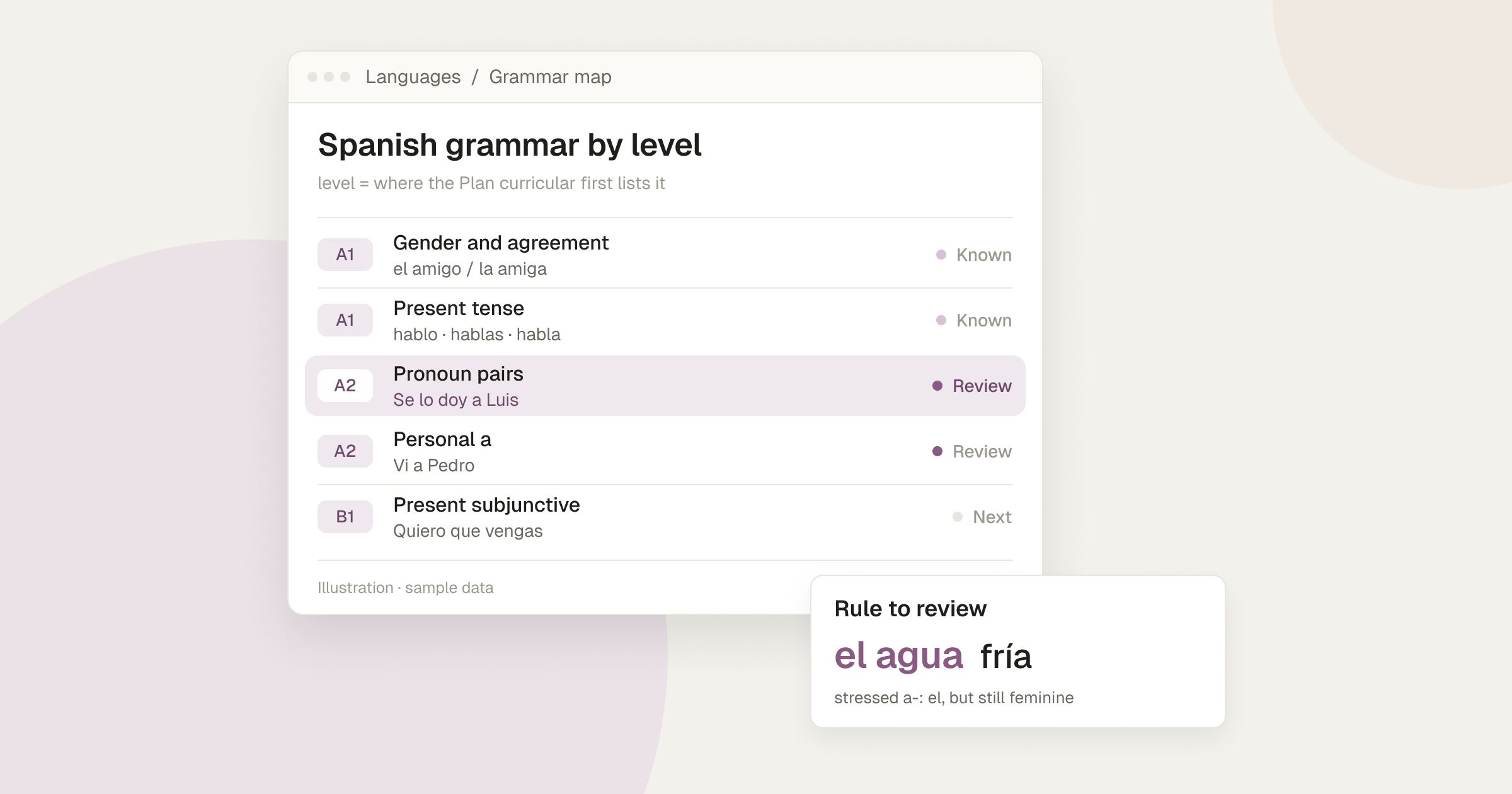
Follow the levels in the map: the present first, then the preterite, imperfect and present perfect, then the future, conditional and present subjunctive, and the remaining subjunctive tenses last. The present tense alone carries real conversation at A1. For a weekly plan built on this order, see the best way to learn Spanish as an adult. For grammar beyond verbs, our Spanish grammar guide maps every topic by level.
Which Spanish verb forms look the same?
Several forms look identical and only context separates them. Hablamos and vivimos are both present ("we speak") and preterite ("we spoke"), because -ar and -ir verbs share their nosotros endings in the two tenses. -Er verbs don't: comemos ("we eat") vs comimos ("we ate"). And fui means both "I was" (ser) and "I went" (ir).
More pairs worth knowing:
- Yo and él in the imperfect and conditional. Hablaba, comía and hablaría are the same for "I" and "he/she". Add the pronoun when it isn't clear from context.
- Imperative and third person. Habla is both "he speaks" and the command "speak!" (tú). Intonation and context tell them apart.
- Accents. Hablo ("I speak") and habló ("he spoke") differ only in the written accent and the stress. Hablé vs hable works the same way: preterite vs present subjunctive.
What are moods in Spanish: indicative, subjunctive and imperative?
A mood shows how the speaker presents the action. The indicative states facts and asks questions (Vives aquí, "You live here"). The subjunctive covers wishes, doubt and what hasn't happened yet (Quiero que vivas aquí, "I want you to live here"). The imperative gives commands (Vive aquí, "Live here"). Most of this chart is indicative.
The subjunctive has its own rules about when to use it, and our Spanish subjunctive guide covers them with every subjunctive tense. For the forms, the present subjunctive column above is the one to learn first.
How do you memorize Spanish conjugations?
Learn the endings as patterns, not verb by verb: once you know -ar present endings, every regular -ar verb is covered. Learn irregular verbs as whole words. Then practice producing forms from a prompt ("tener · preterite · nosotros") instead of rereading charts, and space your reviews over days. Track the forms you get wrong.
A routine that works for most self-learners:
- Start with the irregular core. Ser, estar, ir, tener, hacer and poder appear constantly. Drill them before grinding through regular verbs.
- Group regular verbs by pattern. Learn hablar's endings, then check yourself on three other -ar verbs instead of fifty.
- Use recall prompts. "Tener · preterite · nosotros →" (tuvimos). Answer first, then check. Spaced repetition: Anki vs Notion explains how to schedule the prompts.
- Collect verbs from what you read. Write each new verb with the sentence you found it in, as in a vocabulary notebook. A form you've met in context is easier to recall.
- Keep a list of your weak forms on paper, in a spreadsheet or in Notion, and review that list first.
Its Tenses section gives each Spanish tense a page for your chart, examples and weak forms, and it works on the Notion free plan.
I learned English and French as an adult, and conjugation was the part where patterns paid off most. If French is next, our French verb conjugation guide uses the same structure. For realistic timelines, see how long it takes to learn a language.
FAQ
How do you do conjugations in Spanish?
Remove -ar, -er or -ir from the infinitive and add the ending for the person and tense: hablar → hablo, hablas, habla. The future and conditional add endings to the whole infinitive (hablaré, hablaría). Irregular verbs follow one of four patterns or must be learned as whole forms.
How many tenses are there in Spanish? Are there 12?
The RAE's conjugation tables show 10 indicative tenses, 6 subjunctive tenses and the imperative. Counts like 12 or 18 group them differently. The future subjunctive is out of everyday use, so learners need about a dozen.
What are the "super 7" verbs in Spanish?
There is no official "super 7" list. The Instituto Cervantes curriculum starts with ser, estar, haber and ir at A1, then adds the irregular preterites of tener, hacer, estar, ser, ir, ver and dar at A2. Those are a sensible core.
Can you give me 20 basic Spanish verbs?
There is no official list. Our suggested starter set: ser, estar, ir, tener, hacer, poder, haber, saber, dar, poner, pensar, pedir, dormir, buscar, hablar, comer, vivir, ver, decir and querer. The first nine are irregular in common tenses, so learn them as whole forms.
Do I need to learn vosotros?
If you're learning Spanish from Spain, yes. In the Americas, the Canary Islands and part of Andalusia, ustedes is used for every plural "you" (RAE). Learn to recognize vosotros forms either way.
Why are hablamos and vivimos the same in the present and the past?
-Ar and -ir verbs share their nosotros endings in the present and the preterite, so context decides. -Er verbs keep them apart: comemos ("we eat") vs comimos ("we ate").
How can I memorize Spanish verbs quickly?
Learn endings as patterns, irregular verbs as whole forms, and practice from prompts with spaced reviews. There's no reliable shortcut on speed; short, regular sessions are simply easier to keep up.
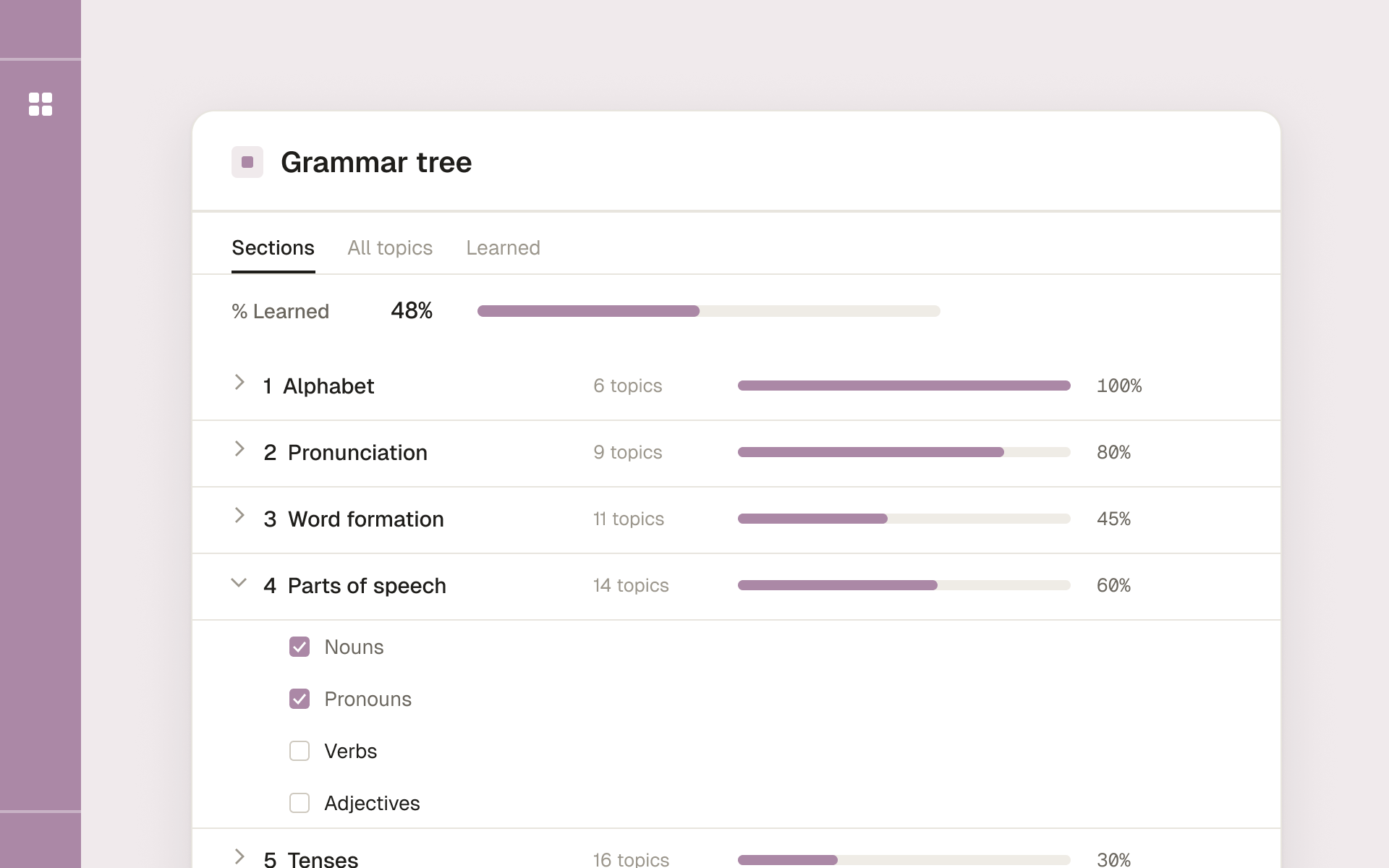
One grammar framework for any language, organized into seven sections from alphabet to punctuation.