Last updated: 13 October 2026 · By Zoya K
French pronunciation looks unpredictable from the spelling, but most of it follows a small set of patterns. This guide covers the vowels English doesn't have, the French R, which final letters you say, what the accent marks do to a sound, how words link together, and the rhythm that makes French sound French.
Each sound has an audio clip from a native speaker and a phonetic spelling in brackets, written in the International Phonetic Alphabet (IPA). You don't need to know IPA to use this page; the clips do the work.
How does French pronunciation work?
French pronunciation works through regular spelling patterns, with three habits English speakers need to learn. Many final letters are silent. Words run together through liaison, enchaînement and elision. And syllables are evenly weighted, with a light beat only on the last syllable of each phrase. Start with the vowels English lacks; they matter most.
Standard French has up to 13 oral vowels and up to 4 nasal vowels, depending on the speaker and the region. That's more vowel distinctions than most English speakers are used to hearing, and it's why the vowel section below is the longest.
The good news is the consonants. Most of them are close to English, and the ones that differ (the R, and the way final letters drop) follow clear rules. Once you know when a letter is silent and how words connect, written French becomes much easier to read aloud.
Which French vowels don't exist in English?
The French vowels English doesn't have are the u sound [y] in tu (you), the rounded eu sounds, and the four nasal vowels in un bon vin blanc (a good white wine). The pair that matters most is u versus ou: tu [y] and tout [u] (all) are different words, and English has only the second sound.
U versus ou
Say tout [tu], which is close to the English "too". Keep your lips rounded exactly as they are, and move your tongue forward until it's behind your lower front teeth. That gives you tu [ty]. The lips don't change; only the tongue moves.
Practice it in pairs where the difference changes the word: rue [ʁy] (street) and roue [ʁu] (wheel).

Le versus les, and é
The short, relaxed vowel in le [lə] (the) is different from the closed [e] in les [le] (the, plural). English speakers often turn [e] into "ay" with a glide at the end. French keeps it pure and short: été [ete] (summer) is two clean, equal syllables.
The four nasal vowels
French has four nasal vowels, made by letting air out through the nose and the mouth at once. Lawless French gives the phrase that contains all four: un bon vin blanc. In much of France the vowel in un has merged with the one in vin, so you'll often hear three.
| Sound | Common spellings | Example |
|---|---|---|
| [ɑ̃] | an, am, en, em | vent (wind) |
| [ɛ̃] | in, im, ain, ein, un | vin (wine) |
| [ɔ̃] | on, om | vont (they go) |
| [œ̃] | un, um | un (one, a) |
Hear the first three side by side: vin, vent, vont. The n is not pronounced as a consonant. It only tells you the vowel is nasal. When the n or m is followed by a vowel, the vowel isn't nasal: une (a, feminine) has a plain u followed by a real n.
How do you pronounce the French R and silent final letters?
The French R is made at the back of the mouth, where you say the g in "get", with air rubbing through instead of a full stop. Most final consonants are silent, but not all: Lawless French counts nine that are usually pronounced at the end of a word, and the -er ending of verbs is a common exception.
The French R
Lawless French writes the French R as [ʁ] and describes it as made in the throat, in the same place as the g in "get", without closing the throat completely. Keep the tip of your tongue down behind your lower teeth. It isn't rolled, and it isn't the English r. Practice words: rue, très, frère (brother).
Which final letters do you say?
The classic memory aid is CaReFuL: final c, r, f and l are usually pronounced, the rest usually aren't. Lawless French points out that it's not quite that simple and counts nine consonants that are usually pronounced at the end of a word: b, c, f, g, k, l, m, q and r. The most useful exception for learners: the r of the -er verb ending and of -er and -ier suffixes is silent, so parler (to speak) and premier (first) end in a vowel sound.
Most other final consonants (d, p, s, t, x, z) are silent: grand (big), beaucoup (a lot), petit (small). A final -e without an accent is usually silent too, but it makes the consonant before it heard: petit ends in [i], petite ends in [t].
Cent [sɑ̃] (hundred) is a good test. The t is silent on its own, but it comes back in liaison before a vowel: cent ans [sɑ̃ tɑ̃] (a hundred years).
Gn, ch and ill
A few letter pairs have their own sound. Gn sounds like the ny in "canyon": montagne (mountain). Ch is the sh sound in "shoe": chat (cat). And ill after a vowel or in many words is a y sound: fille (girl). Ville (town) and mille (thousand) are well-known exceptions where ll stays an l.
What do French accent marks do to the sound?
French has five accent marks, and three of them change how a letter sounds. The acute accent (é) gives a closed e, the grave and circumflex (è, ê) give an open e, and the cedilla (ç) turns c into an s sound. The dieresis (ë) splits two vowels. On à and ù the mark only separates two words.
This is the meaning of "French accent" that people usually search for: the little marks over letters. Lawless French says they are essential in French, unlike English, where "naïve" and "naive" are both fine.
| Mark | Found on | Effect on the sound | Example |
|---|---|---|---|
| Acute ´ (accent aigu) | e only | Closed [e], short and pure | été (summer) |
| Grave ` (accent grave) | a, e, u | On e: open [ɛ]. On a and u: no change, it separates words | très (very); où (where) vs ou (or) |
| Circumflex ^ (accent circonflexe) | a, e, i, o, u | On e: open [ɛ]. Often marks an s that disappeared | être (to be); hôpital (hospital) |
| Dieresis ¨ (tréma) | e, i, rarely u | Say the two vowels separately | Noël (Christmas), maïs (corn) |
| Cedilla ¸ (cédille) | c, before a, o, u | Turns the k sound into [s] | ça (that), leçon (lesson) |
Listen to the three e sounds and the others: été, très [tʁɛ], être [ɛtʁ], Noël [nɔɛl], ça [sa].
The circumflex and the 1990 spelling reform
The circumflex often stands where Latin had an s: hôpital and "hospital", forêt and "forest". In 1990 the French spelling council's corrections, endorsed by the Académie française, made the circumflex optional on i and u. It stays where it is useful: in some verb endings and in words it tells apart, such as dû (owed), jeûne (fast), mûr (ripe) and sûr (sure). Both the old and the new spellings remain accepted, so you'll see maîtresse and maitresse in print.
How do liaison, enchaînement and elision link French words?
French links words in three ways. Liaison pronounces a normally silent final consonant before a vowel: les amis [le zami]. Enchaînement carries an already pronounced consonant onto the next word: avec elle. Elision drops a vowel and writes an apostrophe: l'homme. Some liaisons are required, some forbidden and some optional.
Definitions in one line each:
- Liaison: a silent final consonant is pronounced because the next word starts with a vowel or a mute h. Les amis [le zami] (the friends).
- Enchaînement: a final consonant you'd say anyway moves onto the next word. Avec elle [a.vɛ.kɛl] (with her). Lawless French explains the difference: liaison only happens with normally silent consonants.
- Elision: a vowel is dropped and replaced by an apostrophe, in writing as well as speech. Le + homme becomes l'homme [lɔm] (the man). In French, written elisions are required in every register.
In liaison some consonants change sound. Lawless French lists them: s and x become [z] (vous avez, deux enfants), d becomes [t] (quand on), and f becomes [v].

The liaison map
This table brings together Lawless French's lessons on required, forbidden and optional liaisons. If you're unsure, a good default is to make the required ones, avoid the forbidden ones, and skip the optional ones in casual speech.
| Type | Where it happens | Examples |
|---|---|---|
| Required | Article or number + noun or adjective | les amis, un homme, deux enfants |
| Required | Pronoun + verb, pronoun + pronoun | vous avez, nous en avons, ont-ils |
| Required | Short adverbs and prepositions | très utile, chez elle, bien étrange |
| Required | Fixed expressions | c'est-à-dire, plus ou moins, comment allez-vous |
| Forbidden | Before h aspiré, onze and oui | les héros, les onze enfants |
| Forbidden | After et, after a singular noun, after a name | avant et après, un garçon intelligent |
| Forbidden | After inversion, and after comment, combien, toujours | Parlez-vous espagnol ? |
| Optional | After plural nouns, in two-part verbs, after être | des livres utiles, je suis allé, il est ici |
| Optional | After longer adverbs, prepositions and some conjunctions | après être venu, mais enfin |
Lawless French notes that optional liaisons are a matter of register: more of them sounds more formal, fewer sounds more casual. Comment allez-vous keeps its liaison because it's a fixed expression, even though comment normally blocks one.
All of this on one printable page:
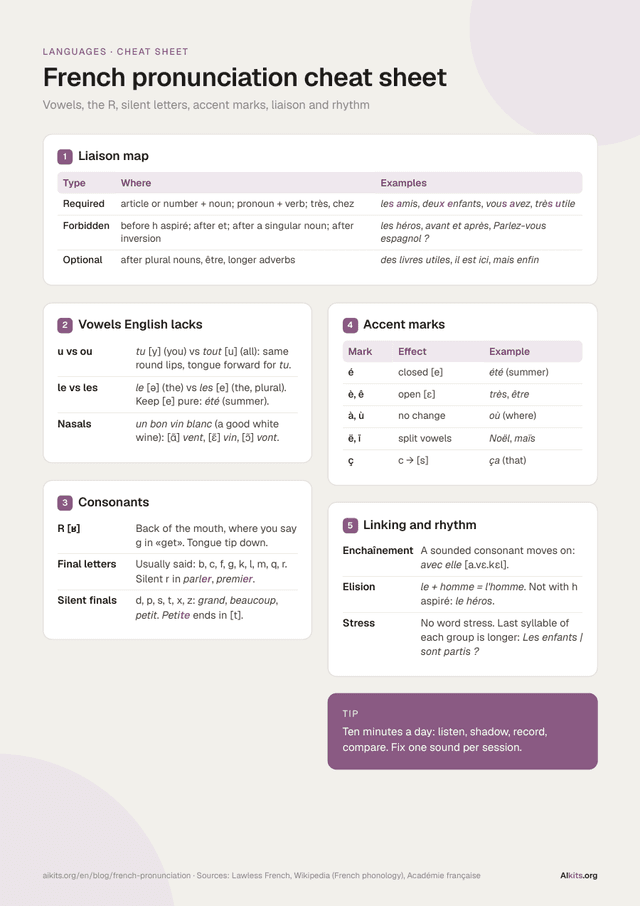
Print it or keep it on your phone. Free, no sign-up.
Download the PDFH muet versus h aspiré
French h is never pronounced, but there are two kinds. A mute h (h muet) acts like a vowel, so it allows elision and liaison: l'homme, les hommes [le zɔm]. An aspirated h (h aspiré) acts like a consonant: Lawless French says it doesn't allow elisions or liaisons. So it's le héros (the hero), and les héros [le eʁo] with no z sound. Many h aspiré words are borrowings, such as le hamburger and le hamster; dictionaries mark them with a symbol such as * or '.
Where does the stress fall in French?
French has no stress on a particular syllable within a word. Instead, words group into short rhythmic groups, and the last syllable of each group is a little longer and stronger. Statements fall in pitch at the end; yes-or-no questions rise. Every syllable keeps its full vowel, so nothing gets swallowed the way unstressed syllables are in English.
Wikipedia's article on French phonology notes that word stress is not distinctive in French: two words can't be told apart by stress alone, and vowels keep their full quality in all syllables. Lawless French describes the result as rhythmic groups of up to about seven syllables, each a unit of meaning, with the final syllable marked by pitch and a slight lengthening.
Try it with a question from that lesson: Les enfants sont partis ? (Have the children left?). Two groups, les enfants and sont partis, and the voice rises on the last syllable. Said as a statement, the same words fall at the end.

How can you reduce your English accent in French?
To reduce an English accent in French, work on six habits: say every vowel fully instead of reducing it to "uh", keep syllables even, use the French R, say p, t and k without a puff of air, separate u from ou, and keep vowels pure, without the English glide.
"French accent" also has a second meaning: how to sound French when speaking English, for acting or for fun. That's a different topic. This section is about the opposite problem, sounding less English when you speak French.
The six habits, with what to do:
- Full vowels. English reduces unstressed vowels ("banana" has one clear a). French doesn't: Canada has three equal a sounds.
- Even syllables. Give each syllable about the same length and keep the beat for the end of the group.
- The French R. Throat, not tongue tip, as described above.
- No puff after p, t, k. In English, "pat" has a small burst of air after the p. French /p, t, k/ are unaspirated. Hold a sheet of paper in front of your mouth: in papa it shouldn't move much.
- U versus ou. Keep tu and tout apart.
- Pure vowels. Les and été end cleanly, with no "ay-ee" glide.
How should you practice French pronunciation every day?
A daily pronunciation routine needs only four steps and about ten minutes: listen to a short clip, repeat it right after the speaker (shadowing), record yourself, and compare the two recordings. Pick one weak sound per session rather than fixing everything at once, and keep a short log of what you worked on.
A simple way to split the ten minutes:
- Listen (2 minutes). One sentence or a few words with your target sound, from a native recording.
- Shadow (3 minutes). Repeat right after the speaker, matching speed and rhythm, not only the sounds.
- Record (2 minutes). Say the same material on your own.
- Compare (3 minutes). Play both and note one difference. That difference is tomorrow's target.
Keep a short sound log: the sound, two or three example words, a mouth cue in your own words ("tongue forward, lips stay round"), and a status (working on it, getting there, solid). Paper, a spreadsheet or a Notion page all work. Dated recordings are the most useful part, because you can hear the change over weeks.
For listening material at the right level, see comprehensible input and language immersion at home. Review hard words with spaced repetition. Pronunciation and grammar meet in liaison, so the French grammar guide is a good companion. If you're preparing for the speaking test of the TCF or TEF for Canada, the same routine fits in: see TCF and TEF Canada preparation.
Its Pronunciation section is a ready place for your sound log, next to the Alphabet section and the grammar you're learning.
FAQ
What is the accent over letters in French?
French uses five marks: the acute (é), grave (è, à, ù), circumflex (â, ê, î, ô, û), dieresis or tréma (ë, ï) and cedilla (ç). Some change the sound, like é and ç; others, like the grave on à, only tell two words apart.
What sound is è in French?
È is the open e [ɛ], roughly the e in English "bet". You hear it in très (very) and mère (mother). É is the closed [e], with the mouth less open: été (summer).
How hard is French pronunciation?
Most of the work is learning how spelling maps to sound: silent final letters, nasal vowels and liaison. The sounds themselves are learnable with practice. For the language overall, the U.S. Foreign Service Institute puts French in Category I, the group closest to English, at 30 weeks of full-time training.
How do you say hi in Paris?
Bonjour [bɔ̃ʒuʁ] is the standard greeting for anyone, including shop staff. Salut [saly] is the informal "hi" for friends.
How do you say «I love you» in French?
Je t'aime [ʒə tɛm]. The te elides to t' before aime, so it's two syllables: "zhuh tem".
How is 100 pronounced in French?
Cent is [sɑ̃], with a nasal vowel and a silent t. The t returns in liaison before a vowel: cent ans [sɑ̃ tɑ̃] (a hundred years).
How do I say «I'm sorry, I don't speak French»?
Désolé, je ne parle pas français (a woman writes désolée; both sound the same) listen.
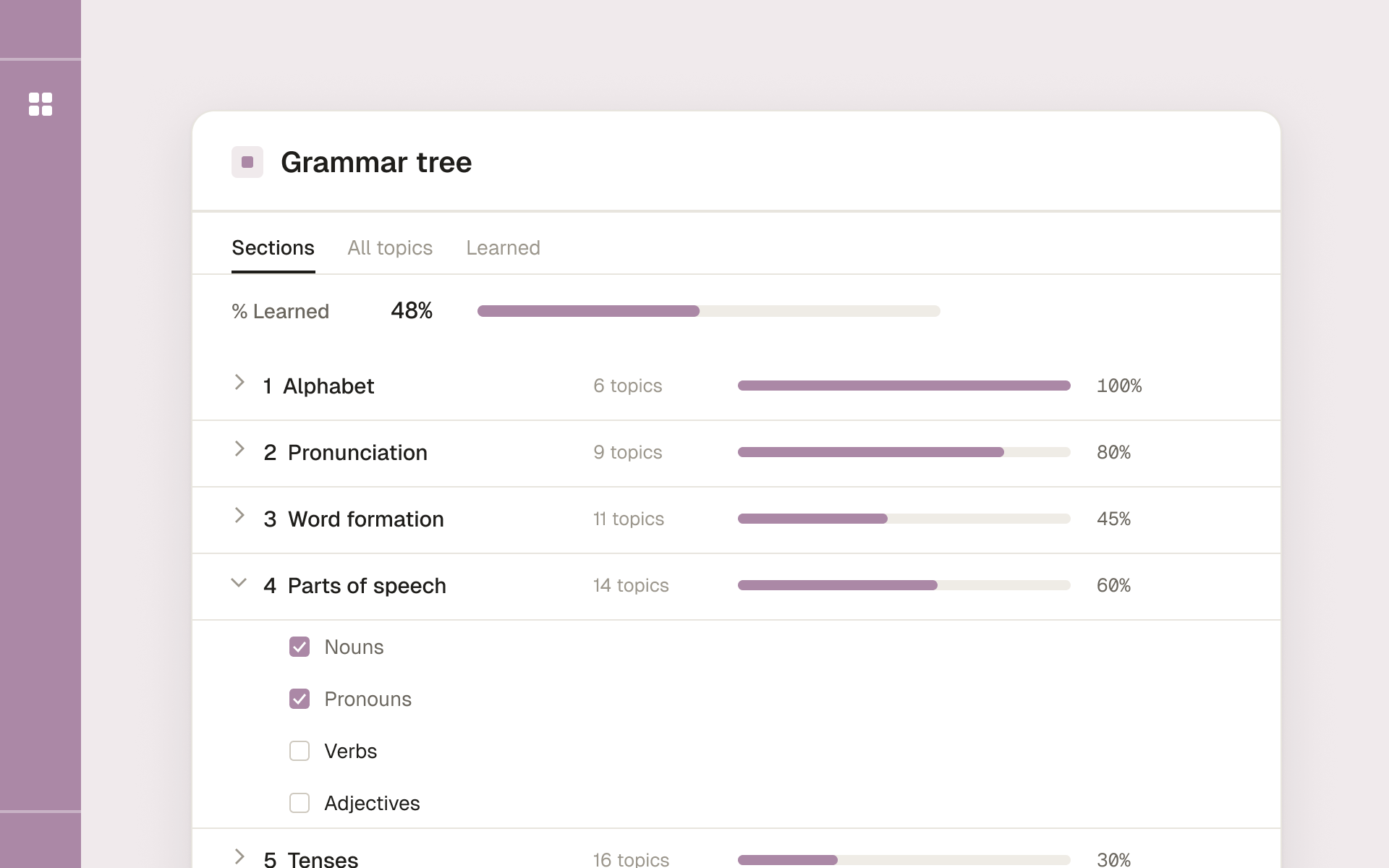
One grammar framework for any language, organized into seven sections from alphabet to punctuation.