Last updated: 13 October 2026 · By Zoya K
French grammar has a reputation for endless rules, but most beginner sentences rest on six of them. This guide explains those six with examples, shows the mistakes English speakers make most often, and gives an order for learning the rest so each topic builds on the one before.
Every French example has an English translation in parentheses. I learned French as an adult, so the order below is written for adult self-learners, not for school classes.
What are the basics of French grammar?
French grammar rests on six basics. Every noun is masculine or feminine. Articles and adjectives agree with the noun. Verbs change their ending for each person. The order is subject–verb–object, but object pronouns go before the verb. Negation wraps around the verb (ne … pas). And tu and vous mark how familiar you are with someone.
Here is what each of those looks like in one sentence:
- Gender and agreement: la petite table (the small table) but le petit bureau (the small desk). Table is feminine and bureau is masculine, and the article and adjective follow the noun's gender.
- Verb endings: je parle, tu parles, nous parlons (I speak, you speak, we speak).
- Word order: Je vois Marie (I see Marie) becomes Je la vois (I see her). The pronoun moves in front of the verb.
- Negation: Je ne la vois pas (I don't see her).
- Tu and vous: tu for one person you know well, vous for someone you don't, and for any group.
The rest of French grammar mostly builds on these. Once they feel automatic, new tenses and pronouns slot into a structure you already have.

Is French grammar similar to English?
French grammar is partly similar to English. Both languages put the subject before the verb and the object after it, and they share a large stock of Latin-based words. French adds things English lacks: grammatical gender, agreement, a full set of verb endings, object pronouns placed before the verb, and most adjectives after the noun.
The linguistics database WALS lists French as SVO (subject–verb–object), the same as English. That shared core is why simple sentences feel familiar: Marie mange une pomme (Marie is eating an apple) lines up word for word.
The differences start around the core. Nouns carry gender, and the words around them change to match. Verbs have different endings for each person, where English mostly adds an -s. Pronoun objects jump in front of the verb. And while English puts adjectives before nouns, French usually puts them after: un livre vert (a green book).
Nouns, gender and articles in French
Every French noun is either masculine or feminine, and the article in front of it shows which. French has three kinds of article: definite (the), indefinite (a, some) and partitive (some, for amounts you don't count). Each has a masculine, a feminine and a plural form, plus a short form before a vowel.
Gender is grammatical, not biological. Lawless French points out that there is no obvious reason for a desk to be masculine and a table to be feminine. You learn it with the word.
| Article | Masculine | Feminine | Before a vowel or mute h | Plural |
|---|---|---|---|---|
| Definite (the) | le livre | la table | l'ami, l'homme | les livres |
| Indefinite (a, some) | un livre | une table | un ami, une amie (no change) | des livres |
| Partitive (some, any) | du pain | de la soupe | de l'eau | des épinards |
The partitive is the one English speakers don't expect. It refers to an unspecified quantity of something you can't count: J'ai mangé du pain hier (I ate bread yesterday). English often drops the article there; French can't. After a negative, all three partitive forms become de: Je n'ai pas mangé de pain (I didn't eat any bread).
Contractions: au, aux, du, des
The prepositions à and de merge with le and les. Lawless French lists them: à + le = au, à + les = aux, de + le = du, de + les = des. They don't merge with la or l'. So it's Je vais au cinéma (I'm going to the cinema) but Je vais à la plage (I'm going to the beach).
Learn every noun with its article
The most reliable way to know a noun's gender is to memorize it with the article: not livre but un livre, not idée but une idée. This is Lawless French's main advice on gender. Some endings lean masculine or feminine, but every pattern has exceptions, so the article is the safer habit.
How do French adjectives agree and where do they go?
French adjectives match the noun in gender and number, and most of them come after it. For regular adjectives you add -e for feminine and -s for plural: vert, verte, verts, vertes. A short group of very common adjectives goes before the noun. The memory aid for them is BAGS.
The agreement rules from Lawless French cover most cases. The masculine singular is the base form. If it already ends in -s or -x, the masculine plural looks the same (un homme heureux, des hommes heureux). If it ends in -e, masculine and feminine are the same (un livre rouge, une table rouge). Irregular adjectives such as beau and vieux have their own forms.
Position is the second half. Descriptive adjectives such as colors and shapes usually follow the noun: le livre vert (the green book). The BAGS group comes before:
- Beauty: une belle maison (a beautiful house), un joli appartement (a nice apartment)
- Age: un jeune homme (a young man), une vieille dame (an old woman)
- Good and bad: une bonne idée (a good idea), un mauvais restaurant (a bad restaurant)
- Size: un grand livre (a big book), une petite maison (a small house)

What are the three French verb groups and which tenses come first?
French sorts verbs into three groups. The first group is regular -er verbs like parler (to speak), several thousand of them. The second is regular -ir verbs like finir (to finish). The third holds everything else, including the most common irregular verbs. Learn the present tense first, then the passé composé, the imparfait and the futur proche.
Lawless French calls -er verbs the largest category of regular verbs, with several thousand members. The second group has several hundred verbs. Many verbs that also end in -ir, such as partir and courir, are irregular and belong to the third group with être, avoir, aller, faire and the other high-frequency verbs.
| Group | Infinitive ending | Example (je / nous) | Note |
|---|---|---|---|
| 1st | -er | parler: je parle / nous parlons | Several thousand verbs; the pattern new verbs follow |
| 2nd | -ir (with -issons) | finir: je finis / nous finissons | Several hundred verbs |
| 3rd | -ir, -re, -oir and irregular | aller: je vais / nous allons | Few verbs, but the most common ones |
For full conjugation tables of all the main tenses, see French verb conjugation.
Avoir or être in the passé composé
The passé composé is the main past tense, and Lawless French calls it the most important one. It has two parts: an auxiliary verb and a past participle (j'ai mangé, I ate). According to Lawless French, avoir is the auxiliary for the vast majority of verbs. Être is used with all pronominal verbs (je me suis assis, I sat down) and with a short list of intransitive verbs of movement such as aller, arriver, partir, monter and naître. So it's je suis allé (I went), never j'ai allé.
The conditional for polite requests: je voudrais
Je voudrais (I would like) is the conditional of vouloir, and it's the standard polite way to ask for something: Nous voudrions commander maintenant (We'd like to order now). One trap from Lawless French: "if you would like" is si vous voulez, not si vous voudriez, because the conditional isn't used after si in that kind of sentence.
The subjunctive, briefly
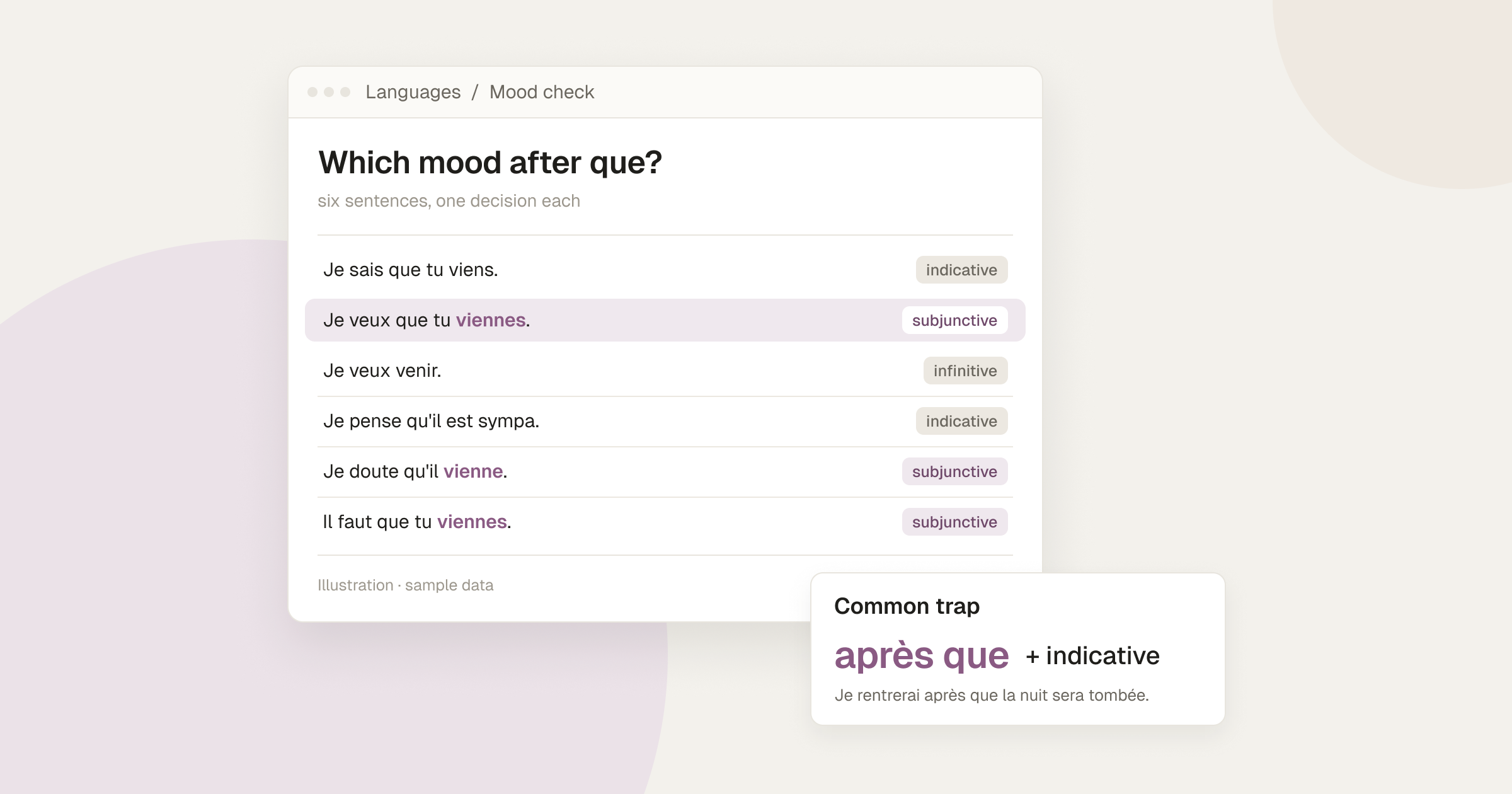
The subjunctive is a verb mood used after expressions of necessity, wishes, feelings and doubt, most often after que: Il faut que tu viennes (You have to come). It's a later topic for most learners. When and how to use it is covered in the French subjunctive.
Where do pronouns go in a French sentence?
French object pronouns go in front of the conjugated verb, not after it as in English. Je vois Marie (I see Marie) becomes Je la vois (I see her). When two pronouns meet, they follow a fixed order. The one exception is a positive command, where the pronouns follow the verb with hyphens: Montre-le-moi (Show it to me).
Subject pronouns come first: je, tu, il, elle, on, nous, vous, ils, elles. Use tu with one person you know well, and vous with someone you don't know or with any group of people. On means "one" or "people", and in everyday speech often "we".
Object, reflexive and adverbial pronouns (y and en) precede the verb in every tense and mood except the positive imperative. When there are two, they line up like this: me, te, se, nous, vous → le, la, les → lui, leur → y → en. Examples from Lawless French: Il me les montre (He's showing them to me), Je le lui ai donné (I gave it to him), Il y en aura beaucoup (There will be a lot of them). Two pronouns is the limit.

How do negation and questions work in French?
French negation puts ne before the verb and pas after it: Je ne parle pas espagnol (I don't speak Spanish). Pronouns stay inside the pair. For questions you have three options: keep the statement and raise your voice at the end, put est-ce que in front, or invert the subject and the verb.
With a pronoun, the order is ne + pronoun + verb + pas: Je ne le vois pas (I don't see him). In the passé composé, pas goes after the auxiliary: Je n'ai pas fini (I haven't finished). Before a vowel, ne becomes n'.
For questions, Lawless French calls est-ce que the most common way. You put it in front of a statement without changing anything else: Est-ce que vous aimez voyager ? (Do you like traveling?). Inversion is more common in formal situations: Aimez-vous voyager ? In everyday speech you'll also hear a plain statement with rising intonation: Vous aimez voyager ?
In what order should you learn French grammar?
Learn French grammar in the order that the rules depend on each other. Start with gender, articles and the present tense, because every later topic uses them. Then the past and future, then pronouns and connectors, then moods. The CEFR levels (A1 to C2) describe what you can do, not which tense belongs to which level.
The CEFR global scale describes ability, for example A1 as someone who "can understand and use familiar everyday expressions and very basic phrases". The detailed lists of French forms per level are in the Council of Europe's Reference Level Descriptions for French, a book series published by Didier (Niveau A1 pour le français and its companions). The sequence below is our own and is not an official level assignment. Each stage uses what the previous one built.
| Stage | Topics | Why at this point | What you can do after it |
|---|---|---|---|
| 1. Foundations | Gender and articles; subject pronouns, tu and vous; être and avoir; present of -er verbs; adjective agreement; ne … pas; est-ce que questions | Every later topic uses these | Describe yourself and others, ask simple questions |
| 2. Past and future | Passé composé with avoir and être; imparfait; futur proche (aller + infinitive); present of aller, faire, pouvoir, vouloir | The passé composé is built from avoir or être plus a participle | Say what happened and what you're going to do |
| 3. Pronouns and connectors | Direct and indirect object pronouns; y and en; qui, que, où, dont; à and de with places; comparatives | Pronouns sit right next to the verb, so verb forms need to be steady first | Avoid repeating nouns, join ideas into longer sentences |
| 4. Moods and nuance | Conditional and si clauses; subjunctive after il faut que; futur simple; plus-que-parfait | Built on all the tenses before | Give opinions, talk about what would or could happen |
Two notes on using it. Je voudrais is worth learning as a fixed phrase in stage 1, long before the conditional itself. And the stages overlap: you'll keep meeting stage 3 pronouns in stage 2 input, which is fine. The order is about what you practice on purpose, not what you're allowed to hear.
All of this on one printable page:
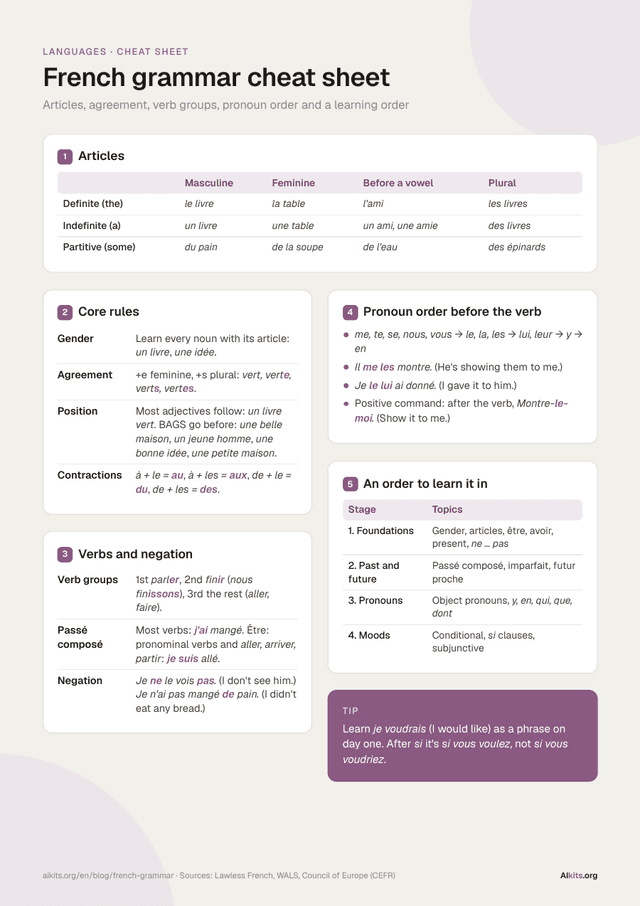
Print it or keep it on your phone. Free, no sign-up.
Download the PDFWhat grammar mistakes do English speakers make in French?
English speakers make the same handful of French grammar mistakes, because they carry English habits across: the wrong auxiliary in the past tense, être for age, pronouns after the verb, adjectives before the noun, a forgotten gender and the conditional after si. Each one has a short fix, shown below.
| ✗ Wrong | ✓ Right | Why |
|---|---|---|
| J'ai allé au cinéma. | Je suis allé(e) au cinéma. (I went to the cinema.) | Aller is one of the verbs that take être |
| Je suis vingt ans. | J'ai vingt ans. (I'm twenty.) | French gives age with avoir: "I have twenty years" |
| Je ne vois le pas. | Je ne le vois pas. (I don't see him.) | The pronoun goes before the verb, inside ne … pas |
| un vert livre | un livre vert (a green book) | Colors follow the noun; only BAGS adjectives come first |
| une bureau | un bureau (a desk) | Gender is learned with the noun, not guessed from meaning |
| Si vous voudriez venir… | Si vous voulez venir… (If you'd like to come…) | No conditional after si in this kind of sentence |
How should you study French grammar?
Study French grammar in small loops. Meet a rule in something you read or hear, look it up, then write two or three sentences of your own with it on different days. Check them against a reference or with a tutor, and keep a list of your mistakes. A rule counts as learned once you can produce it.
Input comes first because it gives grammar a context. If you haven't settled on a routine for that, comprehensible input explains how to pick material at your level, and language immersion at home covers building it into a normal day.
For the writing step, use your own life: what you did yesterday (passé composé), what you used to do as a child (imparfait), what you'd do with a free week (conditional).
For the mistake list, one row per error works well: the wrong sentence, the correction, the rule it broke and how many times you've got it right since. Paper, a spreadsheet or a Notion database all do the job. Review it with spaced repetition, and keep new words with their articles in a vocabulary notebook.
If you're preparing for an exam such as the TCF or TEF for Canada, the same loop fits inside a dated plan: see TCF and TEF Canada preparation and how to build an exam study plan. And grammar is only half of sounding right: French pronunciation covers liaison, silent letters and the sounds English doesn't have.
FAQ
Is French grammar similar to English?
Partly. Both are subject–verb–object languages (WALS lists French as SVO), so simple sentences line up. French adds gender, agreement, a full set of verb endings, object pronouns before the verb and most adjectives after the noun.
What is A1, A2, B1, B2, C1, C2 in French?
They are the six levels of the Council of Europe's CEFR, grouped into basic (A), independent (B) and proficient (C) users. At A1 you can understand and use familiar everyday expressions and very basic phrases. The levels describe what you can do, not a list of grammar topics.
Do the French actually say «je voudrais»?
Yes. Je voudrais (I would like) is the normal polite way to ask for something in a shop, café or office. It is the conditional of vouloir; je veux (I want) sounds blunt in the same situation.
What is the 80/20 rule for learning French?
It's an informal heuristic, not an official rule: put most of your effort into the most frequent words and structures first. For grammar, that means the six basics and the present tense before rarer tenses such as the passé simple.
What is the French «5 to 7 rule»?
It isn't a grammar rule. Cinq à sept (five to seven) is an expression for the early-evening hours after work. In France it has long been a euphemism for a discreet affair; in Quebec it means an after-work social gathering, much like happy hour.
How long does it take to learn French grammar?
There's no official figure for grammar alone. For the language as a whole, the U.S. Foreign Service Institute puts French in Category I, the languages closest to English, with 30 weeks of full-time training. Our guide to how long it takes to learn a language explains what those numbers mean for self-learners.