Last updated: 13 October 2026 · By Zoya K
Most of the Spanish you'll say in your first year rests on a small set of rules. This guide covers them one at a time: gender and agreement, how verbs show the person, ser and estar, where pronouns go, negation and questions. Each rule comes with an example, an English translation and, where it helps, the slip English speakers tend to make. The second half maps every later topic to its level, from A1 to C2.
The rules and levels come from two references: the Real Academia Española's Diccionario panhispánico de dudas (DPD) and the Instituto Cervantes Plan curricular (PCIC), the official inventory of what Spanish learners study at each CEFR level. Verb forms and the subjunctive have their own guides, linked where they come up.
What are the basic rules of Spanish grammar?
Every Spanish noun is masculine or feminine, and the articles and adjectives around it agree with it. Verbs change their ending to show who is acting, so the subject pronoun is usually left out. Object pronouns go before the conjugated verb, "no" goes before the verb, and written questions open with ¿. Those rules carry most beginner sentences.
Here they are with an example each. The level is where the Plan curricular first lists the rule.
| Rule | Example | Translation | Level |
|---|---|---|---|
| Nouns are masculine or feminine | el amigo / la amiga | the (male) friend / the (female) friend | A1 |
| Articles and adjectives agree with the noun | un chico guapo / unas chicas guapas | a good-looking boy / some good-looking girls | A1 |
| Adjectives usually follow the noun | un chico guapo | a good-looking boy | A1 |
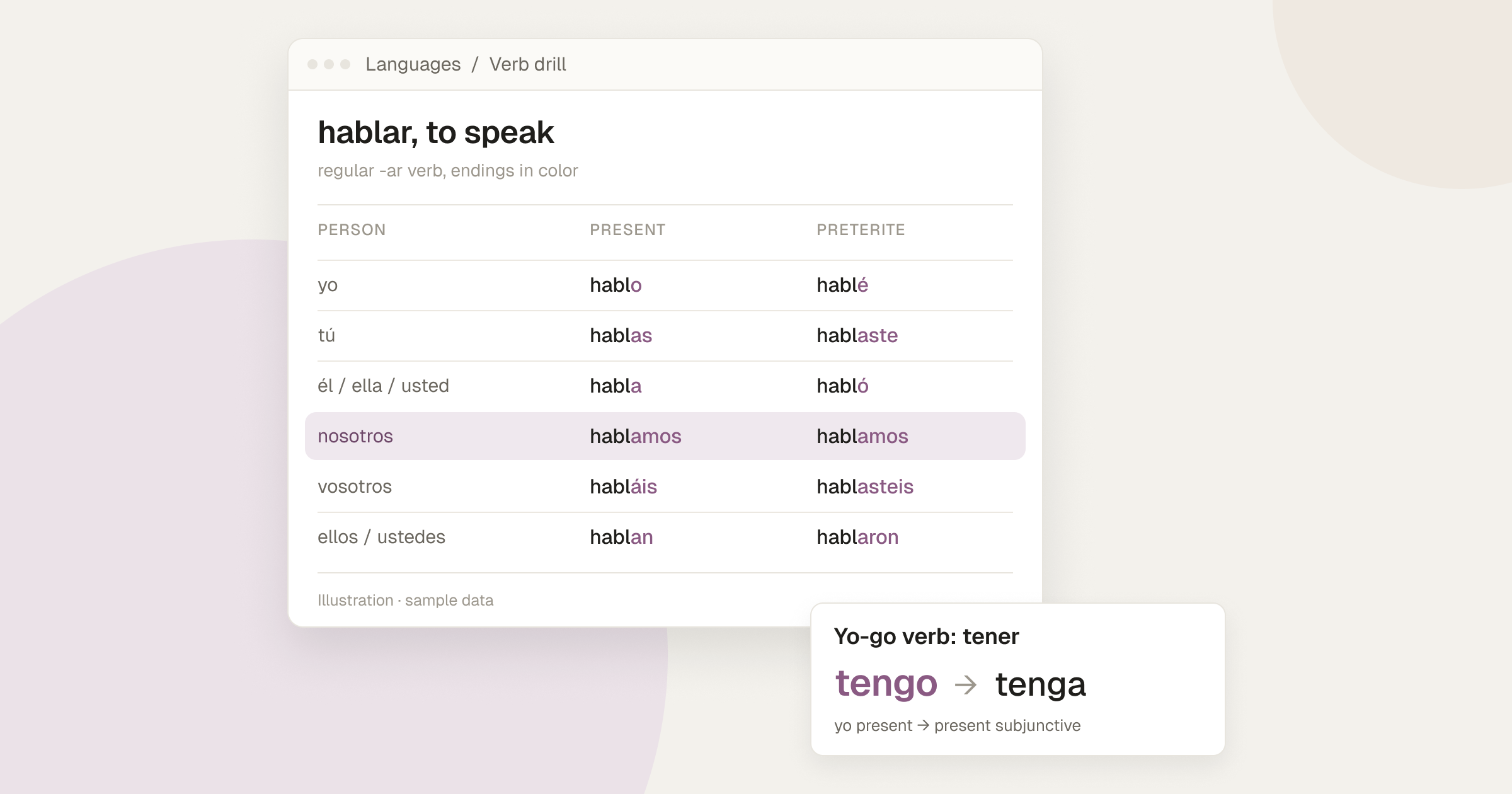
| The verb ending shows the person | hablo, hablas, habla | I speak, you speak, he/she speaks | A1 |
| The subject pronoun is usually dropped | Soy español. | I'm Spanish. | A2 |
| "No" goes before the verb | No soy español. | I'm not Spanish. | A1 |
| Yes/no questions can keep statement order | ¿Te llamas Ana? | Is your name Ana? | A1 |
| Object pronouns go before a conjugated verb | Te lo doy. | I'm giving it to you. | A2 |
Sources: PCIC A1–A2 grammar inventory (sections 1.2, 2.4, 7.1, 13.3); DLE, entry hablar.
How is Spanish grammar different from English?
The biggest differences are grammatical gender, adjectives after the noun, verb endings that make the subject pronoun optional, two verbs for "to be", object pronouns placed before the verb, double negatives that are correct, opening question and exclamation marks, and a separate verb mood, the subjunctive. Word order is also freer than in English.
| Spanish | English | Example |
|---|---|---|
| Every noun has a gender | Only people and some animals do | la mesa (the table, feminine) |
| Adjective usually after the noun | Adjective before the noun | un chico guapo (a good-looking boy) |
| Subject pronoun usually dropped | Subject required | Hablo español. (I speak Spanish.) |
| Two verbs for "to be": ser and estar | One verb | Luis es sincero. / Está contento. (Luis is sincere. / He's happy.) |
| Object pronoun before the conjugated verb | Object after the verb | Te lo advierto. (I'm warning you about it.) |
| Double negatives are correct | Double negatives are nonstandard | No me gusta nada. (I don't like it at all.) |
| Questions and exclamations open with ¿ and ¡ | Only the closing mark | ¿Cuándo vienes? (When are you coming?) |
| Subject can follow the verb | Subject almost always first | Esta mañana ha llegado una carta. (A letter came this morning.) |
| A separate mood for wishes, doubt and the not-yet-real | Mostly gone (a few forms like "if I were") | Quiero que vengas. (I want you to come.) |
The last row has its own guide: the Spanish subjunctive.
How does gender work for Spanish nouns?
Most nouns ending in -o are masculine and most ending in -a are feminine, but common exceptions break the pattern: el problema, el día, la mano. Nouns ending in -e or a consonant can be either (el árbol, la solución). Feminine nouns that start with a stressed a- take the article el but stay feminine: el agua, esta agua.
The Plan curricular lists the basic pattern at A1, "masculino en o y femenino en a", with amigo / amiga as the model. It adds the exceptions at A2: el problema and el tema, el día, la mano. Shortened words keep the gender of the full word, so la foto (from la fotografía) and la moto (from la motocicleta) are feminine. Some pairs are different words altogether: el padre / la madre.
For nouns that end in -e or a consonant, the ending doesn't tell you much. The PCIC's A1 examples are el peine (the comb), la muerte (death), el árbol (the tree), la catedral (the cathedral), la solución (the solution) and el corazón (the heart). Learn these with their article as one unit: "la solución", never just "solución".
Which endings tell you a noun is feminine?
Nouns for things that end in -dad, -ción, -sión, -tud, -umbre, -ez and -triz are feminine. The PCIC lists this at B2 with la ciudad (the city), la sensación (the feeling), la ocasión (the occasion), la actitud (the attitude), la costumbre (the custom), la vejez (old age) and la cicatriz (the scar).
The el agua rule
The RAE's DPD entry for el says the feminine article "toma obligatoriamente la forma el" before feminine nouns starting with stressed /a/: el águila (the eagle), el aula (the classroom), el hacha (the axe). The noun is still feminine, so everything else stays feminine: the DPD says "debe decirse esta agua, y no ⊗este agua", and "mucha hambre", not "mucho hambre". In the plural the ordinary article comes back: las aguas.

How do you make Spanish nouns plural?
Add -s after a vowel and -es after a consonant: mesa / mesas (table / tables), libro / libros (book / books), árbol / árboles (tree / trees), pared / paredes (wall / walls). The article changes too: el → los, la → las. Nouns of more than one syllable that end in an unstressed -s don't change: el lunes / los lunes (Monday / Mondays). The PCIC lists these patterns at A1 and A2.
How do adjectives agree in Spanish?
An adjective takes the gender and number of the noun it describes, and it usually comes after that noun: un chico guapo (a good-looking boy), una chica guapa, unos chicos guapos, unas chicas guapas. Adjectives that end in -e or a consonant change only for number: una casa grande, unas casas grandes (a big house, big houses).
The articles follow the same logic. The definite article has four forms, el, la, los and las, and two contractions every learner meets in week one: a + el = al and de + el = del (Voy al cine, "I'm going to the cinema"; la casa del vecino, "the neighbor's house"). The PCIC puts both at A1.
English speakers' typical slip is to stop agreeing after the first word: ⊗las chicas guapo. Read the noun phrase as a chain. The noun decides, and every article and adjective attached to it copies the ending.

How do Spanish verbs work?
A Spanish verb changes its ending for person and tense: hablo (I speak), hablas (you speak), habló (he/she spoke). Since the ending shows who acts, the pronoun is usually dropped. Spanish also has two verbs for "to be", ser and estar, and two main moods: the indicative for facts and the subjunctive for wishes, doubt and what hasn't happened yet.
The three verb groups end in -ar, -er and -ir (hablar, comer, vivir), and each group has its own set of endings. The PCIC starts at A1 with the present tense of regular verbs plus four irregular ones: ser, estar, haber and ir. The full endings chart, the irregular patterns and every tense are in our Spanish verb conjugation guide.
The subject pronoun (yo, tú, él…) appears mainly when you need it to avoid ambiguity or to contrast people. The PCIC's wording is "presencia para resolver una posible ambigüedad". Saying "Yo hablo español" all the time isn't wrong, but it sounds emphatic, like "I speak Spanish".
Ser or estar?
Both mean "to be". Ser describes what something is: identity, origin, profession, possession, time and price (Es mi libro, "It's my book"; Mario es cocinero, "Mario is a cook"). Estar gives location and states (Estoy en casa, "I'm at home"). Some adjectives work with only one of them: the PCIC's A2 examples are Luis es sincero ("Luis is sincere") and Está contento ("He's happy").
"Permanent vs temporary" is a common rule of thumb, and it often points the right way. It breaks with location, though: a city is always where it is and still takes estar. Treat it as a hint, not the rule.
What is the subjunctive?
The subjunctive is a second set of verb forms. Spanish uses it after wishes, requests, reactions and doubt, and for things that haven't happened yet: Quiero que vengas ("I want you to come"), Cuando llegues, llámame ("When you arrive, call me"). The PCIC introduces it at B1. Our Spanish subjunctive guide covers when to use it and how to form it.
Where do object pronouns go in Spanish?
Object pronouns such as me, te, lo, la, le and se go before a conjugated verb: Te lo advierto ("I'm warning you about it"). They attach to affirmative commands, infinitives and gerunds: Hazlo ("Do it"), al mirarlo ("when looking at it"). With a verb plus infinitive, both work: Debo hacerlo or Lo debo hacer.
All four examples come from the DPD entry on unstressed personal pronouns, pronombres personales átonos (Debo hacerlo means "I have to do it"). The indirect object comes first when two pronouns meet: Te lo doy ("I'm giving it to you").

Why do you say "se lo" and not "le lo"?
When le or les comes right before lo, la, los or las, it turns into se. The DPD entry for se gives the example "Les compré caramelos > Se los compré" ("I bought them sweets" → "I bought them for them"). The PCIC's A2 example is Se lo doy a Luis ("I'm giving it to Luis"). Spanish often keeps both the pronoun and the noun in a sentence like this.
What is the personal a?
When the direct object is a specific person, Spanish puts a in front of it. The DPD's examples are Vi a Pedro ("I saw Pedro") and Está esperando a unos amigos ("He's waiting for some friends"). Things don't take it: No tengo teléfono ("I don't have a phone"). The PCIC lists the personal a at A2 (Hoy he visto a Almudena en el cine, "I saw Almudena at the cinema today"). English has no equivalent, so learners tend to leave it out.
Is Spanish word order fixed?
The basic order is subject–verb–object, as in English, but Spanish moves the subject after the verb more freely, especially when the subject is the new information: Esta mañana ha llegado una carta ("A letter came this morning"). The PCIC lists this at B1. Questions with a question word put the verb right after it: ¿Cuándo vienes?
How do negation, questions and punctuation work in Spanish?
Put no before the verb: No soy español ("I'm not Spanish"). Negative words such as nunca and nada can stack with no: No he estado nunca en Ecuador ("I've never been to Ecuador"). Yes/no questions can keep statement order and rely on intonation (¿Te llamas Ana?). In writing, every question and exclamation opens with ¿ or ¡.
The double negative is standard Spanish, not slang. The PCIC gives both orders at A2: Nunca he estado en Ecuador and No he estado nunca en Ecuador, and No me gusta nada ("I don't like it at all"). If the negative word comes before the verb, no drops out.
The RAE is explicit about the opening marks. Its DPD entry on question and exclamation marks says they "son característicos del español y no deben suprimirse": they are part of the language and must not be left out. Skipping them is common in quick chat messages, but in anything you write for school, work or an exam they belong there.
In what order should you learn Spanish grammar?
The Instituto Cervantes curriculum puts gender, articles, agreement and the present tense (with ser, estar, haber and ir) at A1. A2 adds the past tenses, commands, the personal a and pronoun pairs. B1 brings the future, the conditional and the present subjunctive, and B2 the imperfect subjunctive. A few forms, such as the pretérito anterior, appear only at C2.
The table below is a map, not a schedule. Each row shows when a topic first appears in the Plan curricular, with one example. If you want a week-by-week plan built on the same order, our guide to the best way to learn Spanish as an adult has a 12-week version for A1–A2.
| Level | Nouns, articles, adjectives | Verbs | Pronouns and sentences | Example |
|---|---|---|---|---|
| A1 | -o/-a gender, plurals, el/la/los/las, al/del, adjective after noun | Present tense; ser, estar, haber, ir | Subject pronouns, no + verb, yes/no and question-word questions | No soy español. (I'm not Spanish.) |
| A2 | Gender exceptions (el problema, el día, la mano) | Preterite (pretérito indefinido), imperfect, present perfect, commands (di, haz, pon, sal), stem-changing presents | Pronoun pairs (se lo), personal a, double negatives, ser vs estar with adjectives | Se lo doy a Luis. (I'm giving it to Luis.) |
| B1 | — | Future, conditional, pluperfect; present subjunctive | Subject after the verb for new information | Quiero que vengas. (I want you to come.) |
| B2 | Feminine endings (-dad, -ción, -tud…); el agua / esta agua | Future perfect, conditional perfect; imperfect and pluperfect subjunctive | Subjunctive in relative and time clauses (hasta que, aunque) | Si hubiera podido, habría ido. (If I'd been able to, I'd have gone.) |
| C1–C2 | — | Pretérito anterior; future subjunctive (C2, legal and fixed phrases) | — | Sea como fuere. (Be that as it may.) |
Source: Instituto Cervantes, Plan curricular, grammar inventories A1–A2, B1–B2 and C1–C2.
Two practical points come out of the map. First, the present tense and agreement carry you through A1 on their own. You don't need the past tenses to have real conversations about your life now. Second, the subjunctive is a B1 topic. Meeting it early is fine, but drilling it before the present and past tenses feel automatic usually means drilling it twice.
All of this on one printable page:
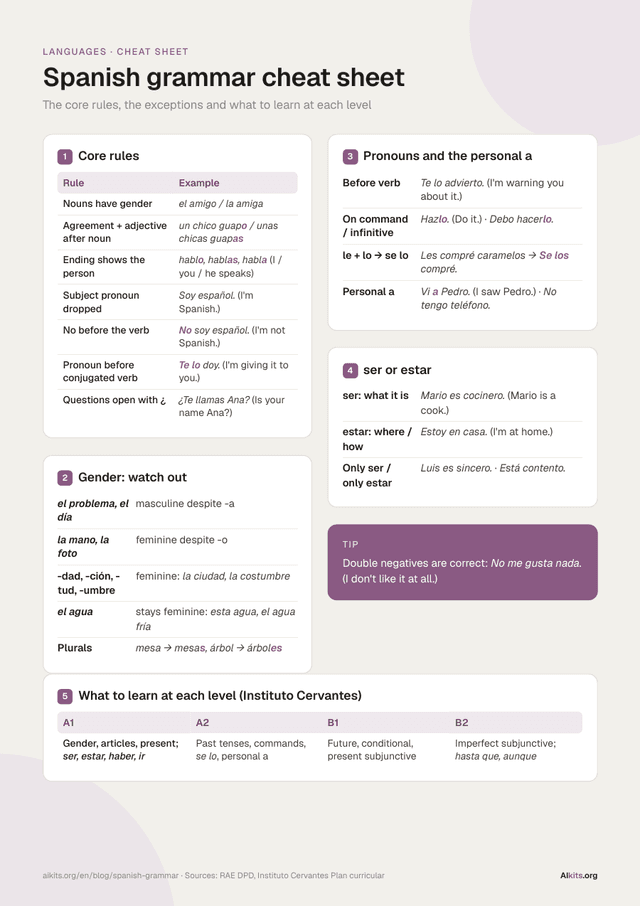
Print it or keep it on your phone. Free, no sign-up.
Download the PDFWhat do A1, A2, B1, B2, C1 and C2 mean?
They are the six levels of the Council of Europe's Common European Framework of Reference (CEFR). A1 and A2 are "Basic user", B1 and B2 "Independent user", C1 and C2 "Proficient user". At A1 you can "understand and use familiar everyday expressions and very basic phrases". At B2 you can talk with native speakers with "a degree of fluency and spontaneity". For time estimates, see how long it takes to learn a language.
How do you keep track of the grammar you've learned?
Keep one row per rule: the rule in your own words, one example you wrote yourself, the mistake you tend to make, and the level. Paper, a spreadsheet or a Notion page all work. A rule counts as learned when you can produce your own example from memory, not when you recognize it on the page.
A few habits make the list useful:
- Collect rules from what you read and hear. A rule you noticed in a podcast sticks better than one from a list. Our guide to comprehensible input explains why input at the right level matters.
- Write the mistake down. "⊗este agua → esta agua" is more useful than the rule restated.
- Review on a schedule. Turn each row into a prompt and space the reviews; spaced repetition: Anki vs Notion compares the two setups. Words with their gender go in a vocabulary notebook.
- Speak with the rule. Apps rarely make you produce full sentences; our Duolingo alternatives list covers options that do.
Its sections (Alphabet, Pronunciation, Word formation, Parts of speech, Tenses, Sentence, Punctuation) match the areas on this page, so each Spanish rule has an obvious place, and it works on the Notion free plan.
I learned English and French as an adult, and the same structure works for any language. If French is next, our French grammar guide uses the same layout.
FAQ
What are the key differences between Spanish and English grammar?
Spanish nouns have gender, adjectives usually follow the noun, verb endings make the subject pronoun optional, there are two verbs for "to be", object pronouns go before the verb, double negatives are correct, questions open with ¿, and Spanish has a full subjunctive mood.
What is A1, A2, B1, B2, C1, C2 in Spanish?
They are the six CEFR levels set by the Council of Europe: A1–A2 "Basic user", B1–B2 "Independent user", C1–C2 "Proficient user". The Instituto Cervantes Plan curricular lists what Spanish grammar belongs to each level.
What are some common word endings in Spanish, and what gender do they signal?
-o usually means masculine and -a feminine, with exceptions such as el problema, el día and la mano. Nouns for things ending in -dad, -ción, -sión, -tud, -umbre, -ez and -triz are feminine: la ciudad, la sensación, la costumbre.
Why is it "el agua" if agua is feminine?
Feminine nouns that start with a stressed a- take el in the singular. The noun stays feminine, so it's el agua fría and esta agua, and las aguas in the plural (RAE, DPD).
Do I need to use yo, tú and other subject pronouns?
Usually not. The verb ending already shows the person, so Hablo español is the normal way to say "I speak Spanish". Use the pronoun to avoid ambiguity or to contrast people.
What are the "super 7" words or verbs in Spanish?
There is no official "super 7" list. If you want a starting set, the Instituto Cervantes curriculum begins with the present tense of regular verbs plus ser, estar, haber and ir at A1.
How can I learn Spanish grammar online?
Pick one structured source (a course or a reference grammar), follow a level order like the one above, and practice each rule by writing and saying your own sentences. Our guide to the best way to learn Spanish as an adult has a 12-week plan.
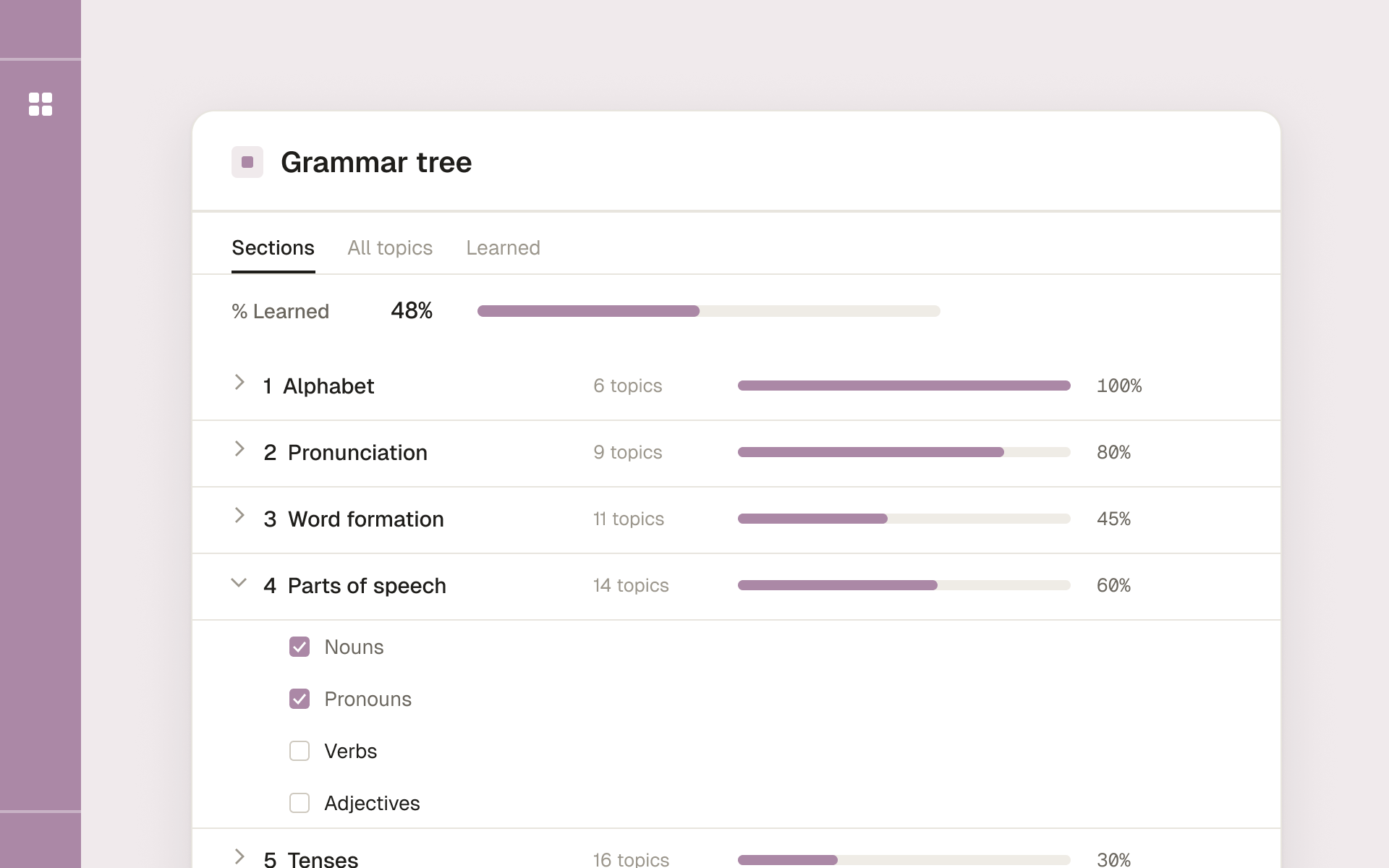
One grammar framework for any language, organized into seven sections from alphabet to punctuation.