Last updated: 13 October 2026 · By Zoya K
The subjunctive is where many learners stall: sentences such as Quiero que vengas ("I want you to come") use a verb form that English barely has. This guide explains when Spanish uses it, in six groups, and shows the pairs where switching mood changes the meaning. It also covers the few cases where the subjunctive is wrong, and how to form every subjunctive tense.
The uses and levels come from the Instituto Cervantes Plan curricular (PCIC), the official inventory of what Spanish learners study at each CEFR level. The forms are checked against the conjugation tables of the RAE's Diccionario de la lengua española (DLE).
What is the subjunctive in Spanish?
The subjunctive is a verb mood, not a tense. Spanish uses it when the speaker doesn't present something as a fact: wishes and requests, reactions, doubt or denial, things not yet identified, and events that haven't happened yet. Compare Sabe que vienes ("He knows you're coming"), a fact, with Quiero que vengas ("I want you to come"), a wish.
In most sentences the subjunctive sits in a second clause introduced by que or a connector such as cuando or para que. The first clause sets the frame (I want, I doubt, before…), and the verb after it switches mood. A few words work on their own, such as ojalá ("hopefully") and quizá ("maybe"): ¡Ojalá llueva! ("I hope it rains!").
Spanish has four subjunctive tenses in everyday use. The present is the one to learn first; the others are covered further down.
When do you use the subjunctive? Six groups
Spanish uses the subjunctive after wishes and requests (quiero que), value judgments (es bueno que), emotions (me alegro de que), doubt and denial (no creo que), when describing something not yet identified (busco un libro que…), and after time and purpose connectors for events that haven't happened (cuando llegues, para que). The table shows each group with its level.
| Group | Typical triggers | Example | Translation | Level |
|---|---|---|---|---|
| Wishes and requests | querer que, ojalá (que) | Quiero que vengas. / Ojalá que tengas suerte. | I want you to come. / I hope you're lucky. | B1 |
| Value judgments | es bueno que, es importante que | Es bueno que estudies. | It's good that you're studying. | B1 |
| Emotions | me alegro de que, siento que | Me alegro de que estés aquí. | I'm glad you're here. | B1 |
| Doubt and denial | no creo que, es probable que, quizá, tal vez | No creo que tengas razón. / Es probable que lo sepa. | I don't think you're right. / He probably knows. | B1 |
| Something not yet identified | busco / necesito … que | Busco un libro que sea divertido. | I'm looking for a book that's fun (any book). | B2 |
| Future time and purpose | cuando, antes de que, para que (B1); hasta que, en cuanto (B2) | Me voy antes de que llueva. / Te lo doy para que lo uses. | I'm leaving before it rains. / I'm giving it to you so you can use it. | B1–B2 |
| "Even if" (indifference) | aunque, a pesar de que | Aunque me lo pidas de rodillas, no lo haré. | Even if you beg me on your knees, I won't do it. | B2 |
Source: Instituto Cervantes, Plan curricular B1–B2, sections 9.2.1, 15.1 and 15.3. The emotion example is ours; the PCIC lists the use ("verbos de emoción o sentimiento") without one.
The groups share one idea: the verb after the trigger isn't being asserted as a fact. A wish isn't real yet, a judgment comments on something instead of reporting it, and a future event hasn't happened.

Indicative or subjunctive? Pairs that change the meaning
The same word can take either mood, and the mood changes what you mean. With cuando, hasta que and aunque, facts and habits take the indicative, and things that haven't happened yet take the subjunctive. Creo que takes the indicative, but no creo que takes the subjunctive. Es seguro que takes the indicative; es probable que, the subjunctive.
| Trigger | Indicative (fact, habit, past) | Subjunctive (not asserted, not yet) |
|---|---|---|
| creer | Creo que tienes razón. (I think you're right.) | No creo que tengas razón. (I don't think you're right.) |
| es seguro / es probable | Es seguro que lo sabe. (He definitely knows.) | Es probable que lo sepa. (He probably knows.) |
| cuando | Cuando llego a casa, ceno. (When I get home, I have dinner.) | Cuando llegues, llámame. (When you arrive, call me.) |
| hasta que | No se fue hasta que llegó su padre. (He didn't leave until his father arrived.) | No me iré hasta que me pagues. (I won't leave until you pay me.) |
| aunque | Aunque está lloviendo, pienso ir a correr. (Although it's raining, I'm going for a run.) | Aunque me lo pidas de rodillas, no lo haré. (Even if you beg me on your knees, I won't.) |
| relative clause | Tengo un libro que es divertido. (I have a book that's fun.) | Busco un libro que sea divertido. (I'm looking for a book that's fun.) |
Sources: PCIC B1–B2 sections 9.2.1, 15.1 and 15.3; RAE, DPD entry for hasta. Our own examples: Creo que tienes razón, Cuando llego a casa, ceno, and Tengo un libro que es divertido.
The cuando rule trips up English speakers most, because English uses the present for the future here: "when you arrive". Spanish can't. The PCIC gives the contrast directly: "Cuando llegues / *Cuando llegarás". The future indicative is wrong after cuando.

Is hasta que a subjunctive trigger?
Only when the event is still ahead. The RAE's DPD gives both sides: No me iré hasta que me pagues ("I won't leave until you pay me") takes the subjunctive, and No se fue hasta que llegó su padre ("He didn't leave until his father arrived") takes the indicative. The PCIC lists the subjunctive use at B2: Me quedo hasta que termines ("I'll stay until you finish"). You will also hear No se fue hasta que no llegó su padre, with an extra no. The DPD accepts it because the use is so deeply rooted, while noting the sentence doesn't need it.
When is the subjunctive wrong?
Three common cases take the indicative only, and learners who overuse the subjunctive get them wrong:
- A lo mejor ("maybe") takes the indicative: A lo mejor voy ("Maybe I'll go"), not ⊗a lo mejor vaya. Quizá and tal vez can take either mood (Quizá tengas razón, "Maybe you're right").
- Si + present never takes the present subjunctive: Si llueve, no saldremos ("If it rains, we won't go out"), not ⊗si llueva.
- Creo que and pienso que in the affirmative take the indicative: Creo que tienes razón. Only the negative switches.
All three are in the PCIC's B1–B2 inventory. ¡Ojalá! is the opposite case: the DPD says it is followed by a verb "en subjuntivo", with que optional (Ojalá que tengas suerte or Ojalá tengas suerte).
What about WEIRDO?
WEIRDO is a classroom mnemonic for subjunctive triggers: Wishes, Emotions, Impersonal expressions, Recommendations, Doubt and denial, Ojalá. It works well for the que-clauses after verbs and expressions. It doesn't cover time and purpose clauses (cuando, para que), clauses describing something not yet identified (busco un libro que…), or aunque, so use it as a memory aid, not as the rule.
WEIRDO also tells you nothing about the cases above where the indicative is required, such as affirmative creo que or a lo mejor. The six groups in this guide follow the PCIC's own categories instead.
How do you form the present subjunctive?
Take the yo form of the present indicative, drop the -o, and add the "opposite" endings: -ar verbs take -e endings, -er and -ir verbs take -a endings. Hablo → hable, como → coma, vivo → viva, tengo → tenga. Six common verbs break the rule and must be learned as they are: sea, esté, vaya, haya, sepa, dé.
| Person | hablar | comer | vivir |
|---|---|---|---|
| yo | hable | coma | viva |
| tú | hables | comas | vivas |
| él, ella, usted | hable | coma | viva |
| nosotros | hablemos | comamos | vivamos |
| vosotros | habléis | comáis | viváis |
| ellos, ustedes | hablen | coman | vivan |
The yo-form rule is why most "irregular" subjunctives look regular once you know the present: tengo → tenga, hago → haga, pongo → ponga. The six verbs below don't come from the yo form at all.
| Verb | Present subjunctive | Example |
|---|---|---|
| ser | sea, seas, sea, seamos, seáis, sean | Sea como sea. (Whatever happens.) |
| estar | esté, estés, esté, estemos, estéis, estén | Me alegro de que estés aquí. (I'm glad you're here.) |
| ir | vaya, vayas, vaya, vayamos, vayáis, vayan | Quizá vaya. (Maybe I'll go.) |
| haber | haya, hayas, haya, hayamos, hayáis, hayan | No es verdad que haya escrito esa carta. (It isn't true that he wrote that letter.) |
| saber | sepa, sepas, sepa, sepamos, sepáis, sepan | Es probable que lo sepa. (He probably knows.) |
| dar | dé, des, dé, demos, deis, den | Ojalá te den el trabajo. (I hope they give you the job.) |
Forms from the DLE. Examples from the PCIC except Me alegro de que estés aquí, Sea como sea ("Whatever happens") and Ojalá te den el trabajo (ours).
All of this on one printable page:
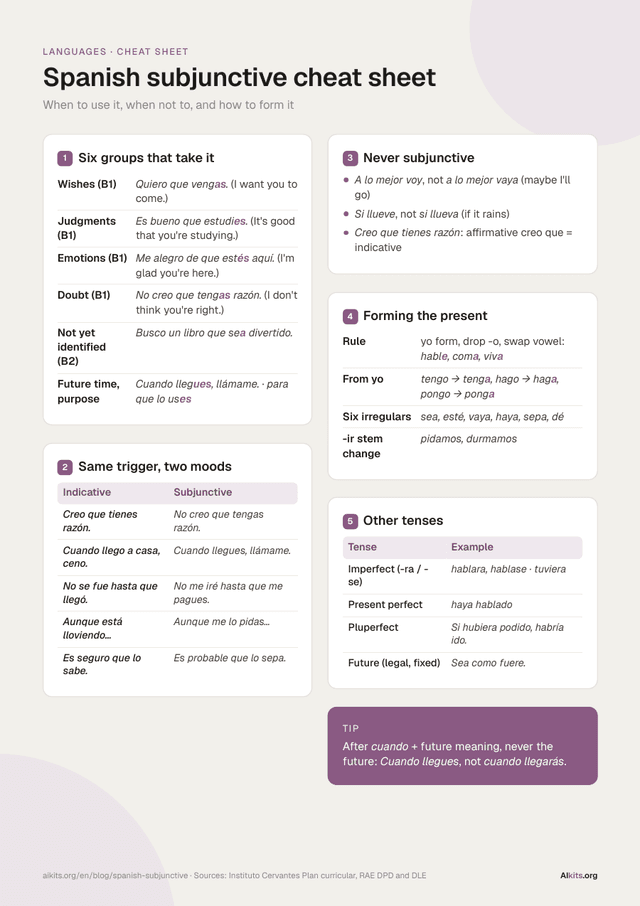
Print it or keep it on your phone. Free, no sign-up.
Download the PDF
Stem-changing and spelling-change verbs
Stem-changing verbs keep their change in the same persons as in the present indicative: pensar → piense, pienses, piense, pensemos, penséis, piensen. Poder → pueda, podamos. -Ir stem-changers also change in the nosotros and vosotros forms: pedir → pidamos, pidáis; dormir → durmamos, durmáis. The PCIC's model pair is "cierro > cierre / cerremos, pido > pida / pidamos".
Verbs in -car change their spelling to keep the sound: buscar → busque, busques, busquemos. If verb forms in general are still shaky, our Spanish verb conjugation guide has the full indicative charts.
What are the other subjunctive tenses?
Besides the present, three subjunctive tenses are in everyday use: the imperfect (hablara or hablase), the present perfect (haya hablado) and the pluperfect (hubiera or hubiese hablado). The imperfect is built from the ellos form of the preterite: hablaron → hablara, tuvieron → tuviera. A future subjunctive also exists (hablare), but it survives mainly in legal texts and fixed phrases.
| Tense | How it's formed | Example | Level |
|---|---|---|---|
| Present | yo form minus -o + opposite vowel | Quiero que vengas. (I want you to come.) | B1 |
| Imperfect | ellos preterite minus -ron + -ra or -se | Dijo que fuera. (He told me to go.) | B2 |
| Present perfect | haya + participle | Cuando se haya marchado, avisamos a sus padres. (When he has left, we'll let his parents know.) | B2 |
| Pluperfect | hubiera / hubiese + participle | Si hubiera podido, habría ido. (If I'd been able to, I'd have gone.) | B2 |
| Future (rare) | ellos preterite minus -ron + -re | Sea como fuere. (Be that as it may.) | C2 |
Examples from the PCIC B1–B2 and C1–C2 inventories; forms from the DLE (hablar, tener, poder).
-ra or -se?
Both endings are correct and mean the same: the DLE lists pudiera o pudiese, tuviera o tuviese for every verb. The PCIC notes that Latin America tends to prefer -ra forms and keeps -se for formal registers. If you're unsure, use -ra.
Si-clauses and the sequence of tenses
For unreal conditions, Spanish pairs the imperfect subjunctive with the conditional, and the pluperfect subjunctive with the conditional perfect: Si hubiera podido, habría ido ("If I'd been able to, I'd have gone"). When the main verb moves into the past, the subjunctive follows it: Dice que me siente ("He says I should sit down") becomes Dijo que fuera ("He told me to go"), with the imperfect subjunctive.
The imperfect subjunctive also softens a request: Quisiera ver ese abrigo ("I'd like to see that coat"), which the PCIC lists as the "imperfecto de cortesía".
Where is the future subjunctive still used?
The PCIC's C2 inventory describes the future subjunctive as out of use in Latin America ("desuso") and limits it to "jerga administrativa y jurídica" and fixed expressions: A quien correspondiere ("To whom it may concern"), Sea como fuere ("Be that as it may"). Recognize it in legal texts and old sayings; use the present subjunctive in its place.
In what order should you learn the subjunctive?
The Instituto Cervantes curriculum introduces the present subjunctive at B1 with wishes (ojalá, quiero que), value judgments, doubt, para que, and cuando with a future meaning. B2 adds hasta que, aunque, relative clauses (busco un libro que sea…), the "never subjunctive" contrasts, and the imperfect, present perfect and pluperfect subjunctive.
In practice:
- Before B1: get the present and past indicative solid. Our Spanish grammar guide maps what comes first.
- B1: learn the present subjunctive forms and the first four groups in the table, plus cuando + subjunctive.
- B2: add the pairs, hasta que and aunque, then the past subjunctive tenses and si-clauses.
If you're still at A1–A2, the weekly plan in the best way to learn Spanish as an adult leaves the subjunctive out on purpose, and the PCIC does the same at that level.
Do Spanish speakers actually use the subjunctive?
Yes. The subjunctive is part of standard Spanish everywhere, and in many sentences there is no alternative: Quiero que vengas can't be said with the indicative. Regional differences are small. Latin America prefers -ra forms of the imperfect subjunctive, and in Mexico, the Antilles and parts of South America capaz que + subjunctive is a common way to say "maybe".
The PCIC records that last one at B2: "tendencia a usar la expresión capaz que + subjuntivo" with the meaning "es posible, quizás, probablemente".
The feeling that natives "don't use it" usually comes from the cases where the indicative is correct, such as a lo mejor and affirmative creo que, and from the future subjunctive, which has largely fallen out of use.
How do you practice the subjunctive?
Practice in pairs, not lists. Take one trigger and say both moods, such as Creo que tiene razón and No creo que tenga razón. Then write one sentence about your own week for each of the six groups. Keep a short list of the triggers you get wrong, on paper, in a spreadsheet or in Notion, and review it first.
A few ways to build the habit:
- Notice it in input. Listen for the forms after cuando, para que and ojalá in podcasts and TV. Our guide to comprehensible input explains how to pick material at your level.
- Turn pairs into prompts. "No creo que… (tener razón)" → No creo que tenga razón. Spaced repetition: Anki vs Notion covers how to schedule them.
- Say the future sentences out loud. Cuando llegues, antes de que salgas, hasta que termines. English has no matching form here, so these need the most practice.
I learned English and French as an adult, and French has a subjunctive too. Our French subjunctive guide compares well if you're learning both. For realistic timelines, see how long it takes to learn a language.
FAQ
Do Spanish speakers actually use the subjunctive?
Yes. It's standard everywhere, and after triggers like querer que or para que there is no indicative alternative. Natives seem to "skip" it mainly where the indicative is correct anyway, such as a lo mejor or affirmative creo que.
Why is the subjunctive so hard?
English rarely marks mood in its verb forms, so there's no habit to copy. In Spanish the choice depends on meaning (is this asserted as a fact?), not on a single word, and some triggers such as cuando take both moods.
What are the four types of subjunctive in Spanish?
The four subjunctive tenses in everyday use are the present (hable), the imperfect (hablara or hablase), the present perfect (haya hablado) and the pluperfect (hubiera hablado). A future subjunctive exists but survives mainly in legal language.
What phrases trigger the Spanish subjunctive?
Common triggers are querer que, ojalá, es bueno que, me alegro de que, no creo que, es probable que, para que, antes de que, and cuando or hasta que for future events. A relative clause about something not yet identified also takes it.
Do Mexicans use the subjunctive?
Yes, the same as everywhere else. Regional differences are small: a preference for -ra forms, and capaz que + subjunctive for "maybe", which the Instituto Cervantes curriculum notes for Mexico, the Antilles and South America.
Is hasta que a subjunctive trigger?
Only for events that haven't happened yet: No me iré hasta que me pagues. For past events it takes the indicative: No se fue hasta que llegó su padre (RAE, DPD).
Does quizás take the subjunctive?
It can take either mood: Quizá tengas razón or Quizá tienes razón. A lo mejor, which also means "maybe", takes only the indicative.