Last updated: 13 October 2026 · By Zoya K
Many of the grammar mistakes learners make come back to a short list of rules: tense and time words, verb endings, articles, a few word pairs and some punctuation. This guide covers those rules, with a correct and an incorrect example for each and a link to the dictionary or grammar reference behind it.
The examples follow American usage. Where British English differs, a short UK note says so. I learned English as an adult, so the rules below are the ones I'd want on one page.
What are the basic rules of English grammar?
A basic English sentence has a subject and a verb, usually in subject–verb–object order: "Maria reads the news." The verb agrees with its subject, a or an depends on the next sound, adjectives go before the noun in a set order, and the tense depends on whether the time you're talking about is finished.
Here is the core set, each covered in more detail below:
- The verb agrees with the subject. He works, they work. Not "he work".
- Finished time takes the past simple. "I saw her yesterday", not "I have seen her yesterday".
- Time up to now takes the present perfect. "I've seen three movies this month."
- A or an follows the sound. A university, an hour.
- A and an go only with singular countable nouns. A sister, but some advice.
- Opinion adjectives come before fact adjectives. An amazing red coat.
- Fewer for plurals, less for uncountable nouns. Fewer cars, less traffic.
- Two full sentences need more than a comma. Use a period, a semicolon or a joining word.
A grammar rule is a regular pattern for how words combine into sentences. The rules here describe how careful American English works, the way dictionaries and grammar references record it. They aren't laws, and a few "rules" people repeat turn out not to be rules at all (more on that below).
Which English grammar rules do learners get wrong most often?
There is no official ranking of grammar mistakes, so the table below doesn't claim one. It groups the rules behind common learner errors: agreement, tenses, articles, word order, quantity words, prepositions, confusing pairs and punctuation. Each row shows a correct sentence, an incorrect one and a short note on why the mistake happens.
| Rule | Correct | Incorrect | Why learners slip |
|---|---|---|---|
| He/she/it takes -s in the present simple | He hates hospitals. | He hate hospitals. | Many languages don't mark the third person this way |
| Plural subjects take don't, not doesn't | They don't do enough art at school. | They doesn't do enough art at school. | The -s rule gets applied to every verb |
| Be agrees with the subject | Are you ready? | Is you ready? | Question word order hides the subject |
| Group nouns can take a singular or plural verb | The audience was silent. / The audience were silent. | (both are correct; stay consistent) | Learners think only one form is allowed |
| Past simple for a definite past time | We met in January 1975. | We have met in January 1975. | Some languages use a perfect form for any past event |
| For + a period, since + a starting point | The house has been empty for three years. / since 2006. | The house has been empty since three years. | One word covers both in many languages |
| If + present simple, will + verb (likely) | If you win the next match, will you be in the semi-final? | If you will win the next match, will you be in the semi-final? | Future meaning, but the if-clause stays in the present |
| If + past simple, would + verb (unlikely) | If I won a million dollars, I would quit tomorrow. | If I would win a million dollars, I would quit tomorrow. | Would gets copied into both clauses |
| A or an by sound, not spelling | a university, a one-year-old child, an hour, an MP3 player | an university, a hour | The first letter misleads |
| A/an only with singular countable nouns | I need some advice. | I need an advice. | Advice is countable in many other languages |
| Opinion adjective before fact adjective | She was wearing an amazing red coat. | She was wearing a red amazing coat. | Adjective order is free in many languages |
| Fewer with plurals, less with uncountables | fewer cars, less work | less cars (in writing) | Speech uses less for both |
| Much with uncountables, many with plurals | I don't have much change. / Are there many campsites near you? | Are there much campsites near you? | Both mean "a lot", so they get swapped |
| Depend on | It depends on the weather. | It depends of the weather. | Prepositions translated word for word |
| Interested in | He wasn't interested in what I was saying. | He wasn't interested about what I was saying. | Same as above |
| Good at | She's very good at geography. | She's very good in geography. | Same as above |
| It's = it is / it has; its = belonging to it | It's nearly the end of the month. Every house has its own garage. | Every house has it's own garage. | An apostrophe usually signals possession, but not here |
| Affect is usually the verb, effect usually the noun | The fire affected both buildings. The policy had a big effect. | The fire effected both buildings. | The two words sound almost the same |
| Don't join two full sentences with only a comma | Nobody goes there anymore. It's boring. | Nobody goes there anymore, it's boring. | A pause in speech feels like a comma |
| Singular "they" for an unknown person | No one has to go if they don't want to. | (not an error) | Learners are told "they" is plural only |
Sources: subject–verb agreement, past simple, for/since, conditionals, articles, adjective order, fewer/less, much/many and its/it's from Cambridge English Grammar Today; depend on, interested in, good at and affect from the Cambridge Dictionary; effect, comma splice and singular "they" from Merriam-Webster. Two examples are adapted to American usage (dollars, movies).
All of this on one printable page:
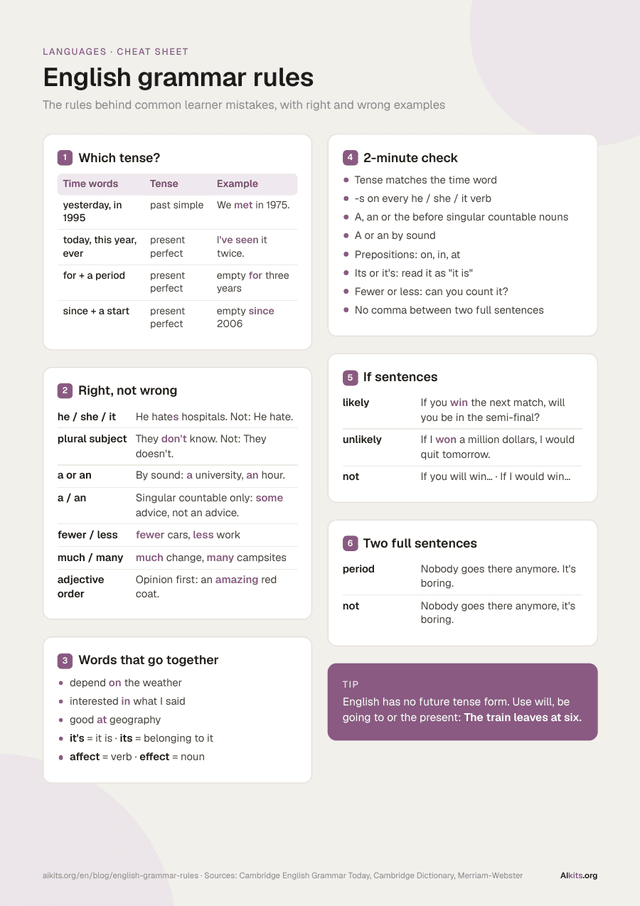
Print it or keep it on your phone. Free, no sign-up.
Download the PDFPresent perfect or past simple: which one do you need?
Use the past simple for a finished time: yesterday, two weeks ago, last year, in 1995. Use the present perfect for time up to now: today, this year, ever. "We have met in January 1975" is wrong because January 1975 is finished. In American English, the past simple also often replaces the present perfect with already and yet.
Cambridge puts the line between "definite time in the past" and "time up to now". A quick test: if you can add a finished time word, use the past simple.
- I saw that movie last week. (finished time)
- I've seen that movie twice this year. (the year isn't over)
- She lived in Boston from 2015 to 2019. (finished period)
- She's lived in Boston since 2019. (still there)
US note: in everyday American English, "Did you eat yet?" and "I already finished" are normal. Cambridge records this: "In American English the past simple is often used instead of the present perfect simple, often with already and yet." UK note: British English prefers "Have you eaten yet?" and "I've already finished." Both versions are correct in their own variety.

For or since?
Use for with a length of time (for three years, for ages) and since with the moment something started (since 2006, since Monday). Cambridge's examples: "That house on the corner has been empty for three years", not "since three years", and "empty since 2006", not "for 2006".
How does subject–verb agreement work in English?
The verb changes with the person and number of its subject. In the present simple that mostly means adding -s for he, she and it: he hates, she works, it rains. Plural subjects take the base form and don't: they work, they don't know. The verb be has its own forms: I am, you are, he is.
Cambridge's examples cover the most common slips: "He hates being in hospital", not "He hate being"; "We often go to Edinburgh", not "We often goes"; "Are you ready?", not "Is you ready?"; "They don't do enough art at school", not "They doesn't do".
Two cases cause most of the trouble:
- A long subject. "The list of items is on the desk." The subject is list, not items, so the verb is singular.
- Group nouns. Words like audience, team and government can take a singular or a plural verb: "The audience was silent" or "The audience were silent", per Cambridge. Pick one and keep it for the whole text.
When do you use a, an or the?
Choose a or an by the sound that follows, not the letter: a university and a one-year-old child (they start with a consonant sound), an hour and an MP3 player (they start with a vowel sound). Use a or an only with singular countable nouns. With plural or uncountable nouns, use some, the, or no article.
Cambridge states the countable rule plainly: "We only use a/an with singular countable nouns." That's why "an advice" and "an information" are wrong in English, even though the words are countable in many other languages. Say "some advice", "a piece of advice" or "the information".
The comes in when both speaker and listener know which one you mean: "I saw a dog" (any dog) versus "I saw the dog" (the one we talked about). The is fine with singular and plural countable nouns: the tree, the trees.

What order do adjectives go in?
When several adjectives come before a noun, opinion comes before fact: "an amazing red coat", not "a red amazing coat". The usual order is opinion, size, physical quality, shape, age, color, origin, material, type and purpose. Most phrases use two or three adjectives, so you rarely need the whole list at once.
The sequence comes from Cambridge's adjective order page, which calls it "the most usual sequence" when no adjective is being stressed:
- opinion: unusual, lovely, beautiful
- size: big, small, tall
- physical quality: thin, rough, untidy
- shape: round, square, rectangular
- age: young, old, youthful
- color: blue, red, pink
- origin: Dutch, Japanese, Turkish
- material: metal, wood, plastic
- type: general-purpose, four-sided, U-shaped
- purpose: cleaning, hammering, cooking
Cambridge's own examples: "a long, narrow, plastic brush" (size, shape, material) and "a round, Italian, bread-like Christmas cake" (shape, origin, type). It also notes that a phrase using every type would be "extremely rare". If you're unsure, put opinion first and material or purpose last. UK note: Cambridge writes colour; the order is the same.
Fewer or less: which is correct?
Use fewer with plural nouns (fewer cars, fewer emails) and less with uncountable nouns (less traffic, less time). You'll often hear less with plurals in casual speech, as in "less pizzas", but traditionally it isn't considered correct. In writing, emails and exams, use fewer with anything you can count.
Cambridge puts it this way: less with plural nouns appears "in informal spoken situations, but traditionally it is not considered to be correct." So "less people" isn't a sign that someone doesn't speak English. It's an informal form, and the safe choice in anything written is fewer.
The same split shows up with much and many: much with uncountable nouns ("I don't have much change"), many with plurals ("Are there many campsites near you?"). In positive sentences, a lot of works with both.
Which "rules" aren't really rules?
Some rules learners hear in class don't match how English works. English has no future tense form; it uses will, be going to or the present. Singular "they" for a person whose gender isn't known is listed in Merriam-Webster. And "less people" is informal rather than wrong. Knowing this saves you from fixing sentences that were fine.
- "English has a future tense." Cambridge: "There is no future tense form of verbs in English." The future uses will (I'll call you), be going to (I'm going to call her) or the present (The train leaves at six). The "12 tenses" taught in many courses combine three time frames (past, present, future) with four forms (simple, continuous, perfect, perfect continuous). They're useful for study, but they aren't separate verb forms.
- "They is always plural." Merriam-Webster lists they "used with a singular antecedent to refer to an unknown or unspecified person": "An employee with a grievance can file a complaint if they need to."
- "Less with plurals is always wrong." As above: informal in speech, avoided in careful writing.
How can you check your grammar in two minutes?
Read your text once for each check below, not once for everything. It's easier to spot one kind of mistake when it's the only thing you're looking for. The checklist covers the rules in this guide; add your own repeat mistakes to the end of it.
- Does every tense match its time word? (yesterday → past simple; this year, ever → present perfect)
- Does every he, she or it verb have its -s?
- Is there an a, an or the where a singular countable noun needs one?
- Did you use a or an by sound?
- Are dependent prepositions right? (depend on, interested in, good at)
- Its or it's? Read it as "it is". If that works, use it's.
- Fewer or less? Count it. If you can, use fewer.
- Are two full sentences joined by only a comma? Use a period, a semicolon or a joining word like and, but or so.
On point 8: Merriam-Webster calls this a comma splice, "the use of a comma between coordinate main clauses not connected by a conjunction". Its example is "nobody goes there anymore, it's boring". A semicolon also works when the two ideas are closely related.
How do you learn English grammar and keep improving?
Learn one topic at a time and use it the same week in sentences you write yourself. Come back to it a few days later, then again weeks later. Keep a short log of the mistakes you actually make and study those first. Read and listen to English you mostly understand, so you meet each rule in real sentences.
A simple weekly routine for a learner with 20 to 30 minutes a day could look like this (adjust the pace to your week):
- Monday: one new topic. Read the rule, copy three examples, write two of your own.
- Tuesday: exercises on Monday's topic. Mark what you got wrong.
- Wednesday: a second topic, plus five minutes rereading Monday's notes.
- Thursday: a short paragraph that uses both topics.
- Friday: review this week's topics and one from last week. No new material.
- Weekend: read or listen to something you enjoy and notice the week's grammar in it.

Keep a mistakes log
A mistakes log is a list of errors you made in real writing or speech, each with its correction. Four columns are enough: what you wrote, the correct version, the rule, and how many times it happened. Paper, a spreadsheet or a Notion database all work. When a mistake repeats, add to its count instead of a new row; the top of the list becomes your study plan.
Review on a schedule
Reviewing a rule at growing intervals, just before you're likely to forget it, is called spaced repetition. Our guide to spaced repetition for language learning compares Anki and Notion, and the Notion spaced repetition setup shows how to build a review queue for grammar rules. For the reading and listening side, see comprehensible input, and for new words, how to keep a vocabulary notebook. Preparing for a test date? Start from how to make a study plan for any exam.
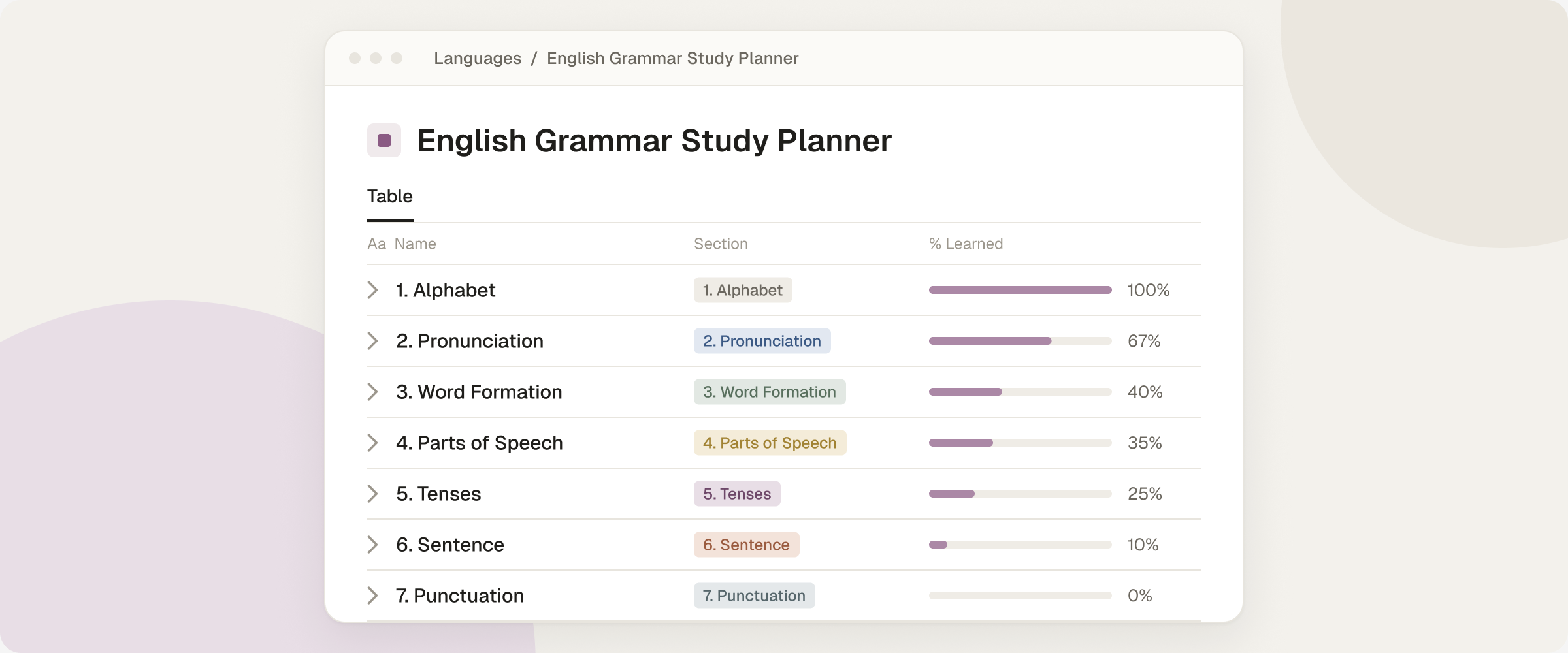
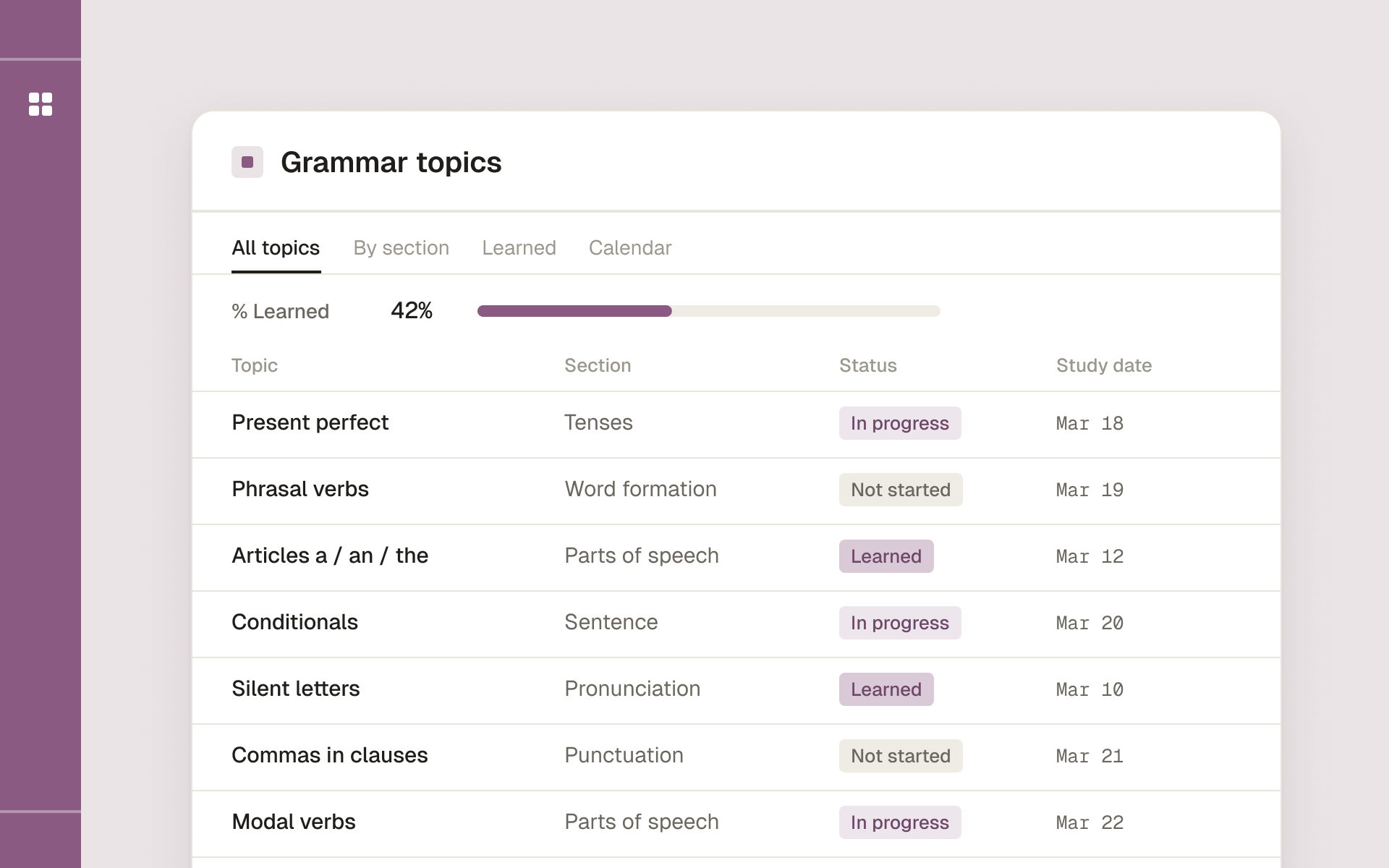
It organizes English grammar into seven sections with a lesson page per topic (theory, examples, exercises and an answer key), study dates and the share of each section you've learned, which is the weekly routine above in one place.
FAQ
What are the 12 basic rules of English grammar?
There's no official list of 12 (or 10, or 7). Grammar references describe many rules, and lists with a fixed number are someone's selection. A good core set: subject–verb agreement, past simple for finished time, present perfect for time up to now, a/an by sound, articles with countable nouns, adjective order, fewer vs less, and no comma between two full sentences.
What are the 10 most important rules of English grammar?
No source ranks them. If you want ten to start with, take the eight core rules above plus much vs many and dependent prepositions (depend on, interested in, good at). The table in this guide shows a right and a wrong example for each.
What is the golden rule of English grammar?
There isn't one. If you need a single habit rather than a single rule, check each sentence for a subject and a verb that agree with each other. Most other checks build on that.
What are common grammar mistakes in English?
Using the present perfect with a finished time ("I have seen her yesterday"), dropping the -s on he/she/it verbs, choosing a or an by spelling, "an advice", "less" with plurals in writing, "it's" for "its", and joining two sentences with a comma.
How many tenses are there in English?
Cambridge describes two tense forms of the verb, present and past, and notes there is no future tense form. The "12 tenses" taught in many courses combine three time frames (past, present, future) with four forms (simple, continuous, perfect, perfect continuous). Both descriptions are used in teaching; they just count differently.
Is singular "they" grammatically correct?
Yes. Merriam-Webster lists "they" for a singular antecedent and for an unknown or unspecified person: "No one has to go if they don't want to." It's accepted usage, not a mistake.
How can I improve my English grammar?
Study one topic at a time, use it in your own sentences the same week, and review it later on a schedule. Keep a log of your real mistakes and work on the ones that repeat. Read and listen a lot at a level you mostly understand.
Is it "less" or "fewer" people?
Fewer people. People is plural, and fewer goes with plurals. "Less people" is common in casual speech, but Cambridge notes it's traditionally not considered correct, so use fewer in writing.
Study English grammar topic by topic, with exercises and answer keys, and track what you have learned.