Most people learn grammar in bursts: a week of intense study after a bad test result, then nothing for a month. That pattern guarantees you forget faster than you learn. The fix is not more hours, it is a schedule that spreads small, deliberate sessions across the week so each rule gets reviewed before you forget it.
This guide gives you a concrete weekly structure, the logic behind it, and a downloadable template you can drop into a calendar or a Notion board.
Why a Schedule Beats Motivation
Motivation is unreliable. A schedule is a decision you make once and then stop renegotiating. When grammar study has a fixed slot, you skip the daily "should I study today?" debate that quietly kills most learning plans.
The second reason is the forgetting curve. A rule you learn on Monday starts fading within 24 hours. If you only revisit it two weeks later, you are essentially relearning it from scratch. A schedule lets you build in short reviews at the right moments so the rule moves into long-term memory instead.
The Core Structure: Learn, Apply, Review
Every effective grammar week has three kinds of sessions:
- Learn — introduce one new rule or concept. Read the explanation, study examples, write your own.
- Apply — use the rule in context: exercises, short writing, or speaking practice. This is where understanding turns into ability.
- Review — revisit rules from previous days and weeks. Short, fast, no new material.
The mistake most learners make is doing only the first kind. They collect rules and never apply or review them. Aim for roughly one Learn session, two Apply sessions, and ongoing Review woven through the week.
A Sample Weekly Schedule
Here is a balanced week that takes about 20–30 minutes a day. Adjust the rule count to your level.
- Monday — Learn (20 min): Pick one new rule (e.g. present perfect vs. past simple). Read it, note three example sentences, write two of your own.
- Tuesday — Apply (25 min): Complete 8–10 exercises on Monday's rule. Mark anything you got wrong.
- Wednesday — Learn + Review (25 min): Introduce a second rule, then spend five minutes re-reading Monday's rule and your error notes.
- Thursday — Apply (25 min): Write a short paragraph (80–100 words) that forces you to use both rules from this week.
- Friday — Review (20 min): Go back over every rule from the current week plus one rule from last week. No new content.
- Saturday — Mixed practice (30 min): Speaking or free writing on any topic. Notice which rules you avoid — those are the ones to schedule next.
- Sunday — Rest or light review (optional).
That is two new rules a week, roughly 100 rules a year, all reviewed multiple times. Consistency at this pace beats cramming every time.
Building Spaced Review Into the Plan
The single biggest upgrade to any study schedule is spaced repetition: reviewing a rule at expanding intervals — one day later, three days later, a week later, a month later.
You do not need special software. Keep a simple list with a "next review" date next to each rule. When you study, also glance at whatever is due that day. A Notion database makes this trivial: add a date property and filter for rules due today. Every Friday review session can pull from that filtered view.
The practical rule of thumb:
- Got it right easily? Push the next review further out.
- Hesitated or got it wrong? Reset it to tomorrow.
Matching the Schedule to Your Level
Beginner (A1–A2): Focus on one rule per week, not two. Spend more time on Apply sessions with very simple sentences. Quantity of correct repetitions matters more than variety.
Intermediate (B1–B2): The two-rule week above works well. Add real-world input — a short article or video — and pull grammar examples from it rather than only doing exercises.
Advanced (C1+): Shift the balance toward Apply and Review. You likely know most rules; your gap is using them naturally under pressure. Schedule more speaking and timed writing, and review only the rules you actually misuse.
Tracking Whether It Works
A schedule without feedback is just a wish. Track two things:
- Adherence — did you actually do the session? A simple checkmark per day is enough. Aim for 5 of 7 days; perfection is not the goal.
- Accuracy — keep a running count of mistakes per rule. When a rule stops generating errors, retire it from active review and add a new one.
If you use Notion, a small dashboard with a study log and a mistake tracker turns this into something you can actually see improving over weeks.
Common Scheduling Mistakes
- Sessions too long. A 90-minute Sunday session you dread is worse than four 20-minute sessions you actually do.
- All Learn, no Review. Collecting rules feels productive but leaves nothing in long-term memory.
- No flexibility. Build in a buffer day. If you miss Tuesday, slide it to Wednesday instead of abandoning the week.
- Ignoring your own errors. Your mistake log is the most valuable study material you have. Prioritize it over generic exercises.
Download the Schedule
Use the downloadable schedule as your starting frame. Drop it into your calendar with reminders, or rebuild it as a Notion board with a rules database, a study log, and a spaced-review view. Then change exactly one thing each week based on what your tracking tells you.
The goal is not a perfect plan. It is a plan boring enough that you keep doing it — because that is the only kind that produces real grammar improvement.
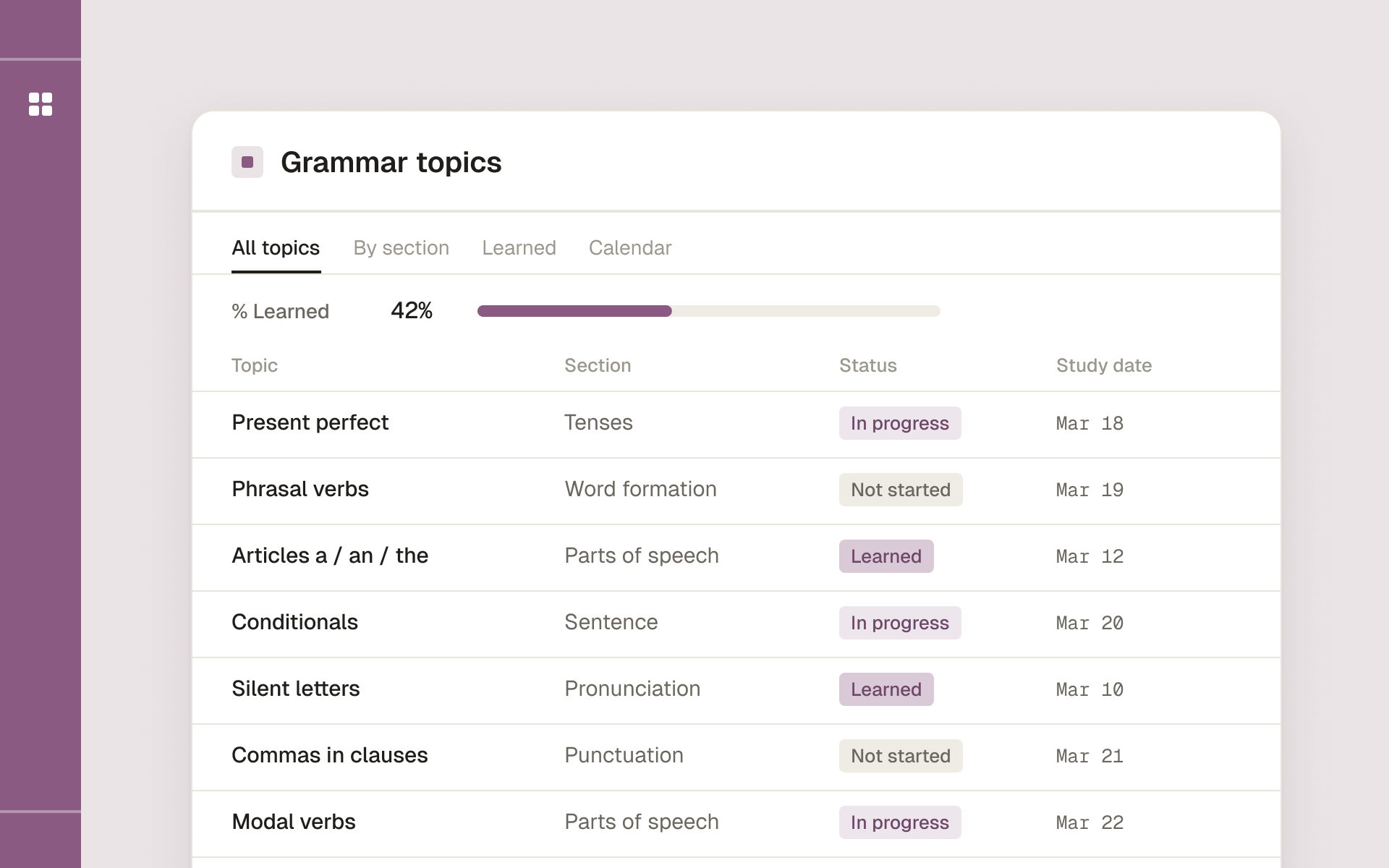
Study English grammar topic by topic, with exercises and answer keys, and track what you have learned.