Last updated: 12 October 2026 · By Zoya K
HSK 1 is the usual first step on the HSK, and the numbers you find online disagree: 150 words, 300 words, 500 words. This guide uses the official 2025 syllabus to settle the word count, lists every HSK 1 grammar point with its page, and ends with a sample eight-week plan.
What is HSK 1?
HSK 1 is the first of nine levels of the HSK, China's official Chinese proficiency test, run by CTI (Chinese Testing International). At HSK 1 you can handle simple exchanges about everyday life: names, dates, prices, the weather. The test checks listening and reading in about 40 minutes, and the official sample paper prints pinyin above the characters.
CTI's HSK 3.0 competency profile puts it in one line: at HSK 1 you "can communicate simply in Chinese about everyday situations" (our translation).
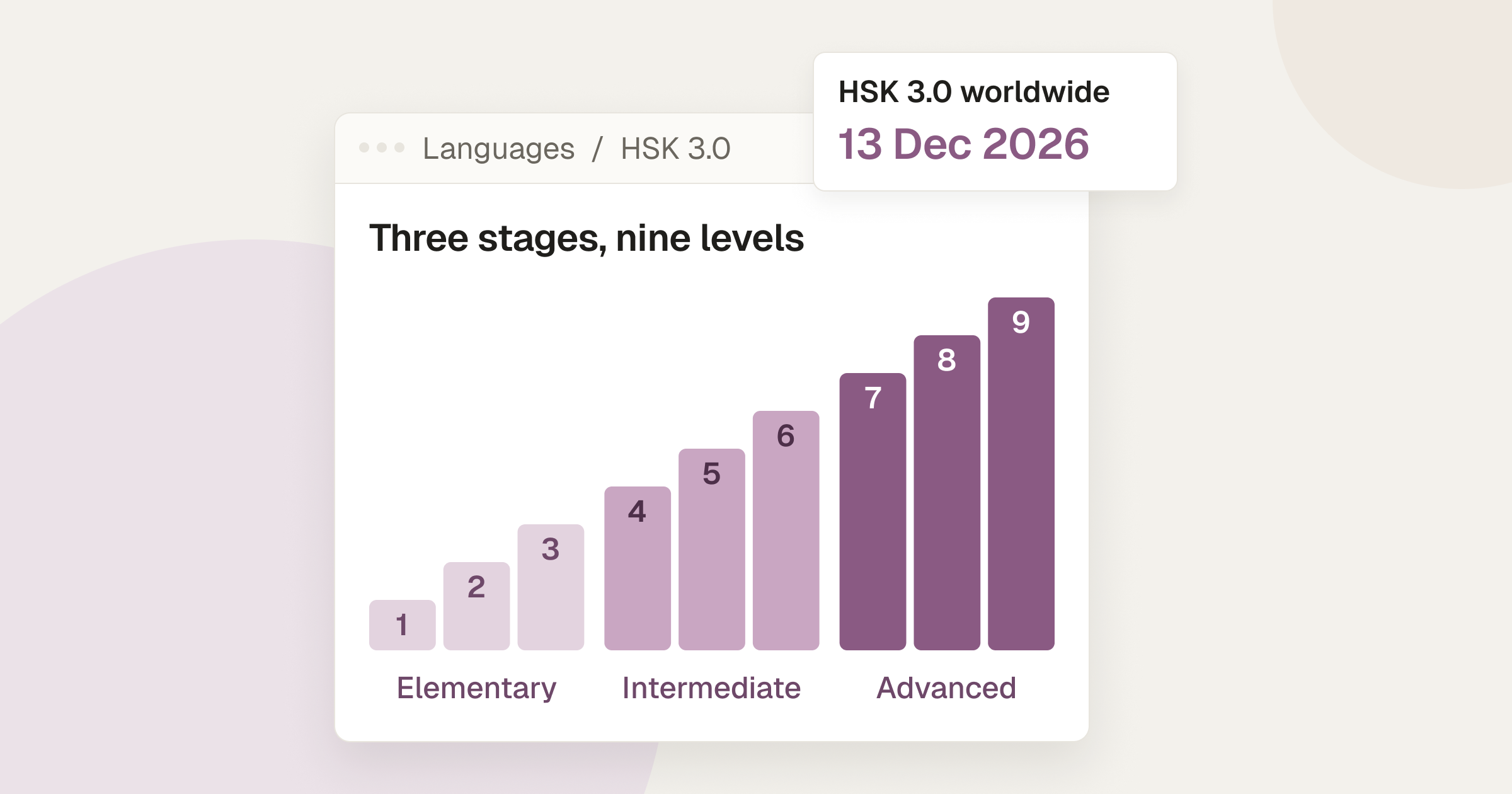
The HSK is moving from six levels to nine. HSK 1 is the entry point of the elementary stage (levels 1–3), and the new version asks for more than the old one. For all nine levels, the launch date and the new formats, see HSK levels explained.
Which HSK 1 will you sit: 2.0 or 3.0?
If your test date is before 13 December 2026, you sit the old HSK 1 with its 150-word list. HSK 3.0 launches worldwide on 13 December 2026, and its HSK 1 asks for 300 words. Check the version with your test centre before you choose a word list.
The launch date is from CTI's announcement "HSK 3.0 will be officially launched worldwide on December 13, 2026". CTI's 2026 calendar, published earlier, still lists 13 December under the six-level exam, so confirm with your centre if you are booking that date.
| HSK 1, six-level version (until 13 Dec 2026) | HSK 1, HSK 3.0 (from 13 Dec 2026) | |
|---|---|---|
| Words | 150 | 300 |
| Sections | Listening, reading | Listening, reading |
| Questions | 40 (20 listening, 20 reading) | 40 (20 listening, 20 reading) |
| Time | About 40 min; listening about 15, reading 17 | About 40 min; listening about 12, reading 20 |
| Scoring | 200 points, pass at 120 | Not published yet |
Sources: CTI HSK 1 page for the six-level version; the official HSK 3.0 sample paper and 2025 syllabus for HSK 3.0. Both times include about five minutes for personal details and three minutes for the answer sheet.
HSK 1 vocabulary: how many words?
The official HSK 3.0 syllabus lists 300 words for HSK 1, up from 150 in the old exam. 146 of the old 150 words stay at HSK 1, so if you learned the old list you need about 154 more. Lists that say 500 words follow the 2021 Standard, a separate document from the exam syllabus.
The four old words that left level 1, by our comparison of the two official lists: 北京 (Běijīng, "Beijing"), which isn't in the new word list at all; 前面 (qiánmiàn, "in front") and 后面 (hòumiàn, "behind"), now level 2; and 小姐 (xiǎojiě, "Miss"), now level 5.
The 500 figure comes from the Chinese Proficiency Grading Standards for International Chinese Language Education (GF0025-2021), which gives 500 words for level 1 and 1,272 for level 2. The Standard is the framework the exam is built on. The 2025 syllabus is the exam document, and it sets HSK 1 at 300.

Where to find the official HSK 1 word list
The list is in the syllabus PDF, pp. 77–83: 300 entries, each with pinyin and part of speech, from 爱 (ài, "to love") to 做饭 (zuò fàn, "to cook"). Copy it into your own notebook or flashcard deck rather than trusting a third-party list, since many still mix the old and new versions. A vocabulary notebook keeps each word with an example, and spaced repetition handles the reviews. Lists alone won't train your ear, so add audio you mostly understand; comprehensible input explains why.
How many characters for HSK 1?
The syllabus lists 246 characters to recognise at level 1 (p. 353) and 100 characters to write by hand for levels 1 and 2 together (p. 374). Recognising a character means reading it in a word; writing means producing it from memory.
HSK 1 grammar: the full checklist
The HSK 1 syllabus covers basic word classes, simple sentence patterns and a few time and aspect markers. That means 是 and 有 sentences, questions with 吗 and question words, negation with 不 and 没(有), both uses of 了, and actions in progress with 在/正在. Everything sits on syllabus pp. 383–385.
The table follows the syllabus groups. Use it as a checklist: one row, one tick.
| Group | What to know | Syllabus items | Page |
|---|---|---|---|
| Prefixes and suffixes | 小 before names, 第 for ordinals; plural 们; 边 in place words | 小—, 第—, —们, —边 | 383 |
| Location words | On, under, in, out, front, back | 上, 下, 里, 外, 前, 后 | 383 |
| Modal verbs | Can, want, may | 会, 能, 想, 要, 可以 | 383 |
| Separable verbs | Verb-object words that can split | 看病, 睡觉, 说话, 上课, 下课, 上班, 下班, 生病 | 383 |
| Question words | How many, which, where, what, who, how | 多, 多少, 几, 哪, 哪儿, 哪里, 哪些, 什么, 谁, 怎么, 怎么样 | 383 |
| Personal and demonstrative pronouns | I, you, he, she, it, we, everyone; this, that, here, there, some | 我, 你, 您, 他, 她, 它, 们 forms, 大家; 这, 那, 这儿, 那儿, 这里, 那里, 这些, 那些, 这个, 那个, 有的, 有些 | 383 |
| Numbers | Zero to the thousands, half; 二 vs 两 | 一 to 十, 零, 百, 千, 半, 二/两 | 383 |
| Measure words | Nouns and containers; dates, age, clock time | 本, 个, 家, 口, 块, 件, 只, 元, 杯; 日, 号, 岁, 点, 分, 年, 天 | 383 |
| Adverbs | Very, too, a bit; all; in progress; again; also; not | 非常, 很, 太, 真, 有(一)点儿; 都; 在, 正在; 再; 还, 也; 不, 没(有), 不要 | 383 |
| Prepositions and conjunction | At or in; with, to; and | 在; 和, 对; 和 | 383 |
| Particles and interjection | Possessive 的; aspect 了; sentence-final particles; "hello" on the phone | 的; 了; 吧, 吗, 呢; 喂 | 383 |
| Phrases and sentence parts | Basic phrase types, number + measure word, preposition + object, place phrases; subject, predicate, object, modifiers; verb + how many times | 联合, 偏正, 动宾, 主谓, 数量, 介宾, 方位短语; 动词 + 动量补语 | 384 |
| Sentence types | Verb, adjective and noun predicates; statements, yes/no questions, question-word questions, A-not-A questions, requests, exclamations | 动词/形容词/名词谓语句; 是非问句, 特指问句, 正反问句; 祈使句, 感叹句 | 384 |
| Special patterns | 是 for "is"; 有 for "has"; "there is" sentences; two verbs in a row; two objects | "是"字句, "有"字句, 存现句 (处所 + 是/有 …), 连动句, 双宾语句 | 384 |
| Linking clauses | Two clauses with 也 or 还 | ……,也……; ……,还…… | 385 |
| Aspect | Completed action, change of state, action in progress | 了1, 了2; 在/正在 + verb (+ 呢), …… 呢 | 385 |
| Numbers in use | Money, ordinals, dates, days of the week, clock time | 钱数, 第 + 数词, 年/月/日/星期, 钟点 | 385 |
A few of these in a sentence:
- 我是学生。(Wǒ shì xuésheng, "I am a student.")
- 你是老师吗?(Nǐ shì lǎoshī ma? "Are you a teacher?")
- 桌子上有一本书。(Zhuōzi shang yǒu yì běn shū, "There's a book on the table.")
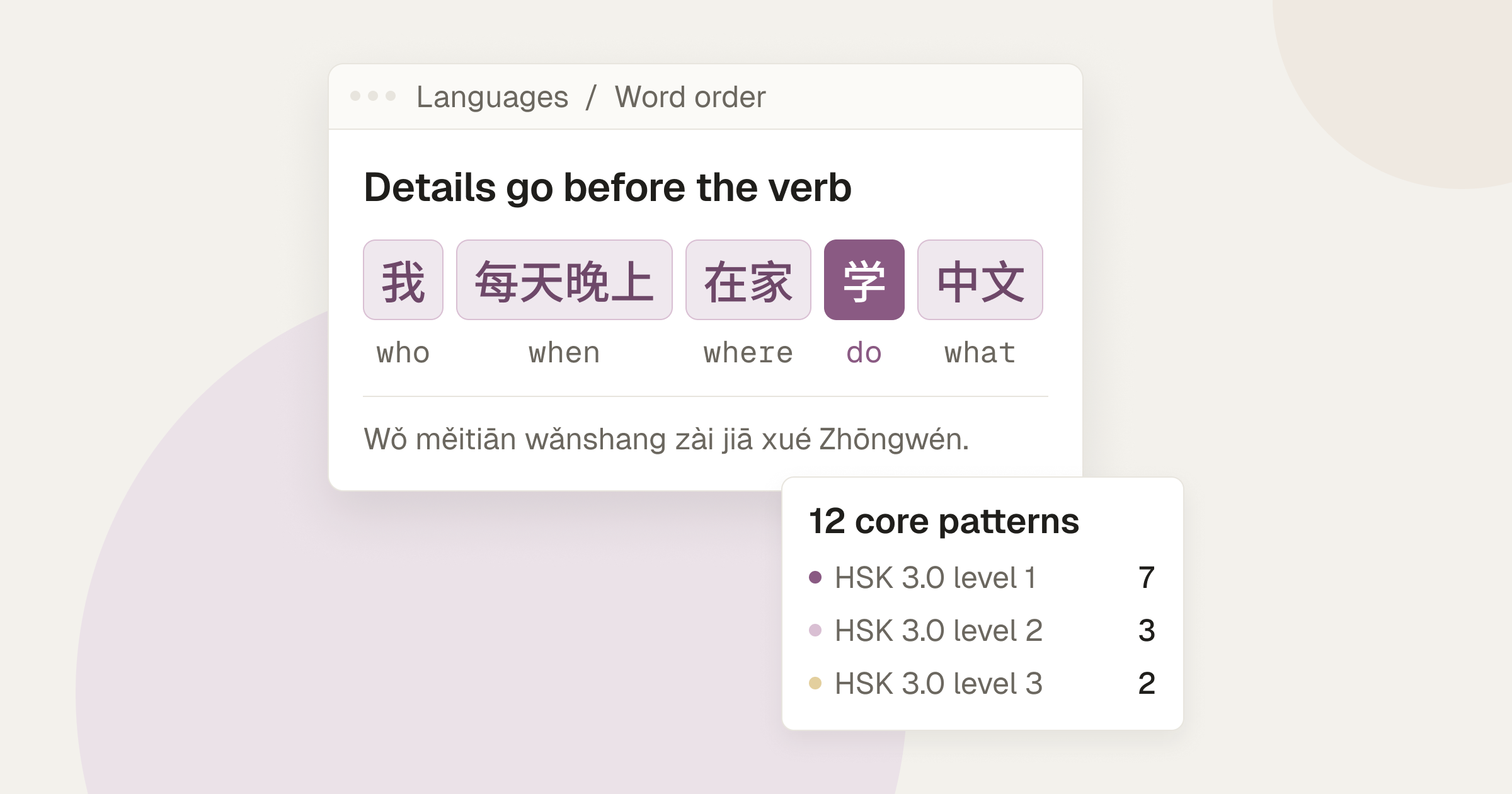
- 我买了一个杯子。(Wǒ mǎi le yí ge bēizi, "I bought a cup.") Here 了 marks a finished action.
- 下雨了。(Xià yǔ le, "It's started raining.") Here 了 marks a change.
- 我在看书呢。(Wǒ zài kàn shū ne, "I'm reading.")
Word order matters more than endings in Chinese, so Chinese sentence structure is the natural next read. Measure words get their own guide: Chinese measure words.

File each HSK 1 point from the checklist under Parts of Speech, Sentence and Tenses, and keep tone notes in the Pronunciation section.
What topics does HSK 1 cover?
The syllabus groups HSK 1 into five topic areas with 15 subtopics: basic information, daily life, education, work, and culture and tradition. Its task list covers talking about yourself, times and dates, objects, the weather, food, shopping, transport, being ill, free time, school and work, all in short, simple exchanges.
The five areas and their subtopics, from the syllabus topic list (pp. 56–57):
- Basic information: personal details, events (dates, times, places, phone numbers), objects, the weather and surroundings, everyday politeness.
- Daily life: food and drink, getting around, shopping, health, free time.
- Education: your studies, your school.
- Work: your job, types of jobs.
- Culture and tradition: Chinese food and traditional drinks.
The task list (pp. 2–5) turns these into 15 things you should be able to do, such as asking someone's name and nationality, saying what the weather is like, asking a price in a shop, or saying you're ill. The sample paper's items come straight from these situations: a weather question, a price question, a time to meet.

HSK 1 test format
Both versions of HSK 1 have 40 questions, 20 listening and 20 reading, and take about 40 minutes. In the HSK 3.0 sample paper, listening runs about 12 minutes and reading 20. Many items ask you to match what you hear or read to a picture, and the sample prints pinyin above the characters.
What the official HSK 3.0 sample paper contains:
- Listening (questions 1–20): match recordings to pictures, choose the best reply to a question, match short dialogues to pictures, and answer a question about a short statement, such as where the speaker is going in the afternoon.
- Reading (questions 21–40): match sentences to pictures, pair questions with answers (你女儿多大了? Nǐ nǚ'ér duō dà le? "How old is your daughter?"), fill gaps from a word bank, and answer a question about a short text.
After the listening part you get three minutes to transfer answers to the answer sheet. Because the sample prints pinyin, HSK 1 mainly checks that you know the words and patterns; reading every character without pinyin comes at later levels. Tones still matter in listening: Chinese tones covers them.
What score do you need to pass HSK 1?
In the current HSK 1, the maximum score is 200 and you pass with 120 or more. The score report gives listening, reading and a total. CTI hasn't yet published scoring or a pass mark for HSK 3.0. HSK scores are valid for two years from the exam date.
The figures are from CTI's HSK 1 page, which describes the six-level exam. If you sit HSK 3.0 on or after 13 December 2026, check CTI's site for the scoring rules closer to your date.
An 8-week HSK 1 study plan
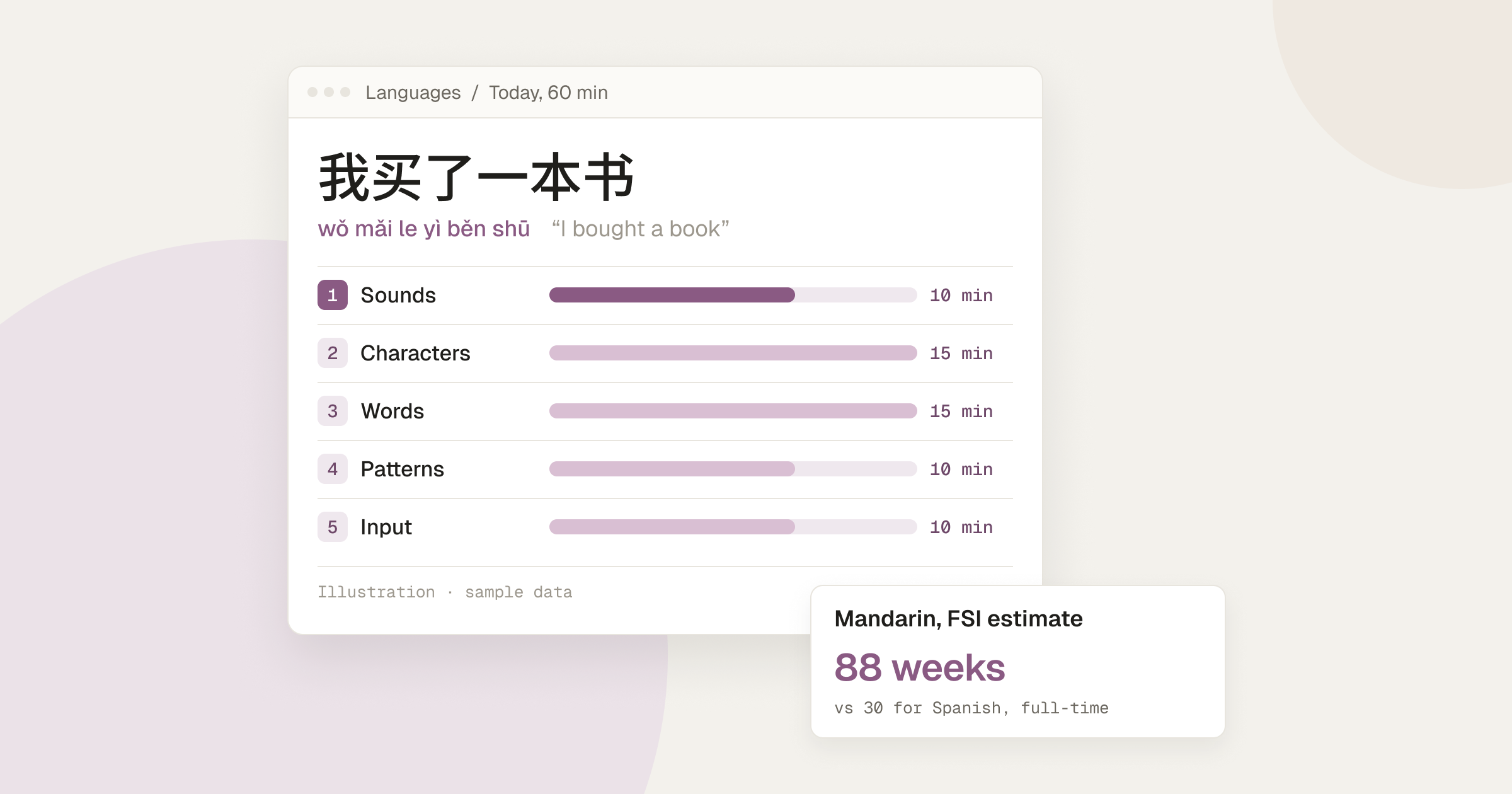
At 30–45 minutes a day, eight weeks can cover the 300 words (about 38 a week), the grammar checklist and two full practice tests. Weeks 1–2 focus on pinyin, tones and numbers, weeks 3–6 on words and grammar groups, and weeks 7–8 on timed practice and review.
This is a sample plan, not an official schedule. Adjust the pace if you already know the old 150-word list: you mainly need the 154 new words.
| Week | Words (running total) | Grammar focus | Practice |
|---|---|---|---|
| 1 | 40 | Pinyin and tones; numbers; 是 sentences; personal pronouns | Introduce yourself aloud: name, country, age |
| 2 | 80 | Questions with 吗; question words 什么, 谁, 哪儿, 几, 多少 | Say today's date, the time and your phone number |
| 3 | 120 | Measure words 个, 本, 口, 块; 这/那; money | Role-play buying fruit and asking prices |
| 4 | 160 | 有 sentences; "there is" sentences; location words | Listen to short dialogues on weeks 1–4 topics |
| 5 | 200 | Negation with 不 and 没(有); modal verbs 会, 能, 想, 要, 可以 | Describe the weather and what you want to do |
| 6 | 240 | 了 for completed actions and for change; 在/正在 … 呢 | Read short texts on weeks 1–6 topics, pinyin covered |
| 7 | 280 | Two verbs in a row (去商店买东西); two objects; linking with 也 and 还 | Official HSK 3.0 sample paper, timed at 40 minutes |
| 8 | 300 | Review every checklist row not yet ticked | Second full test (CTI's online mock or a textbook test); fix the weakest topic |
The full sample paper is in CTI's HSK 3.0 sample pack, linked from the HSK 3.0 announcement. Track progress in Notion, a spreadsheet or on paper: one row per word or grammar point, with a state such as "learning" or "can use". For working back from a test date, see how to build an exam study plan.
FAQ
Is HSK level 1 hard?
CTI publishes no pass rates, so the honest answer is the workload: 300 words, a grammar list that fits on three syllabus pages, and a 40-minute test that prints pinyin above the characters in the official sample. For a first exam it's a manageable target, and how to learn Chinese covers the groundwork.
What does HSK stand for?
The 2025 syllabus calls the test 中文水平考试 (Zhōngwén Shuǐpíng Kǎoshì), the Chinese Proficiency Test. The letters HSK come from the older name 汉语水平考试 (Hànyǔ Shuǐpíng Kǎoshì), as Wikipedia notes.
What is the minimum score to pass HSK 1?
In the six-level exam, 120 out of 200. CTI hasn't published a pass mark for HSK 3.0 yet.
Can I take the HSK test in the USA?
Check the "Find a Test Center" search on chinesetest.cn, which lists centres by country. To register, you choose the test type, level, format and date, then a centre, per CTI's registration rules. Outside mainland China, CTI says you pay at the centre or by the method the centre specifies.
At what HSK level are you fluent?
There's no official "fluent" level, and HSK 1 is the starting point. HSK levels explained gives CTI's description of every level, from HSK 1 to HSK 9.
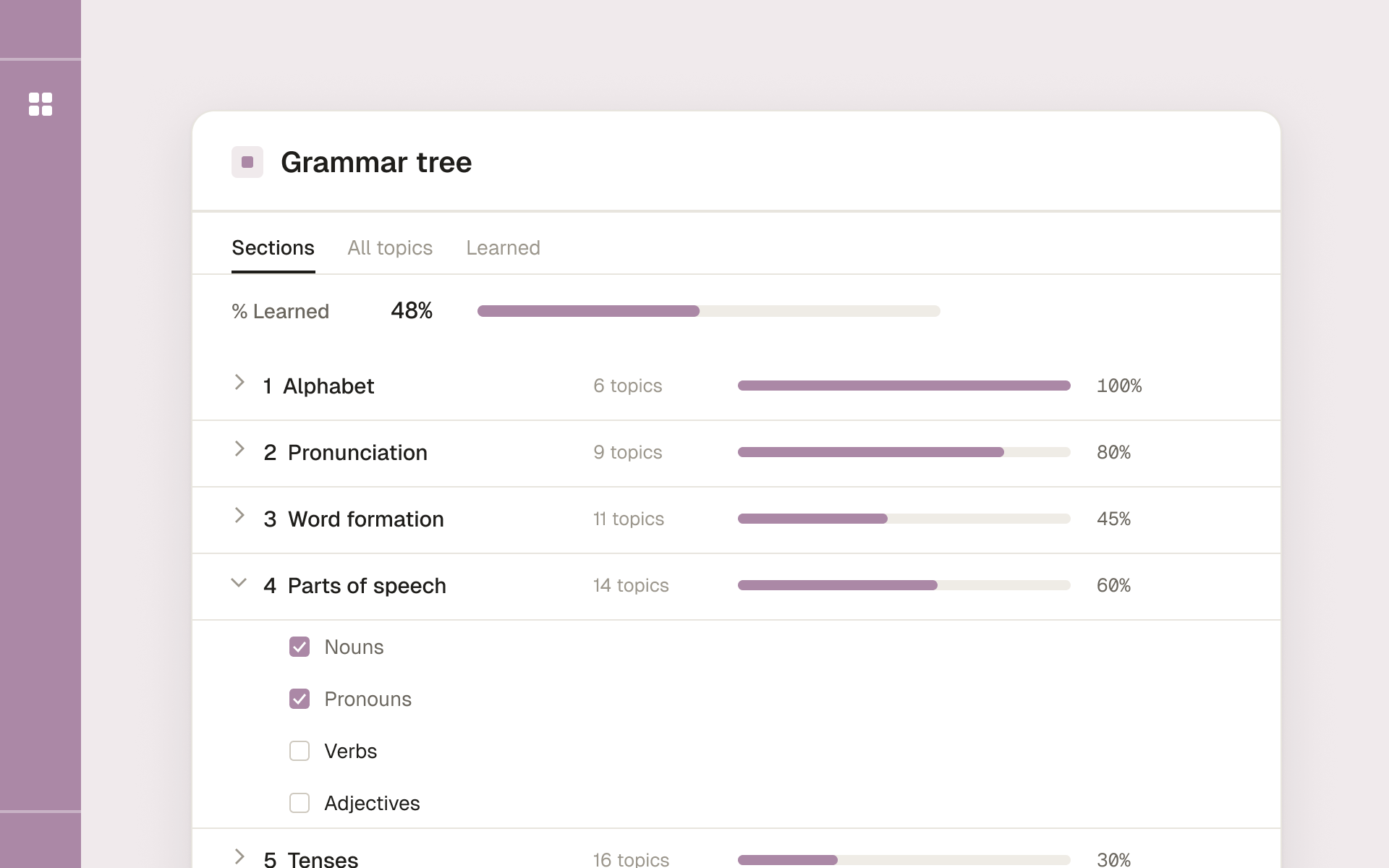
One grammar framework for any language, organized into seven sections from alphabet to punctuation.