Last updated: 12 October 2026 · By Zoya K
Chinese word order looks like English for about three words, then it stops matching. This guide covers the slot order behind most sentences, the topic-first habit that confuses English speakers, where adjectives go, and 12 core patterns with their level in the official HSK 3.0 syllabus.
Every example has characters, pinyin with tone marks and an English gloss. Pinyin shows 一 and 不 with the tone they are actually pronounced with (一个 yí gè).
What is the basic Chinese sentence structure?
Chinese sentence structure is subject–verb–object, the same basic order as English: 我爱你 (wǒ ài nǐ, "I love you"). The difference is where the extra details go. Time, place and manner all come before the verb, so a full sentence runs: who → when → where → how → do → what.
The linguistics reference WALS lists Mandarin's basic order as SVO. What English speakers have to relearn is everything around that core. In English, details pile up after the verb ("I study Chinese at home every evening"). In Chinese they line up in front of it:
我每天晚上在家学中文。(Wǒ měitiān wǎnshang zài jiā xué Zhōngwén, "I study Chinese at home every evening.")
Read it slot by slot: 我 (who) · 每天晚上 (when: every evening) · 在家 (where: at home) · 学 (do: study) · 中文 (what: Chinese). The verb and its object close the sentence; everything that frames the action comes first.
A useful way to remember it, borrowed from the Chinese Grammar Wiki: things are said in the order they have to exist. A time has to arrive before you can be somewhere, and you have to be somewhere before you can do anything there.
Chinese also has almost no inflection. Wikipedia's overview of Chinese grammar notes that words typically have one grammatical form, so verbs don't change for person or tense. Word order and small particles carry that information instead, which is why getting the order right matters more than in English.

Where do time and place go in a Chinese sentence?
Time words go right after the subject, or before it to set the scene, but not at the end of the sentence. Place phrases with 在 (zài, "at, in") come after the time and before the verb. So it is 我明天在家工作 (wǒ míngtiān zài jiā gōngzuò, "I'm working from home tomorrow"), never "I work at home tomorrow" order.
Both positions for time are correct:
- 他星期二来。(Tā xīngqī'èr lái, "He's coming on Tuesday.")
- 明天我去北京。(Míngtiān wǒ qù Běijīng, "Tomorrow I'm going to Beijing.")
Putting the time first sets the scene for everything after it; putting it after the subject is the neutral default. The one position that sounds foreign is the English one, at the very end.
The official HSK 3.0 syllabus (HSK考试大纲, published November 2025, in force from July 2026) lists "words of time and place used as adverbials" among the level 1 grammar points (p. 384). In other words, this is the first thing the exam expects you to get right.
A few verbs break the place rule and take the location after the verb, joined by 在 or 到. The common ones are 住 (zhù, "live"), 坐 (zuò, "sit") and 走 (zǒu, "walk"):
- 我们住在中国。(Wǒmen zhù zài Zhōngguó, "We live in China.")
- 请坐在这儿。(Qǐng zuò zài zhèr, "Please sit here.")
The Chinese Grammar Wiki treats these as location complements: the place is where the action ends up, so it follows the verb.
Where does duration go?
Duration ("for three months", "for two hours") is the exception to "details before the verb". It comes after the verb:
我去年在北京学习了三个月。(Wǒ qùnián zài Běijīng xuéxíle sān gè yuè, "Last year I studied in Beijing for three months.")
The point in time (去年, last year) stays in front; the length of time (三个月, three months) moves behind the verb. Mixing the two up is an easy mistake to make early on.
Do questions change the word order?
No. A Chinese question keeps the statement's word order, and the question word sits in the slot where the answer will go:
- 你什么时候去北京?(Nǐ shénme shíhou qù Běijīng? "When are you going to Beijing?")
- 我明天去北京。(Wǒ míngtiān qù Běijīng, "I'm going to Beijing tomorrow.")
什么时候 ("when") and 明天 ("tomorrow") occupy the same slot. English moves "when" to the front and adds "are you"; Chinese changes nothing else.
Is Chinese really SVO? Topic and comment
Yes, the basic clause is SVO. But Chinese is also topic-prominent: speakers like to open with what they are talking about, then say something about it. 水果,我最爱吃草莓 (Shuǐguǒ, wǒ zuì ài chī cǎoméi) means "As for fruit, I like strawberries best." The topic comes first even when it isn't the subject.
Wikipedia's Chinese grammar article, citing the linguist Chaofen Sun, describes "a strong preference for sentences that begin with the topic", usually information the listener already knows, followed by the comment, which is the new information.
A topic-comment sentence names what the sentence is about first, then says something about it. The topic can be an object that would normally follow the verb:
- 我的笔,弟弟弄坏了。(Wǒ de bǐ, dìdi nònghuài le, "My pen? My little brother broke it.")
In plain SVO order that would be 弟弟弄坏了我的笔. Both are correct. The topic version is what you hear when the pen is already being talked about. When writing, put a comma after the topic, as the Chinese Grammar Wiki recommends.
The textbook relative of this is the subject-predicate-predicate sentence (主谓谓语句), where a whole small sentence acts as the comment:
他身体很好。(Tā shēntǐ hěn hǎo, "He's in good health," literally "he, body very good.")
The HSK 3.0 syllabus places this type at level 2 (p. 387). You don't need the term. You need to stop reading every first noun as the subject.

Where do adjectives go in a Chinese sentence?
Adjectives go before the noun, as in English: 新书 (xīn shū, "a new book"). Longer or modified adjectives usually take 的 (de) as a link: 很贵的书 (hěn guì de shū, "a very expensive book"). When the adjective is the predicate, it needs no 是: 她很高 (tā hěn gāo, "she's tall"), not 她是高.
WALS records Mandarin as Adjective-Noun order, so the first half is easy for English speakers. Short, common adjectives often attach directly (好朋友, hǎo péngyou, "good friend"). Once the adjective grows (很贵, "very expensive") or becomes a phrase, 的 joins it to the noun.
The predicate half is where English speakers slip. English needs "is" between "she" and "tall". Chinese doesn't; the adjective works as the verb. The HSK 3.0 syllabus lists this adjective-predicate sentence (形容词谓语句) at level 1 (p. 384).
- ✗ 她是高。
- ✓ 她很高。(Tā hěn gāo, "She's tall.")
- ✗ 我是忙。(as a plain statement)
- ✓ 我很忙。(Wǒ hěn máng, "I'm busy.")
The 很 (hěn) here is mostly a connector. Its literal meaning is "very", but in a plain statement it is weak. A bare adjective without it tends to sound like a contrast: 这个贵 suggests "this one is the expensive one".
When several details describe one noun, they go in a fixed order: owner → this/that + number + measure word → adjective → noun.
我的那两本新书 (wǒ de nà liǎng běn xīn shū, "those two new books of mine")
That 本 (běn) is a measure word, and measure words always sit between the number and the noun. Our guide to Chinese measure words covers which one goes with which noun.
12 core Chinese sentence patterns (with HSK 3.0 levels)
The table below lists 12 core sentence patterns with a structure, one example and the level where the official HSK 3.0 syllabus introduces each. Seven are level 1, three are level 2, and the two patterns that move the object, 把 and 被, are level 3. Learning them roughly in that order follows the exam's own sequence.
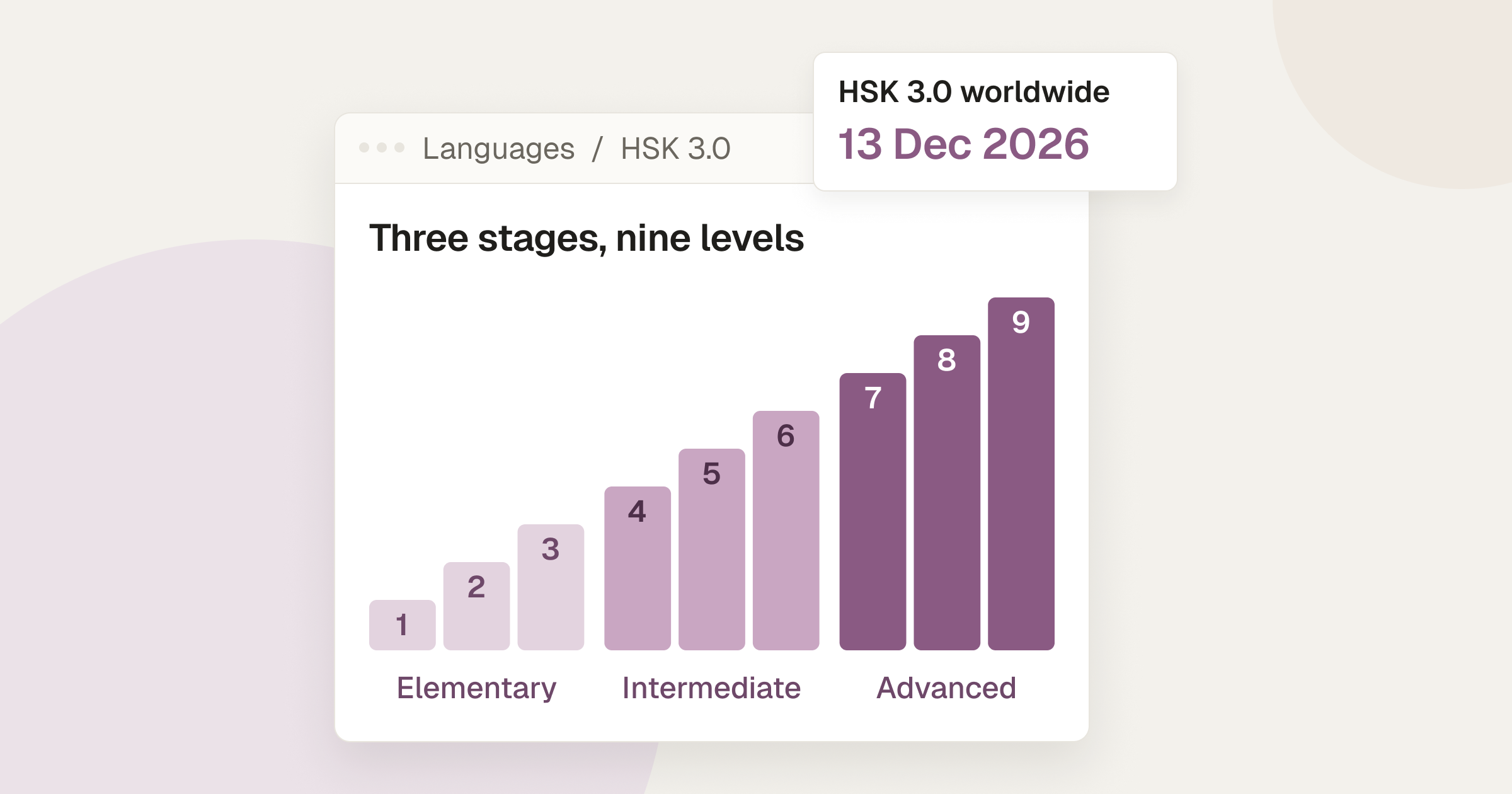
The level and page number come from the official HSK考试大纲 (grammar section, pp. 382 onward), not from a textbook. HSK 3.0 has nine levels in three stages, as Chinese Testing International describes it; our HSK levels guide explains the structure.
| Pattern | Structure | Example | HSK 3.0 level | Syllabus page |
|---|---|---|---|---|
| 是 sentence (identity, category) | A + 是 + B | 我是学生。Wǒ shì xuésheng. "I'm a student." | 1 | 384 |
| Adjective predicate | Subject + 很 + adjective | 她很高。Tā hěn gāo. "She's tall." | 1 | 384 |
| 有 sentence (having) | Subject + 有 + object | 我有一个哥哥。Wǒ yǒu yí gè gēge. "I have an older brother." | 1 | 384 |
| Existence (there is…) | Place + 有 + number + measure word + noun | 桌子上有一本书。Zhuōzi shang yǒu yì běn shū. "There's a book on the table." | 1 | 384 |
| Questions: 吗, question word, A-not-A | Statement + 吗 · question word in the answer slot · verb + 不 + verb | 你是老师吗?Nǐ shì lǎoshī ma? · 你去哪儿?Nǐ qù nǎr? · 你去不去?Nǐ qù bu qù? | 1 | 384 |
| Serial verbs (purpose or manner) | Subject + verb 1 (+ object) + verb 2 (+ object) | 我去商店买东西。Wǒ qù shāngdiàn mǎi dōngxi. "I'm going to the store to buy some things." | 1 | 384 |
| Double object | Subject + verb + person + thing | 他教我们中文。Tā jiāo wǒmen Zhōngwén. "He teaches us Chinese." | 1 | 384 |
| Subject-predicate predicate (topic type) | Topic + subject + predicate | 他身体很好。Tā shēntǐ hěn hǎo. "He's in good health." | 2 | 387 |
| Comparison with 比 | A + 比 + B + adjective | 今天比昨天热。Jīntiān bǐ zuótiān rè. "Today is hotter than yesterday." | 2 | 387 |
| 是……的 (stress time, place, manner) | Subject + 是 + detail + verb + 的 | 我是坐飞机来的。Wǒ shì zuò fēijī lái de. "I came by plane." | 2 | 387 |
| 把 sentence (do something to the object) | Subject + 把 + object + verb + place / result | 我把书放在桌子上了。Wǒ bǎ shū fàng zài zhuōzi shang le. "I put the book on the table." | 3 | 391 |
| 被 passive | Subject + 被 + doer + verb + something else | 蛋糕被弟弟吃了。Dàngāo bèi dìdi chī le. "The cake got eaten by my little brother." | 3 | 391 |
Three definitions help with the table. A serial verb construction strings two verbs together with no "and" or "to"; the second is usually the purpose of the first. A double-object verb takes a person and a thing directly, like English "teach us Chinese". A 是……的 sentence talks about an action that already happened and puts the stress on when, where, how or by whom it happened.
The page numbers let you check any row yourself. The syllabus is in Chinese, but the pattern names (“把”字句, 被动句, 比较句) are easy to search inside the PDF. For the full list of grammar points at each level, use our HSK grammar checklist.
Why does a 把 sentence need something after the verb?
A 把 sentence (把字句) moves the object in front of the verb to say what happened to it. That only works if the sentence then says how the object ended up, so the verb can't stand alone. Every 把 form the syllabus lists at level 3 (p. 391) has something after the verb:
- a place: 我把书放在桌子上了。(Wǒ bǎ shū fàng zài zhuōzi shang le, "I put the book on the table.")
- a second object: 我把钱还给他了。(Wǒ bǎ qián huán gěi tā le, "I gave the money back to him.")
- a result: 我把作业做完了。(Wǒ bǎ zuòyè zuòwán le, "I finished my homework.")
✗ 我把书放。 ✓ 我把书放在桌子上了。 If your 把 sentence ends right on the verb, it is missing its result.

What word-order mistakes do English speakers make in Chinese?
Most word-order mistakes come from keeping English habits: putting the place or time after the verb, adding 是 before adjectives, leaving a 把 sentence without a result, and moving question words to the front. Each one produces a sentence a Chinese speaker can usually decode but will hear as non-native.
| Mistake | ✗ English-style | ✓ Chinese order |
|---|---|---|
| Place after the verb | 我学习在图书馆。 | 我在图书馆学习。Wǒ zài túshūguǎn xuéxí. "I study at the library." |
| Time at the end | 我去北京明天。 | 我明天去北京。Wǒ míngtiān qù Běijīng. "I'm going to Beijing tomorrow." |
| 是 before an adjective | 我是忙。 | 我很忙。Wǒ hěn máng. "I'm busy." |
| 把 with a bare verb | 我把书放。 | 我把书放在桌子上了。Wǒ bǎ shū fàng zài zhuōzi shang le. "I put the book on the table." |
| Question word moved to the front | 什么你想吃? | 你想吃什么?Nǐ xiǎng chī shénme? "What do you want to eat?" |
A quick self-check before you say or write a sentence: find the verb, then make sure that everything describing when, where and how sits in front of it. Only the object, a duration or a result belongs after it.
How do you practise Chinese sentence patterns?
Meet a pattern in real input first, then use it. Write two or three sentences about your own life with it, on different days, and count it as learned only when you can produce it without looking. Reading and producing are different skills.
Recognising 把 in a text is one thing; saying 我把手机忘在家里了 (wǒ bǎ shǒujī wàng zài jiā li le, "I left my phone at home") at the moment you need it is another. A simple routine for one pattern a week:
- Collect two or three real examples from what you read or watch. Comprehensible input explains why examples you understand in context stick better than rules.
- Write one sentence of your own, about your own day, the first time you see the pattern.
- Two days later, write two more without looking at the first.
- Bring the pattern back in your review deck. Spacing it out is the point; our guide to spaced repetition for languages covers how.
To keep track, one row per pattern is enough: pattern · HSK 3.0 level · your own example · status (seen / can produce). A paper notebook works; so does a spreadsheet or a page in Notion. If you already keep a vocabulary notebook, a "patterns" section next to it keeps everything in one place.
Patterns are only part of the picture. Our guide on how to learn Chinese puts grammar next to tones, characters and listening, and how long it takes to learn a language gives realistic time estimates. If characters are the next hurdle, start with Chinese radicals.

Its Sentence section is a ready place for these 12 patterns, one row each with your own examples, and it works on the Notion free plan.
FAQ
Is Mandarin SVO?
Yes. The basic order is subject–verb–object, as WALS records. Mandarin is also topic-prominent, so sentences often open with the topic before the subject: 水果,我最爱吃草莓 (Shuǐguǒ, wǒ zuì ài chī cǎoméi, "As for fruit, I like strawberries best").
Where do adjectives go in a Chinese sentence?
Before the noun, often linked with 的: 很贵的书 (hěn guì de shū, "a very expensive book"). As a predicate the adjective needs no 是: 她很高 (tā hěn gāo, "she's tall"). The HSK 3.0 syllabus lists the adjective-predicate sentence at level 1.
Does Chinese grammar have verb conjugation?
No. Verbs don't change for person or tense. Aspect particles and time words do that work: 了 marks a completed action (level 1 in the HSK 3.0 syllabus), 过 marks experience and 着 an ongoing state (both level 2). 我去过中国 (Wǒ qùguo Zhōngguó) means "I've been to China."
How do you ask a question in Chinese without changing word order?
Add 吗 to the end of a statement, use the A-not-A form (你去不去?Nǐ qù bu qù? "Are you going?"), or put a question word where the answer would go (你去哪儿?Nǐ qù nǎr? "Where are you going?"). All three are level 1 grammar in the HSK 3.0 syllabus.
How many grammar patterns do I need for HSK 1?
We don't give a count: the official HSK 3.0 exam syllabus lists level 1 grammar by category (pp. 383–385), not as a numbered list of patterns. See our HSK 1 guide and the HSK grammar checklist for what each level covers.
What is the 3-3-3 rule in Chinese?
It's about pronunciation, not word order: it refers to how three third tones in a row are pronounced. We cover it in our guide to Chinese tones.
Can the time word go before the subject?
Yes. 明天我去北京 (Míngtiān wǒ qù Běijīng) and 我明天去北京 (Wǒ míngtiān qù Běijīng) both mean "I'm going to Beijing tomorrow" and are both correct. Time can go before or right after the subject, but not at the end of the sentence as in English.
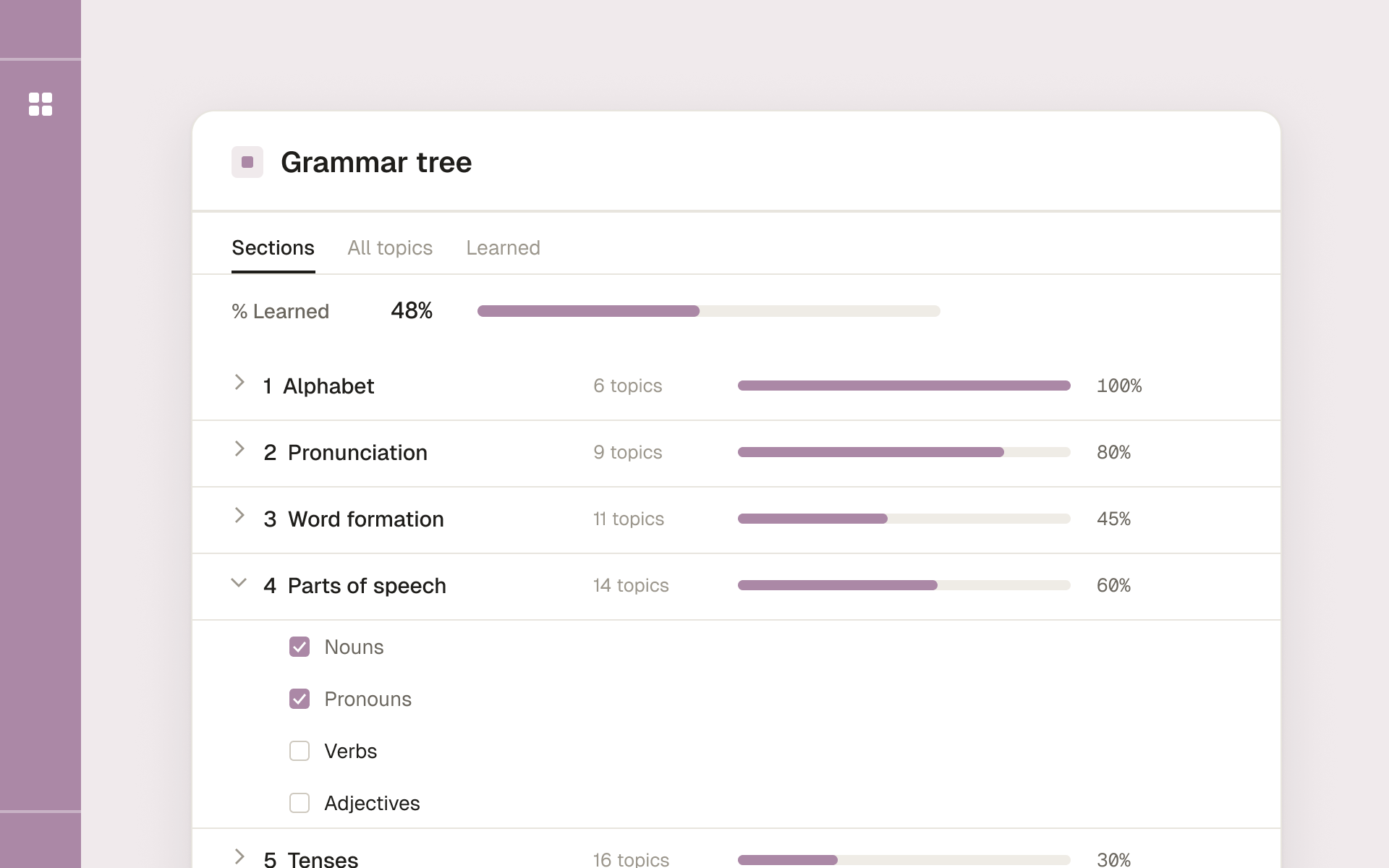
One grammar framework for any language, organized into seven sections from alphabet to punctuation.