Last updated: 12 October 2026 · By Zoya K
The HSK is changing from six levels to nine, and the switch happens in the middle of the 2026 exam season. This guide covers what each level tests, how many words each one needs, the new exam format, and the date that decides which version you sit.
How many HSK levels are there?
The HSK now has nine levels in three stages: elementary (levels 1–3), intermediate (4–6) and advanced (7–9). This is the "Three Stages, Nine Levels" framework of HSK 3.0, which replaces the six-level HSK. Levels 7–9 are a single exam, and your score places you at level 7, 8 or 9.
The HSK is China's standardized test of Chinese as a second language, run by CTI (Chinese Testing International). The 2025 syllabus calls it 中文水平考试 (Zhōngwén Shuǐpíng Kǎoshì, "Chinese proficiency test"); the letters HSK come from the older name 汉语水平考试 (Hànyǔ Shuǐpíng Kǎoshì), which means the same thing.
According to CTI's HSK page, the new exam is built on the Chinese Proficiency Grading Standards for International Chinese Language Education (GF0025-2021) and tests five skills: listening, speaking, reading, writing, and translation at the advanced levels. The stages come from that Standard. The elementary stage ends at level 3, the intermediate stage at level 6, and the advanced stage covers levels 7 to 9 as one block.

HSK 2.0 vs HSK 3.0: which exam will you take?
If you sit the HSK before 13 December 2026, you take the six-level exam, which CTI's calendar lists as "HSK (Levels 1-6)". HSK 3.0 launches worldwide on 13 December 2026, after a pilot that started on 31 January 2026. Check the version with your test centre when you book.
The launch date comes from CTI's announcement of 8 September 2026: "HSK 3.0 will be officially launched worldwide on December 13, 2026". Registration for that date runs until 24:00 Beijing time on 16 November 2026 for the paper test and 3 December 2026 for the computer test.
The 2026 test calendar was published before that announcement. It still shows 13 December under "HSK (Levels 1-6)", next to 17 October and 7 November. That overlap is the reason to confirm the version with your centre rather than rely on the calendar. The advanced exam (levels 7–9) already runs as its own test, with 2026 dates on 9 May and 22 November.
How HSK 3.0 got here:
- November 2025: the new exam syllabus is published. Its cover reads "2025-11 发布 … 2026-07 实施" (published November 2025, in force July 2026).
- 31 January 2026: a pilot of levels 1–6 starts at selected centres in Asia, Europe, the Americas, Africa and Oceania. Candidates for levels 3–6 had to register for the matching speaking test at the same time, CCTV reported.
- 13 December 2026: worldwide launch.
As of 12 October 2026, CTI hasn't published HSK 3.0 scoring or pass marks, the speaking-test rules for 13 December, or what happens to the six-level exam afterwards. Six-level scores are valid for two years from the exam date, per CTI's level pages (for example HSK 1).

The nine HSK levels at a glance
Each HSK 3.0 level has an official can-do statement, a word list and a character list. The table below combines all three. Words are cumulative, so the HSK 4 figure includes everything from levels 1 to 3. Characters are the new ones you learn to recognise at that level. Every number comes from CTI documents.
The descriptions are translated from CTI's HSK 3.0 competency profile (translation ours). Word and character counts are from the 2025 HSK syllabus, pp. 76–373.
| Level | Stage | What you can do (CTI) | Words, cumulative | New characters to recognise | Papers |
|---|---|---|---|---|---|
| HSK 1 | Elementary | Simple communication about everyday life | 300 | 246 | Listening, reading |
| HSK 2 | Elementary | Basic communication in daily life, study and work | 500 | 125 | Listening, reading, writing |
| HSK 3 | Elementary | Effective communication in daily life, study and work | 1,000 | 284 | Listening, reading, writing + speaking paper |
| HSK 4 | Intermediate | Complete, coherent communication in daily life, study and work | 2,000 | 441 | Listening, reading, writing + speaking paper |
| HSK 5 | Intermediate | Accurate, appropriate communication at work and in study | 3,600 | 431 | Listening, reading, writing + speaking paper |
| HSK 6 | Intermediate | Rich, smooth communication at work, in study and in general professional settings | 5,400 | 413 | Listening, reading, writing + speaking paper |
| HSK 7–9 | Advanced | Levels 7 and 8: correct, fluent (7) and appropriate, in-depth (8) communication at work and in general professional and academic settings. Level 9: precise, in-depth communication in professional and academic settings of all kinds | 11,000 | 1,148 | Listening, reading, writing, translation, speaking |
HSK 1 has its own guide with the full word list, grammar and an eight-week plan: HSK 1: vocabulary, grammar and how to pass. If you are still choosing a starting point, how to learn Chinese covers the first months before any exam.
HSK test format by level
In HSK 3.0, level 1 tests listening and reading. Level 2 adds a short writing part. Levels 3–6 test listening, reading and writing, each with a separate speaking paper. Levels 7–9 add translation and speaking in one exam of about 200 minutes. Most levels have fewer questions than the six-level exam.
The HSK 3.0 column below follows the official HSK 3.0 sample papers (CTI), downloadable from the HSK 3.0 announcement page. The six-level column comes from CTI's current level pages (HSK 1 to HSK 6). Times include about five minutes for filling in personal details.
| Level | HSK 3.0 written exam (per the official HSK 3.0 sample papers, CTI) | HSK 3.0 speaking paper | Six-level HSK (until 13 Dec 2026) |
|---|---|---|---|
| 1 | 40 questions, about 40 min | None | 40 questions, about 40 min |
| 2 | 60 questions (10 writing), about 60 min | None | 60 questions, about 55 min |
| 3 | 70 questions, about 83 min | 15 questions, about 15 min | 80 questions, about 90 min |
| 4 | 70 questions, about 85 min | 5 questions, about 20 min | 100 questions, about 105 min |
| 5 | 72 questions, about 110 min | 5 questions, about 23 min | 100 questions, about 125 min |
| 6 | 82 questions, about 125 min | 5 questions, about 23 min | 101 questions, about 140 min |
| 7–9 | 91 questions including speaking, about 200 min | Part of the exam | Already a separate single exam |
What the sections look like in the sample papers:
- Writing at levels 2 and 3 is 书写 (shūxiě), writing characters and short sentences. From level 4 it becomes 写作 (xiězuò), composition.
- The level 3 speaking paper has three parts: repeat what you hear (8 questions), describe a picture (5) and answer two questions, such as "请介绍一下你的一位家人" (Qǐng jièshào yíxià nǐ de yí wèi jiārén, "Please introduce a member of your family").
- Speaking at levels 4–6 has five tasks: retell two recordings, describe one picture, answer two questions.
- Levels 7–9 run in five parts: listening (40 questions), reading (40), writing (2), translation (4) and speaking (5).
In the six-level exam, levels 1 and 2 are scored out of 200 with a pass at 120, and levels 3 and 4 out of 300 with a pass at 180, per CTI's level pages. Speaking is a separate test there (HSKK).
How many words do you need for each HSK level?
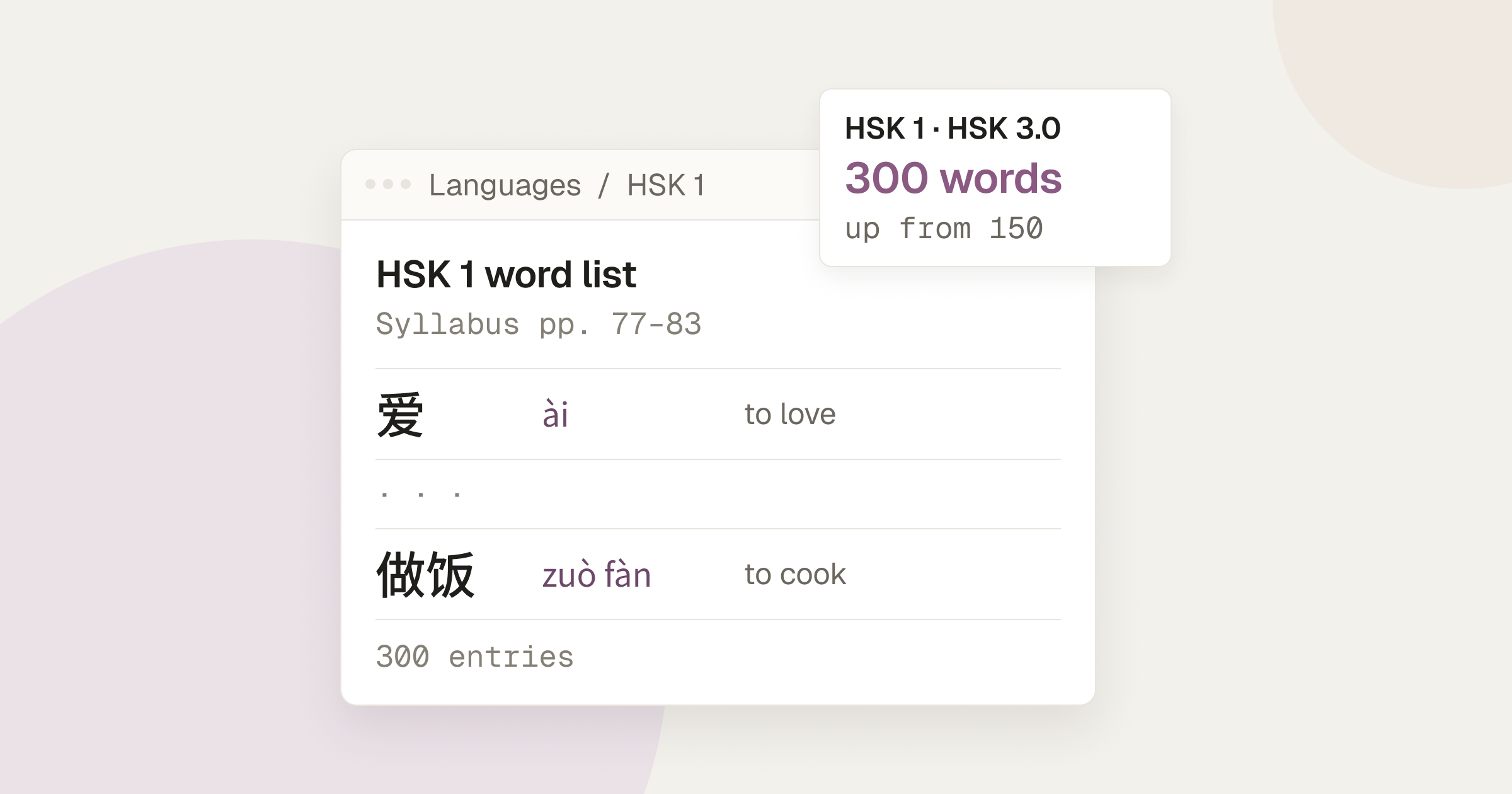
The 2025 HSK syllabus counts words cumulatively: 300 for HSK 1, 500 for HSK 2, 1,000 for HSK 3, 2,000 for HSK 4, 3,600 for HSK 5, 5,400 for HSK 6 and 11,000 for HSK 7–9. The six-level exam asked for far fewer: 150 words at level 1 and 5,000 or more at level 6.
The six-level figures, from CTI's level pages, were 150, 300, 600, 1,200, 2,500 and "5000 or more". So HSK 3.0 levels 1–4 ask for roughly 1.7 to 2 times the vocabulary of the old level with the same number. The gap narrows at levels 5 and 6, and levels 7–9 add about 5,600 words on top of HSK 6.
You will also see "HSK 3.0" lists with 500 words for HSK 1. Those follow the 2021 Standard (GF0025-2021), which gives 500 words at level 1, 1,272 at level 2 and 11,092 in total. The Standard is the framework; the 2025 syllabus is the exam document, and it sets HSK 1 at 300.
The official word list is in the syllabus PDF, pp. 76–351, with pinyin and part of speech for each entry. The character lists follow on pp. 352–381: characters to recognise per level, then characters to write by hand. A word list alone won't get you through listening, so pair it with audio. Comprehensible input explains why, and Chinese tones covers the pronunciation side.

What grammar does each level test?
The 2025 syllabus lists grammar level by level from p. 383 onwards. Level 1 covers basics such as 了 for completed actions and 在/正在 for actions in progress. Level 2 adds 过 for past experience, 比 comparisons and 着 for ongoing states. The 把 and 被 sentences arrive at level 3.
A few items per level, taken from the syllabus grammar tables, with the pages where each level's list sits:
| Level | Examples from the syllabus | Syllabus pages |
|---|---|---|
| 1 | 了 (completed action), 在/正在 + verb (action in progress), question particles 吗 and 呢, measure words such as 个, 本, 口 | 383–385 |
| 2 | 过 (past experience), A 比 B + adjective, 着 (ongoing state), verb doubling (看看, 休息休息) | 386–388 |
| 3 | 把 sentences, 被 passive, 越来越 ("more and more") | 389–391 |
| 4 | 连……也/都 ("even"), 无论……都 ("no matter"), 即使……也 ("even if"), passive with 叫/让 | 392–394 |
| 5 | 不但不……反而 ("not only not … but on the contrary"), passive with 被/叫/让 … 给 | 395–397 |
| 6 | ……以便…… (purpose clauses), 把 sentences with a non-human subject | 398–399 |
| 7–9 | Four-character patterns such as 不A不B and 连A带B, discourse markers such as 换句话说 ("in other words") | From 400 |
What these look like in a sentence:
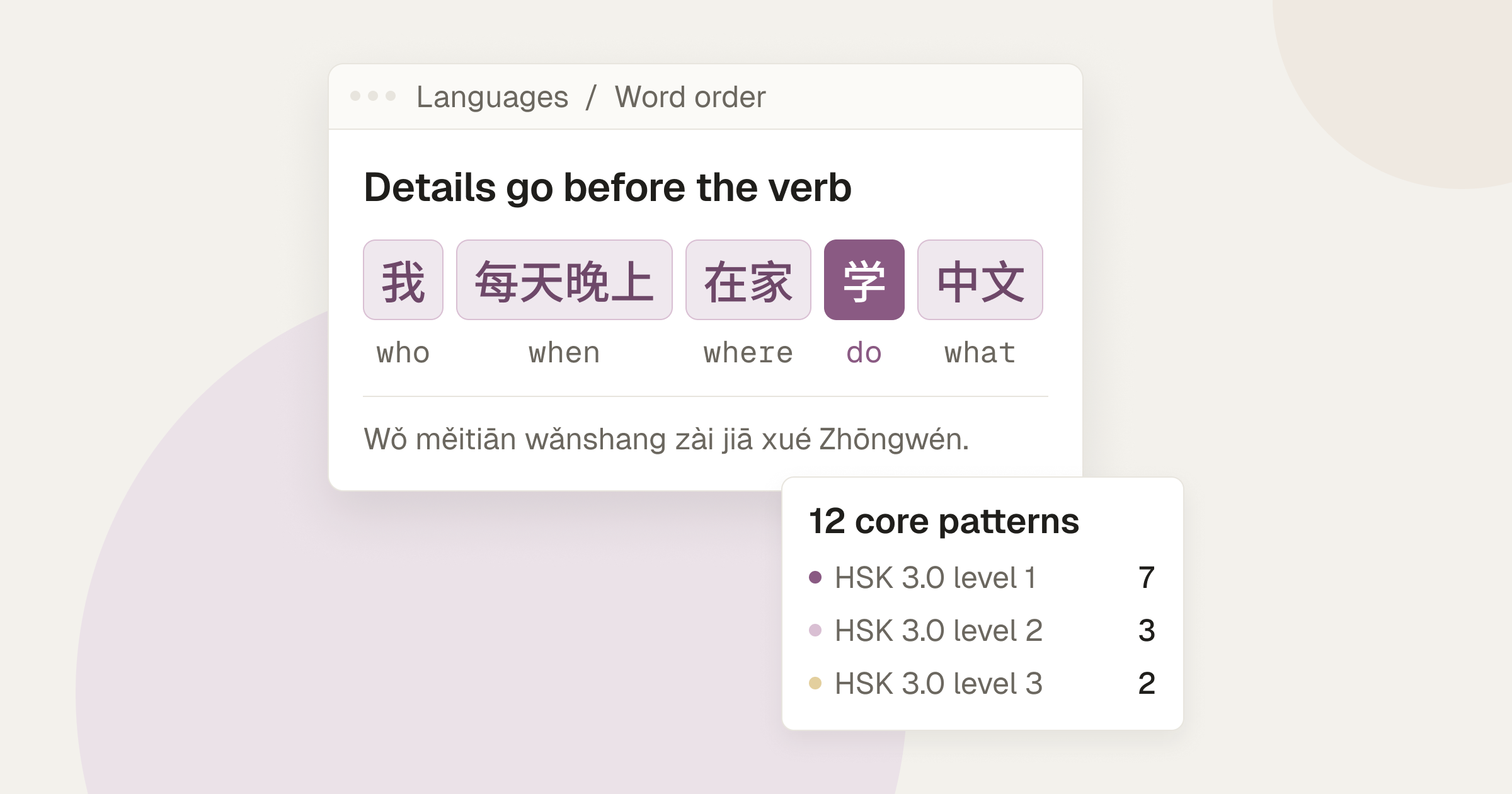
- Level 1: 我买了三本书。(Wǒ mǎi le sān běn shū, "I bought three books.") 他正在开会。(Tā zhèngzài kāihuì, "He's in a meeting right now.")
- Level 2: 我去过北京。(Wǒ qù guo Běijīng, "I've been to Beijing.") 今天比昨天冷。(Jīntiān bǐ zuótiān lěng, "Today is colder than yesterday.")
- Level 3: 我把书放在桌子上了。(Wǒ bǎ shū fàng zài zhuōzi shang le, "I put the book on the table.") 天气越来越冷了。(Tiānqì yuèláiyuè lěng le, "It's getting colder and colder.")
- Level 4: 他连早饭都没吃。(Tā lián zǎofàn dōu méi chī, "He didn't even have breakfast.")
Every full HSK 1 grammar point, with glosses, is in the HSK 1 guide. Measure words get their own article: Chinese measure words.
How to track your HSK progress
Keep one list per level with three states: not started, learning, and can produce. Two weeks before the exam, study only what isn't at "can produce" yet. Notion, a spreadsheet or a paper notebook all work, as long as each word and grammar point has one row and one honest state.
"Can produce" means you can say or write it without looking, not just recognise it. Recognition is enough for most listening and reading items; writing and speaking need production. Review the "learning" rows with spaced repetition, keep new words in context in a vocabulary notebook, and work back from your test date with an exam study plan.
File each HSK grammar point by level in its Parts of Speech, Tenses and Sentence sections, and use the Pronunciation section for tones.
FAQ
What HSK level is considered fluent?
There's no official "fluent" level. CTI describes HSK 6 as rich, smooth communication at work, in study and in general professional settings, and HSK 9 as precise, in-depth communication in professional and academic settings of all kinds.
Is HSK 3 considered fluent?
No. HSK 3 is the top of the elementary stage. CTI describes it as "effective" communication in daily life, study and work, which means you can handle familiar situations, not that you speak freely on any topic.
Is HSK 4 enough to live in China?
CTI describes HSK 4 as complete, coherent communication in daily life, study and work. CCTV's report on the HSK 3.0 pilot called HSK 4 the basic language requirement for studying in China, but each university and employer sets its own bar.
What is HSK 9 equivalent to?
CTI hasn't published an official mapping to CEFR or other scales. Its own description of HSK 9 is precise, in-depth communication in professional, specialist and academic settings, which is the top of the HSK scale.
Can I get HSK 4 in 6 months?
CTI publishes no official study hours per level. HSK 4 means 2,000 words, so from zero that's about 11 new words a day for six months before grammar, characters and listening. Treat it as a stretch goal and see how long it takes to learn a language.
Can I skip HSK 1 and 2?
Yes. CTI's registration rules list no prerequisite level. The only restriction they mention is that HSK 5 and HSK 6 can't currently be booked for the same day.
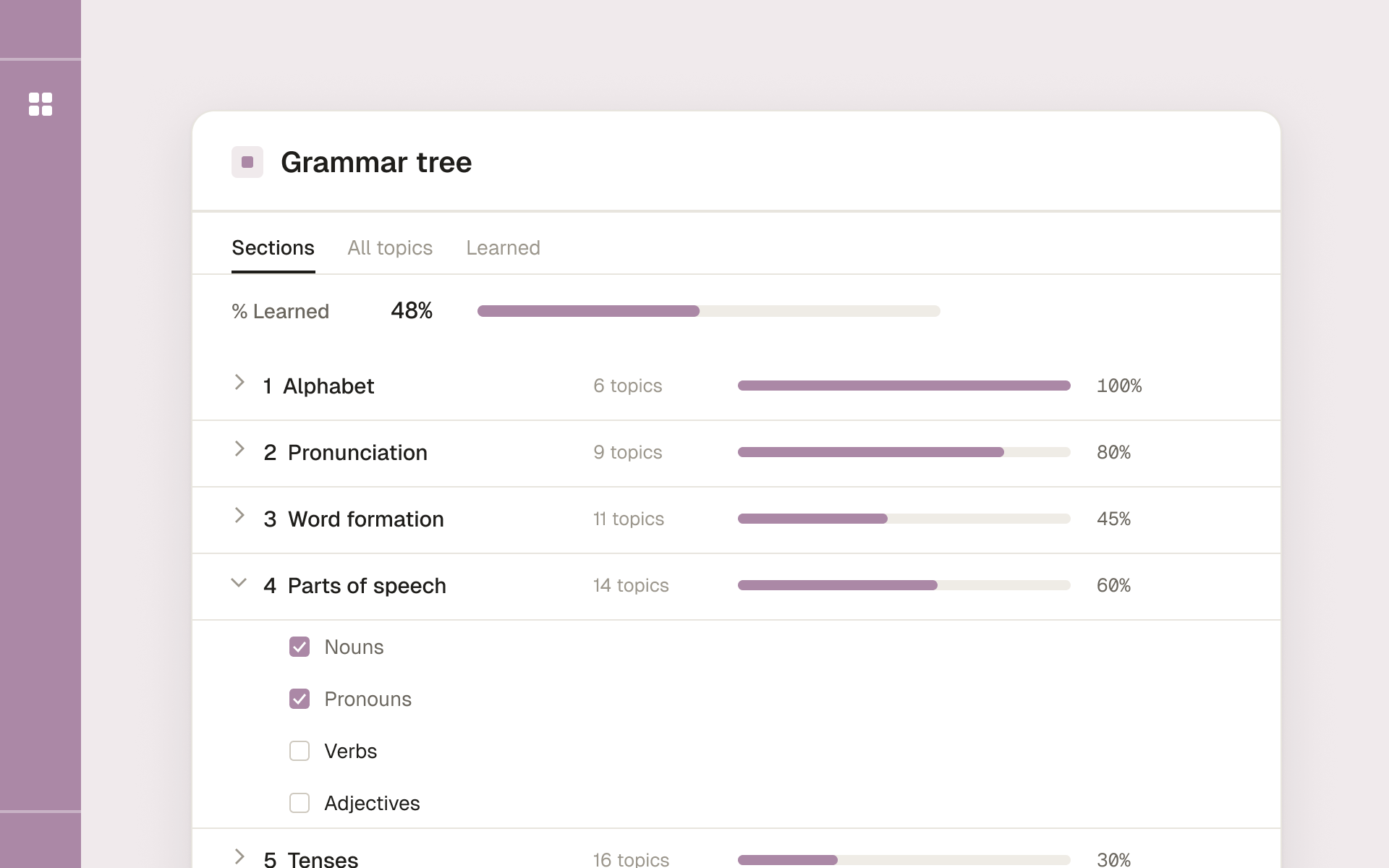
One grammar framework for any language, organized into seven sections from alphabet to punctuation.