Last updated: 12 October 2026 · By Zoya K
Mandarin has a reputation as one of the hardest languages an English speaker can choose, and the official training data agrees. It is still learnable with a plan: five parts worked on together, an honest time frame, and checkpoints you can measure. I learned English and French as an adult, not Chinese, so this guide leans on official sources (the US Foreign Service Institute and the new HSK syllabus) rather than one learner's story.
What is the best way to learn Chinese?
The best way to learn Chinese is to work on five parts at the same time: sounds (pinyin and tones), characters through their components, high-frequency words with spaced review, core grammar patterns, and daily input plus regular speaking. No single app covers all five. A good routine touches each part every week, in small daily blocks.
The parts support each other: tones make listening possible, components make characters memorable, patterns turn words into sentences.
| Part | Why it matters | First step | Deep dive |
|---|---|---|---|
| 1. Sounds | Tones change meaning: mā and mǎ are different words | Learn the pinyin chart, the four tones and the neutral tone | Chinese tones |
| 2. Characters | There is no alphabet, but characters reuse a limited set of parts | Learn the common components (radicals) before whole characters | Chinese radicals |
| 3. Words | A few hundred frequent words cover everyday situations | Start with the official HSK 1 list | HSK 1 |
| 4. Patterns | Verbs don't conjugate; word order and particles carry the grammar | Learn each pattern with one example sentence | Chinese sentence structure |
| 5. Input and speaking | Understanding at speed comes from lots of easy listening and reading | 15 minutes of learner audio a day, one conversation a week | Comprehensible input |

Mandarin or Cantonese? Simplified or traditional?
For most adult learners the answer is Mandarin with simplified characters. Mandarin is the standard language that most courses, textbooks and the HSK exam are built on. Simplified characters are the standard in mainland China; traditional characters are used in Taiwan, Hong Kong and Macau. Pick traditional if that is where you'll read and live.
Cantonese is a separate spoken variety with its own sounds and tones. Learn it if your goal is Hong Kong or a Cantonese-speaking family. Switching scripts later is easier than starting over, because many simplifications change the same component across many characters: 书 and 書 are the same word (shū, "book"). Side-by-side examples are in Chinese radicals and characters.
How long does it take to learn Chinese?
The US Foreign Service Institute puts Mandarin in Category IV, its "super-hard languages" for English speakers: 88 weeks, or 2,200 class hours, to reach professional speaking and listening (ILR 3). Spanish and French take 30 weeks. At an hour a day on your own, plan in years, not months.
The FSI figures describe full-time students. FSI says a typical week is 23 hours in class and 17 hours of self-study, and that the time "can vary" with natural ability, prior language-learning experience and time in the classroom. So the 2,200 hours are classroom hours for diplomats in an intensive program, not a self-study budget.
For a self-taught adult, the useful takeaway is the ratio. The same institute gives Spanish 30 weeks and Mandarin 88, close to three times as long. An hour a day, six days a week, comes to roughly 300 hours a year, about a seventh of the FSI class figure before you count their homework.
ILR 3 is professional fluency. Smaller goals, such as ordering food, a slow conversation or a lower HSK level, arrive much earlier. More on how these estimates work in how long it takes to learn a language.

Step 1: Learn pinyin and the tones first
Pinyin is the official Latin-alphabet spelling of Mandarin sounds, adopted in China in 1958. Learn it in your first weeks, together with the four tones and the neutral tone, because every word you meet later is stored with its sound. A wrong tone can turn one word into another: mā is "mother", mǎ is "horse".
The 1958 scheme itself demonstrates the tones with one syllable:
- 妈 mā, first tone (high and level): "mother"
- 麻 má, second tone (rising): "hemp"
- 马 mǎ, third tone (low, dipping): "horse"
- 骂 mà, fourth tone (falling): "to scold"
- 吗 ma, neutral tone (short, unmarked): a question particle
Tone marks sit over the main vowel, and the neutral tone has no mark. You'll also meet a few sound changes early. The best known: when two third tones meet, the first is said as a second tone, so 你好 (nǐ hǎo, "hello") is pronounced ní hǎo.
Practice tones in pairs of syllables, because that is how you hear them in words, and record yourself to compare with native audio. Fifteen to twenty-five minutes a day in the first month builds the base. The full method, with the tone-pair drill, is in Chinese tones.
Step 2: Learn characters through their parts
Chinese characters are built from a limited set of recurring components, and the ones dictionaries sort characters by are called radicals. Learn the common components first and each new character becomes a combination of parts you know, not a picture to memorize. 妈 (mā, "mother") is 女 "woman" plus 马 mǎ, which hints at the sound.
A radical is the component a dictionary uses to file a character. The traditional list has 214; China's official radical table uses 201 main radicals. You don't need all of them on day one. The common ones show up again and again in beginner vocabulary.
Set realistic targets. The new HSK syllabus asks you to handwrite 100 characters for levels 1 and 2 and 1,200 by the top band, while it expects you to recognize about 3,000. Reading comes first; handwriting can follow at its own pace, and on a phone you type pinyin and pick the character. Which components to learn first, and how to choose between simplified and traditional, is covered in how to learn Chinese characters.
Step 3: Build core vocabulary with spaced repetition
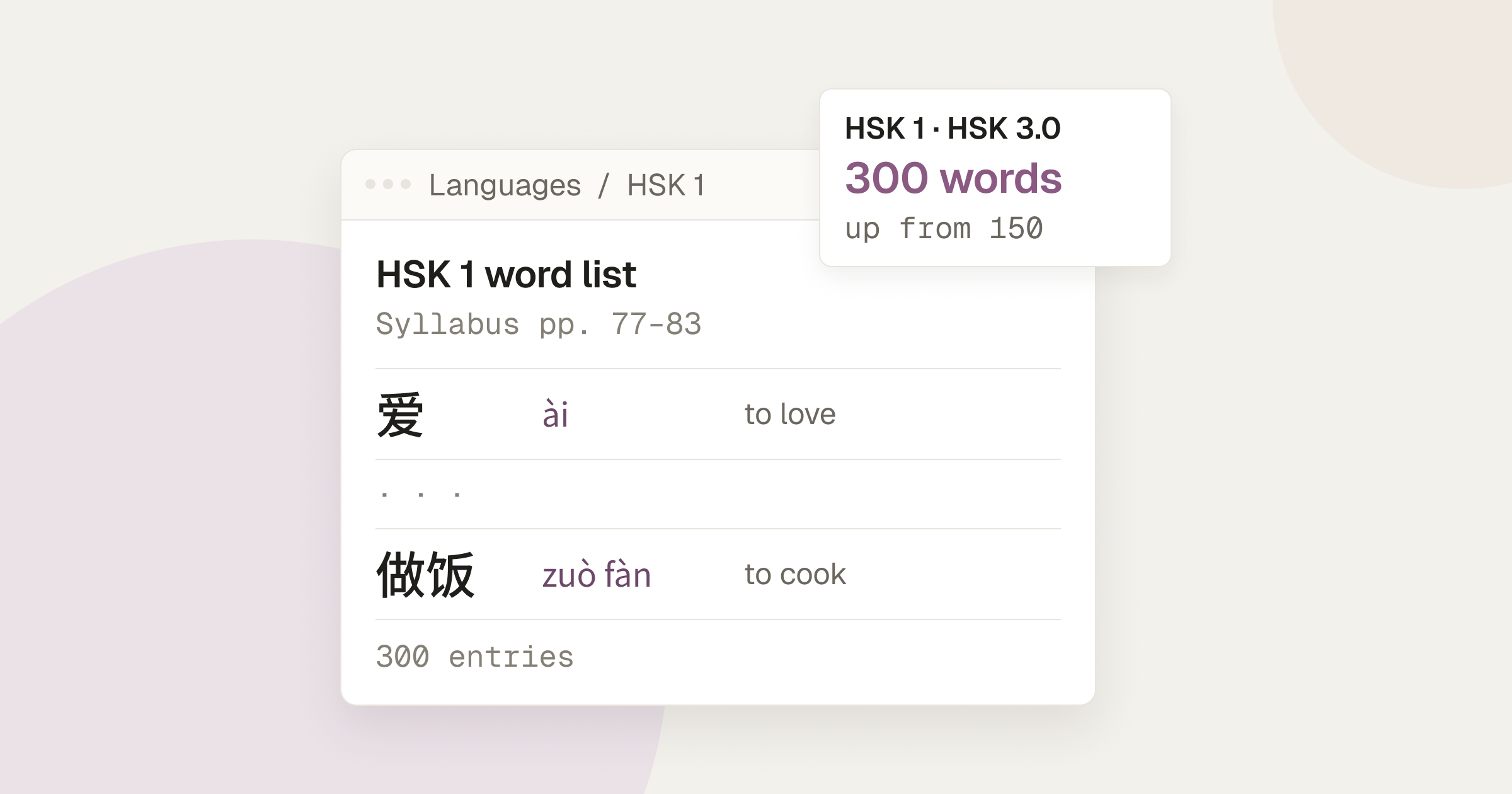
Use the official HSK vocabulary lists as your starting set and review them with spaced repetition, a schedule that shows each word again just before you're likely to forget it. The new HSK syllabus lists 300 words for level 1, 1,000 by level 3 and 11,000 across all nine levels, so start small and build in order.
These numbers come from the official HSK Syllabus (HSK考试大纲), published in November 2025 and in force from July 2026; Chinese Testing International describes the new syllabus on its HSK page. The counts are cumulative: 300 words for level 1, 500 by level 2, 1,000 by level 3, 2,000 by level 4, 3,600 by level 5, 5,400 by level 6 and 11,000 for levels 7–9. Many pages still quote older figures, such as the 150 words of the current six-level HSK 1, so check which exam a list belongs to before you build on it.
Three habits from good vocabulary notebooks carry over to Chinese:
- Capture the sentence, not just the word. Save 书 (shū, "book") inside the sentence where you met it, such as 我买了一本书 (wǒ mǎi le yì běn shū, "I bought a book"). The sentence also teaches the measure word 本 and the particle 了.
- Start with a list, not a system. A plain list you review daily beats an elaborate setup you never open. Add tags and filters later, when you actually need them.
- Keep sound, character and meaning together. Each card shows the characters, the pinyin with tone marks and the meaning, plus audio if your app supports it.
Anki, a notebook or a spreadsheet all work. The tradeoffs are in spaced repetition for language learning and how to keep a vocabulary notebook.

Step 4: Learn the core grammar patterns
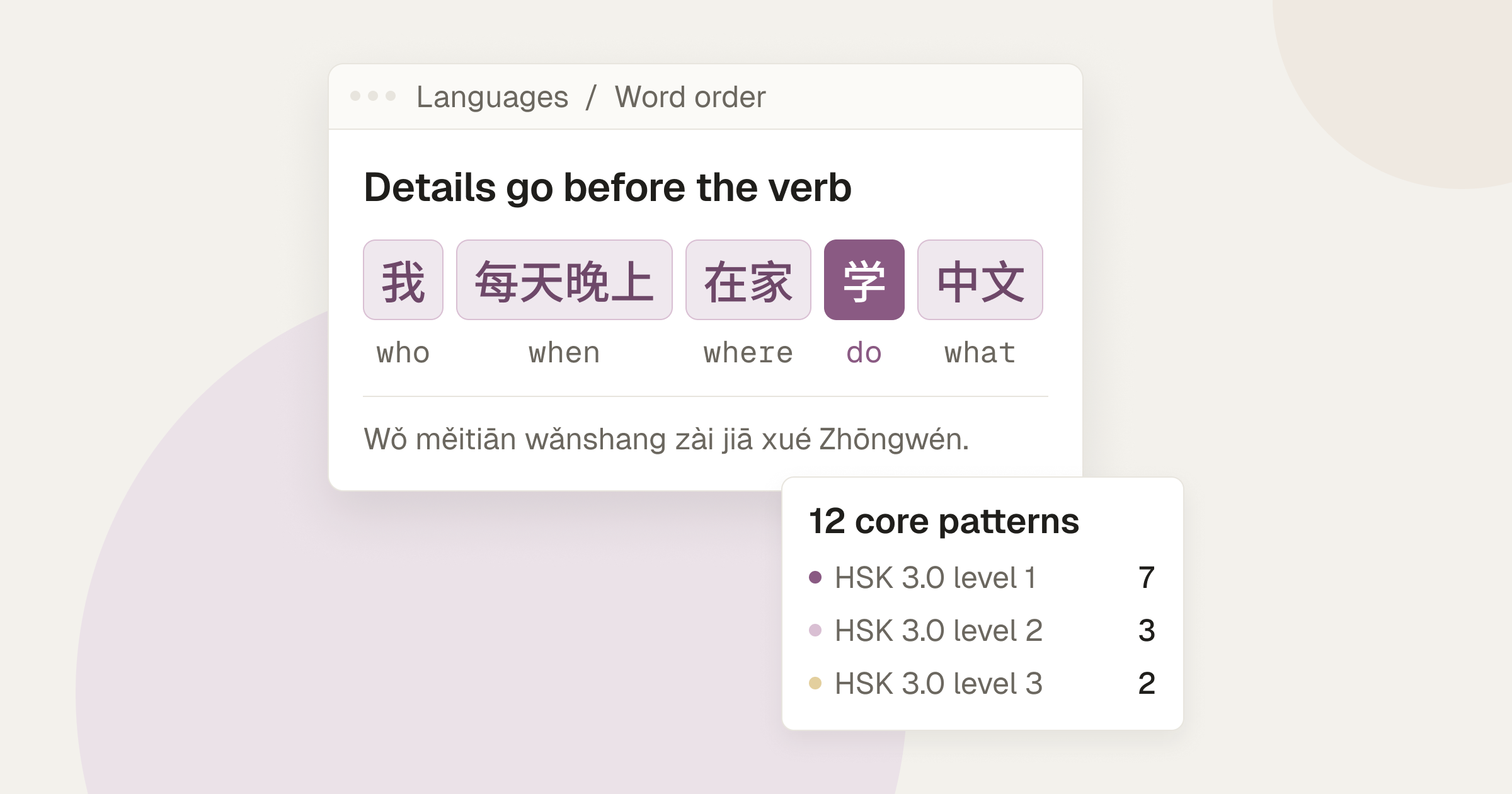
Chinese verbs don't change form for person or tense, and nouns have no grammatical gender. Word order, small particles and measure words do that work instead. Learn patterns as whole sentences: subject-verb-object order, time and place before the verb, 了 and 过 for completed actions and past experience, and a measure word between a number and a noun.
Chinese marks aspect, not tense. 了 shows that an action is complete, 过 shows that something has happened at least once, and time words such as 明天 (míngtiān, "tomorrow") tell you when. The new HSK syllabus places 了 at level 1 and 过 at level 2, together with the other patterns below.
| Pattern | Example | Meaning |
|---|---|---|
| Subject + verb + object | 我是学生 (wǒ shì xuéshēng) | "I am a student" |
| Time and place before the verb | 我明天在家工作 (wǒ míngtiān zài jiā gōngzuò) | "I'm working at home tomorrow" |
| 了 for a completed action | 我买了一本书 (wǒ mǎi le yì běn shū) | "I bought a book" |
| 过 for past experience | 我去过中国 (wǒ qù guo Zhōngguó) | "I have been to China" |
| Number + measure word + noun | 两个人 (liǎng gè rén) | "two people" |
Notice 两 in the last row: before a measure word, "two" is 两 (liǎng), not 二 (èr). Small rules like this are why patterns stick better as sentences than as rules. Learn one pattern with one example you can say out loud, then write two sentences of your own with it. Word order is covered in Chinese sentence structure, and counting words in Chinese measure words.
If you like to see grammar as one connected map rather than a list of rules, a grammar tree helps you place each new pattern where it belongs.
One place to file each Chinese pattern with its example sentence; use the Pronunciation section for pinyin and tones, and since Chinese marks aspect, not tense, use the Tenses section for aspect markers such as 了, 过, 着 and 在.
A Chinese-specific version, with the patterns already organized, is coming soon.
Step 5: Listen, read and speak every week
Input is what turns studied words into words you understand at speed. Spend part of every day on material you can mostly follow: learner podcasts, graded readers written to a word limit, slow news or children's shows. Add speaking at least once a week with a tutor or a language-exchange partner, because understanding and speaking are trained separately.
Easy material is the point. If you need the dictionary for every line, save that text for study sessions. Graded readers use a fixed vocabulary, so you read for the story.
Take a hypothetical learner with a 30-minute commute and 30 minutes in the evening. The commute goes to a learner podcast, replayed until it's easy. The evening goes to SRS review and ten pages of a graded reader. Once a week, a 30-minute call with a tutor covers the patterns of the week.
A simple input log keeps this honest: date, what you listened to or read, minutes, and a rough sense of how much you understood. After a month the log shows if your input is getting longer and harder, which is the progress you want. Ideas for building daily exposure are in comprehensible input and language immersion at home.
A 12-month plan for adult beginners
This plan assumes about one hour a day, six days a week, which adds up to roughly 300 hours in a year. Months 1–2 cover sounds and first words; months 3–6 add characters, core patterns and learner input; months 7–12 move to longer input, weekly speaking and an optional HSK sitting. Adjust the pace, not the order.
| Months | Focus | Daily hour | Checkpoint |
|---|---|---|---|
| 1 | Pinyin, four tones, neutral tone | 25 min pinyin and tone pairs · 20 min first words with audio · 15 min learner audio | You can read any pinyin syllable aloud with the right tone |
| 2 | Survival phrases, numbers, first characters | 20 min SRS · 20 min phrases out loud · 20 min learner audio | You can introduce yourself and ask a few simple questions |
| 3–4 | Common components, HSK 1 words, level 1 patterns (是, 有, 了, questions with 吗) | 20 min SRS · 15 min characters · 15 min patterns · 10 min audio | You can work through an official HSK 1 sample paper |
| 5–6 | HSK 2 words, 过 and measure words, first graded reader | 20 min SRS · 20 min reading or listening · 20 min patterns and your own sentences | You finish your first graded reader |
| 7–9 | Longer input, weekly speaking | 20 min SRS · 30 min input · 10 min shadowing or writing, plus one conversation a week | You can talk for ten minutes about your day and plans with a patient partner |
| 10–12 | HSK 3 words and patterns, native material with subtitles, optional HSK | 15 min SRS · 35 min input · 10 min output, plus one conversation a week | You can follow a learner podcast episode without the transcript |
Treat the table as a plan, not a promise. If a checkpoint isn't met, repeat the block instead of moving on, and keep the daily hour steady rather than making up missed days with long sessions.
Should you take the HSK?
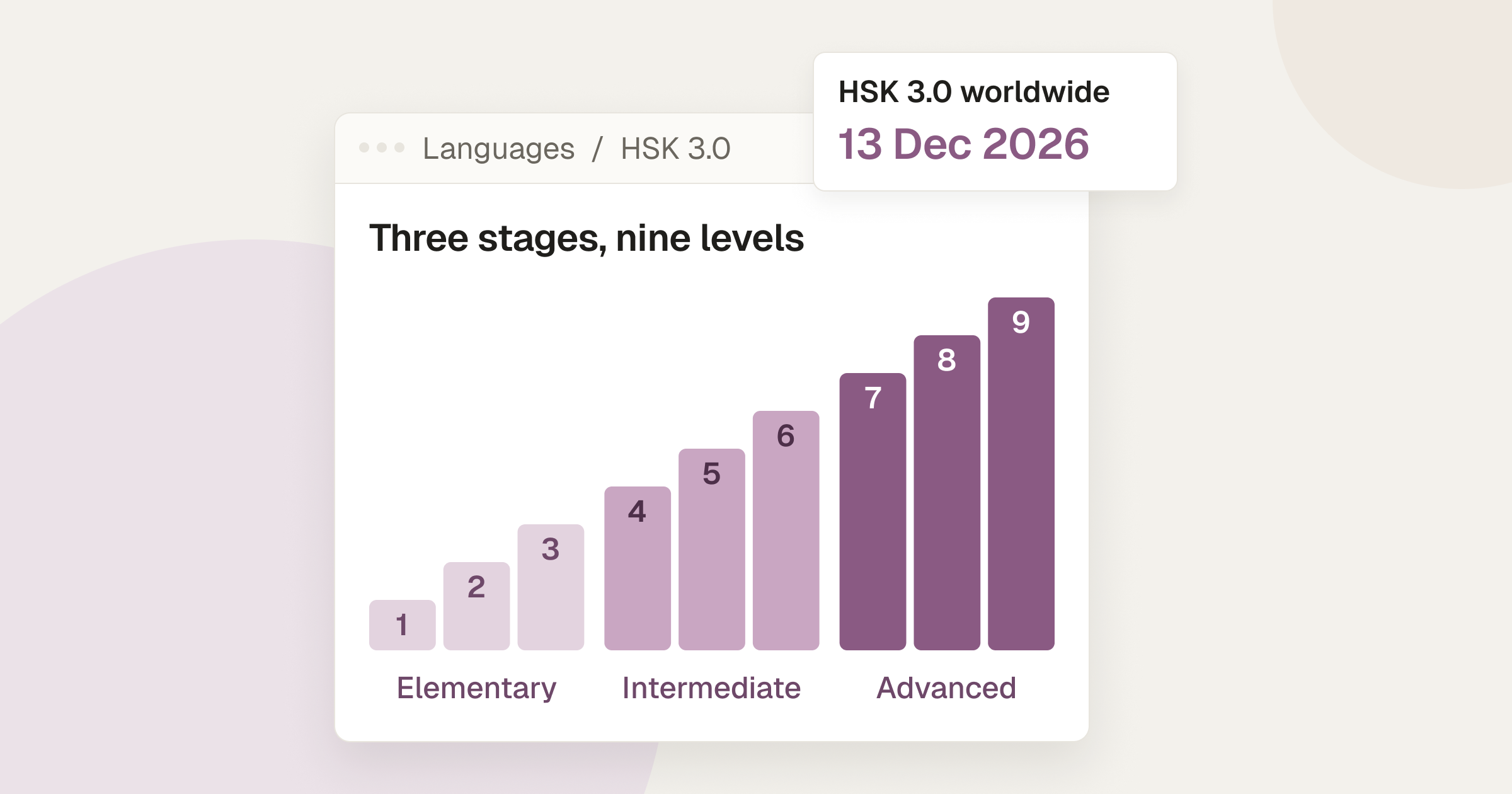
The HSK is optional. Take it if you need a certificate for study, a scholarship or work in China, or if a dated exam keeps you studying. The new HSK 3.0, with a "Three Stages, Nine Levels" structure, launches worldwide on December 13, 2026 and assesses listening, speaking, reading, writing and, at advanced levels, translation.
According to Chinese Testing International, which runs the exam, HSK scores are used for admission, graduation and scholarships at Chinese universities, and a high score can help with employers and work visas in China. If none of that applies, it is still a useful outside check.
HSK 3.0 moves from six levels to nine, grouped in three stages: elementary (levels 1–3), intermediate (4–6) and advanced (7–9). CTI publishes free sample questions and a "Try HSK 3.0" online demo, so you can see the format before you commit to a date.
How the levels compare, what each one tests and which to aim for is in HSK levels explained. For the first exam, see HSK 1. To turn an exam date into weekly study blocks, use the method in how to make an exam study plan.
What are the best resources to learn Mandarin?
You need one tool of each type rather than five apps that do the same thing: a dictionary, a spaced-repetition app, a course or textbook for structure, graded readers and learner audio for input, and a tutor or exchange partner for speaking. Add the official HSK sample papers if you plan to sit the exam.
| Type | What it does | Examples |
|---|---|---|
| Dictionary | Characters, pinyin, meanings and example words | MDBG (free, web), Pleco (app) |
| Spaced repetition | Schedules your word and sentence reviews | Anki, or a notebook with a review routine |
| Course or textbook | Gives the order: what to learn next | Integrated Chinese, HSK Standard Course |
| Grammar reference | Explains one pattern at a time with examples | AllSet Chinese Grammar Wiki (free) |
| Graded readers and learner audio | Easy input within a fixed vocabulary | Mandarin Companion, Chinese Breeze, learner podcasts |
| Speaking practice | Regular conversation and correction | A tutor from an online marketplace such as italki or Preply, or a language-exchange partner |
| Exam practice | Shows the real HSK format | Official sample questions and the "Try HSK 3.0" demo on chinesetest.cn |
Apps are fine as one of these tools, not as the whole plan. If you're choosing between them, see Duolingo alternatives.
How do you track your progress?
Keep one simple list in Notion, a spreadsheet or a paper notebook. Give each word or pattern one row with the sentence where you met it, its pinyin and a status: new, learning or known. Start with a list and add structure only when a real need appears, such as filtering by HSK level.
Next to it, keep the input log from Step 5. Once a week, count how many rows moved from learning to known, and check the plan's current checkpoint.
FAQ
How can I learn Chinese by myself?
Work on the five parts together: pinyin and tones, characters through their components, HSK vocabulary with spaced repetition, core grammar patterns, and daily input. Self-study covers most of it; add a weekly conversation with a tutor or exchange partner so you also practice speaking.
How long does it take to learn Chinese, and is it harder than Spanish?
The US Foreign Service Institute gives Mandarin 88 weeks (2,200 class hours) of full-time training to reach professional speaking and listening, against 30 weeks for Spanish. For English speakers it takes roughly three times as long, so plan in years for fluency and in months for basic goals.
Should I learn simplified or traditional Chinese?
Learn the set used where you'll read and live: simplified for mainland China, traditional for Taiwan, Hong Kong and Macau. Learning one makes the other easier later. See Chinese radicals and characters.
What basic Chinese words should I learn first?
Start with the official HSK 1 list of 300 words, which includes 我 (wǒ, "I"), 你 (nǐ, "you"), 是 (shì, "to be"), 不 (bù, "not") and 谢谢 (xièxie, "thank you"). Learn each word inside a short sentence. The full list and study order are in HSK 1.
What is the 3-3-3 rule in Chinese?
It isn't a standard term. No textbook, official syllabus or grammar reference we checked defines a "3-3-3 rule" for Chinese. The rule you will meet is tone sandhi: when two third tones meet, the first becomes a second tone, as in 你好 (ní hǎo).
What is HSK 3.0?
HSK 3.0 is the new version of the Chinese Proficiency Test, with nine levels in three stages instead of six levels. Chinese Testing International launches it worldwide on December 13, 2026. See HSK levels.
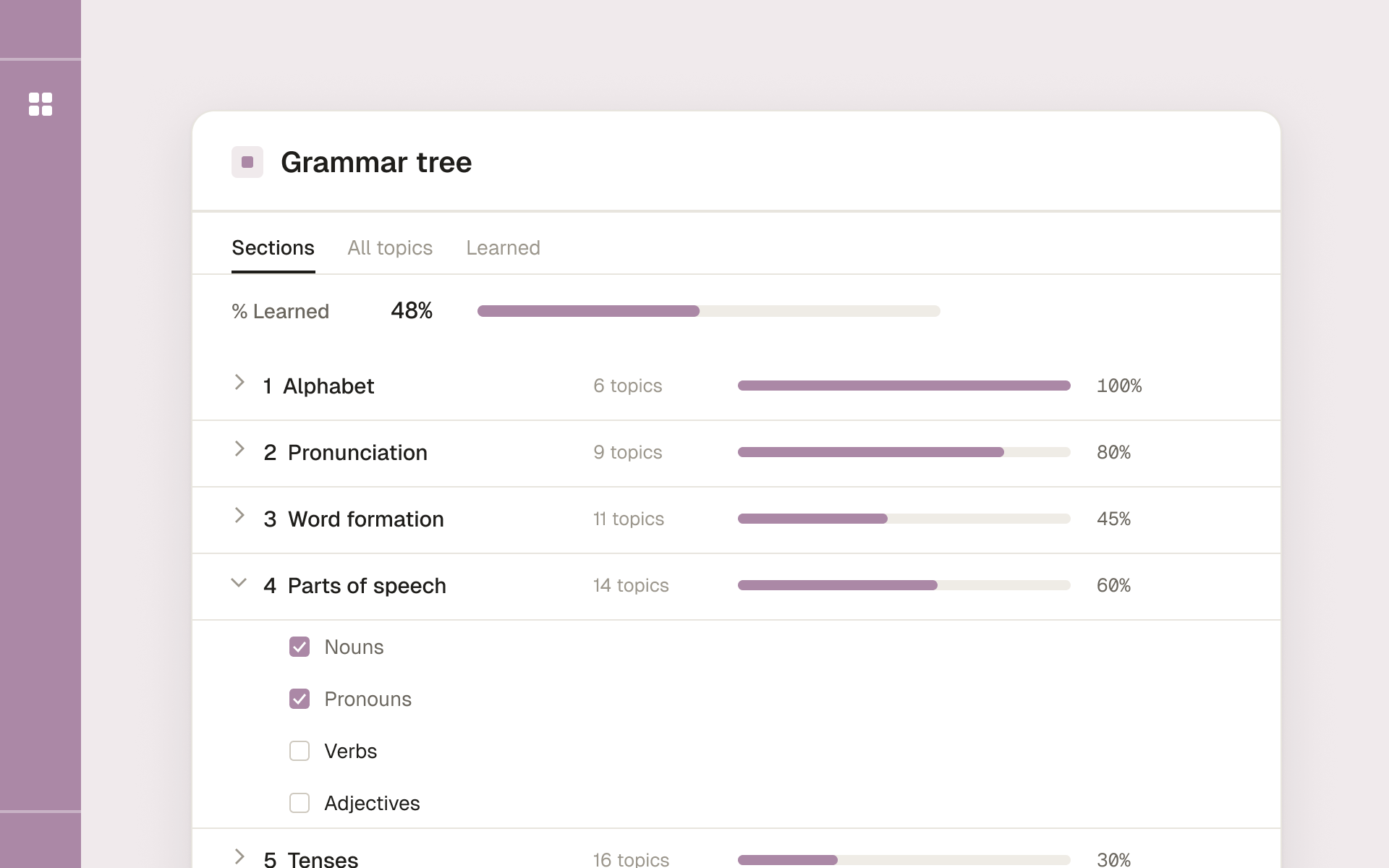
One grammar framework for any language, organized into seven sections from alphabet to punctuation.