Last updated: 12 October 2026 · By Zoya K
Mandarin uses pitch to tell words apart, so 妈 mā ("mother") and 马 mǎ ("horse") are different words that share the same letters. This guide covers the four tones and the neutral tone, the handful of tone changes you hear in everyday words, and a 10-minute drill built on tone pairs.
What are the Chinese tones?
Mandarin Chinese has four main tones plus a light neutral tone. The first tone is high and level, the second rises, the third dips low, and the fourth falls sharply. The neutral tone is short and unstressed. Tone is part of the word itself, so mā, má, mǎ, mà and ma are five different syllables.
A tone is the pitch pattern a syllable carries. Linguists describe Mandarin pitch on a five-level scale, where 5 is the top of your normal speaking range and 1 is the bottom. The values below are Yuen Ren Chao's classic 1968 descriptions, as summarized in Wikipedia's Standard Chinese phonology article.
| Tone | Pinyin mark | Example | How it sounds | Pitch (1 low, 5 high) |
|---|---|---|---|---|
| 1st, high level | ā | 妈 mā, "mother" | Steady and high, as if you were singing one note | 55 |
| 2nd, rising | á | 麻 má, "hemp" | Climbs from mid to high, like a surprised English "What?" | 35 |
| 3rd, low dipping | ǎ | 马 mǎ, "horse" | Drops low; the rise at the end is mostly heard before a pause | 214 |
| 4th, falling | à | 骂 mà, "to scold" | Sharp drop from high to low, like a curt "Stop!" | 51 |
| Neutral | a (no mark) | 吗 ma, question particle | Short and light; its pitch depends on the syllable before it | varies |
The third tone needs one extra note. Its textbook shape is a dip and a rise, but in connected speech the rise usually appears only at the end of a phrase. In the middle of a sentence most speakers just say it low, which some teachers call a "half third tone." If you practice the full dip on every third-tone syllable, your speech will sound slow and sing-song.

Where can you hear the tones?
Tones are learned by ear, so pair this page with real recordings. Four free sources are reliable:
- The tone table in Wikipedia's Standard Chinese phonology article has native recordings of 巴 bā, 拔 bá, 把 bǎ and 爸 bà, hosted on Wikimedia Commons.
- AllSet Learning's Pinyin chart plays every syllable and lets you pick the tone.
- Yoyo Chinese's Tone Pairs tool has a native-speaker recording for a common word in each tone pair.
- Hacking Chinese's tone-pair guide includes audio and video for a set of pair words.
Does Chinese have 4 or 5 tones?
Mandarin has four full tones. The neutral tone is sometimes called the fifth tone, but it behaves differently: it is short, unstressed, and its pitch is set by the syllable before it. The official pinyin scheme lists only four tone marks and leaves neutral syllables unmarked, which is why most teachers say "four tones plus neutral."
The 1958 Scheme for the Chinese Phonetic Alphabet (汉语拼音方案), published by China's Ministry of Education, gives four marks (ˉ ˊ ˇ ˋ) and states plainly that the neutral tone is not marked. Its own example is the same set used above: mā, má, mǎ, mà, ma.
Textbooks and apps that need a label for the neutral tone call it tone 5 or tone 0; both mean the same thing. Neutral syllables are common: Wikipedia's phonology article notes that about 15 to 20 percent of syllables in written texts are considered unstressed.
How do you write tone marks in pinyin?
The tone mark goes over the main vowel of the syllable: hǎo, xué, guì. Neutral-tone syllables get no mark at all. When you type without accents, you add a number after the syllable instead, so hǎo becomes hao3 and the neutral tone is written as 5, as 0, or with no number.
The 1958 scheme only says "the main vowel," so learners use a simple placement rule, summarized in Wikipedia's Pinyin article:
- If the syllable has an a or an e, the mark goes there: hǎo, xiè.
- In ou, the mark goes on the o: dōu, zǒu.
- Otherwise it goes on the second vowel: guì, liù.
The vowel ü takes a mark too, written above the dots, as in 绿 lǜ ("green"). The dots only appear after l and n; after j, q, x and y the same sound is written as plain u, so 去 is qù.
Most Chinese keyboard input methods ignore tones: you type nihao and pick 你好 from a list. Say each word aloud when you add it to your notes so the tone does not slip.
Which tone changes (tone sandhi) actually matter?
Some tones change when they meet certain other tones. Two third tones in a row turn the first into a second tone. 不 bù becomes bú before a fourth tone. 一 yī becomes yí before a fourth tone and yì before the other tones, but stays yī when counting. These cover most changes beginners hear.
Tone sandhi is the change a tone undergoes because of the tones around it. Dictionaries usually print the original tone, so 你好 appears as nǐ hǎo even though everyone says ní hǎo. Some textbooks print the changed tone for 一 and 不 (yídìng, búshì), so you will see both spellings. The table below is the cheat sheet. Rules and examples follow the Standard Chinese phonology article, and every word was checked in MDBG.
| Rule | When it happens | Written (dictionary) | Said |
|---|---|---|---|
| 3 + 3 becomes 2 + 3 | Two third tones in a row | 你好 nǐ hǎo, "hello"; 水果 shuǐguǒ, "fruit" | ní hǎo; shuíguǒ |
| 不 becomes bú | Before a fourth tone | 不是 bù shì, "is not"; 不客气 bù kèqi, "you're welcome" | bú shì; bú kèqi |
| 不 stays bù | Before tones 1, 2 and 3 | 不好 bù hǎo, "not good" | bù hǎo |
| 不 goes neutral | Inside an A-not-A question | 是不是 shì bù shì, "is it or not?" | shì bu shì |
| 一 becomes yí | Before a fourth tone | 一定 yīdìng, "certainly" | yídìng |
| 一 becomes yì | Before tones 1, 2 and 3 | 一天 yītiān, "one day"; 一年 yīnián, "one year"; 一起 yīqǐ, "together" | yìtiān; yìnián; yìqǐ |
| 一 stays yī | Counting, ordinals, end of a word | 一二三 yī èr sān, "one two three"; 第一 dì-yī, "first" | yī èr sān; dì-yī |
| 一 goes neutral | Between a repeated verb | 看一看 kàn yī kàn, "take a look" | kàn yi kàn |
Learn the first, second and fifth rows first. They appear in the first lessons of any course, in words like 你好, 不是 and 一个 (yí ge, "one" with a measure word).
What is the "3-3-3 rule" (three third tones in a row)?
"3-3-3 rule" is not a standard linguistics term. Learners use it for three third tones in a row, where the result depends on how the words group together. Wikipedia's phonology article gives two examples built from the same syllables.
If the first word has two syllables, both of its syllables become second tones: 保管好 bǎoguǎn hǎo ("to take good care of") is said báoguán hǎo. If the first word has one syllable, it keeps its third tone and only the middle syllable changes: 老保管 lǎo bǎoguǎn ("to take care of all the time") is said lǎo báoguǎn. The last syllable never changes. Speed, stress and accent also play a part, so copy what you hear in recordings.
How does the neutral tone sound in everyday words?
The neutral tone has no fixed pitch. It lands just after the previous syllable: lower after a first or second tone, higher after a third tone, and lowest after a fourth tone. Many common words end in a neutral syllable, including 对不起 duìbuqǐ ("sorry"), 姐姐 jiějie ("older sister") and 谢谢 xièxie ("thank you").

Listen: 玻璃 bōli · 伯伯 bóbo · 喇叭 lǎba · 兔子 tùzi
The pattern explains a common learner surprise. In 姐姐 jiějie the second 姐 is light and sits higher than the low first syllable, so the word does not sound like two identical third tones. In 对不起 the middle 不 loses its tone and is said light, neither bù nor bú.
How do tone pairs help you practice?
A tone pair is a two-syllable word practiced as one unit. Pairs are closer to real speech than single syllables, because the average Mandarin word has about two syllables and tones shift when they touch. Four tones times four gives 16 pairs, and four more with a neutral second syllable makes 20.
The grid below has one common word for each pair. Rows give the tone of the first syllable, columns the tone of the second. Every word is a beginner word, and each tone was checked against MDBG, which uses the CC-CEDICT dictionary.
| First / second | 1st | 2nd | 3rd | 4th | Neutral |
|---|---|---|---|---|---|
| 1st | 飞机 fēijī, airplane | 中国 Zhōngguó, China | 开始 kāishǐ, to begin | 音乐 yīnyuè, music | 妈妈 māma, mom |
| 2nd | 明天 míngtiān, tomorrow | 学习 xuéxí, to study | 牛奶 niúnǎi, milk | 学校 xuéxiào, school | 朋友 péngyou, friend |
| 3rd | 老师 lǎoshī, teacher | 美国 Měiguó, USA | 水果 shuǐguǒ, fruit (said shuíguǒ) | 考试 kǎoshì, exam | 姐姐 jiějie, older sister |
| 4th | 面包 miànbāo, bread | 问题 wèntí, question | 电脑 diànnǎo, computer | 再见 zàijiàn, goodbye | 爸爸 bàba, dad |
Two cells deserve attention. The 3-3 cell sounds exactly like the 2-3 cell because of the third-tone rule, so you are really practicing 19 sound patterns. And the 4-4 cell, 再见, is not two identical falls: the first fourth tone falls only partway and the second falls lower, a pattern described in the same Wikipedia article.
What does a 10-minute daily tone routine look like?
Pick one row of the grid. Listen to its five words, shadow them, record yourself, and compare your recording with the reference audio. Write down the one pair that sounds off. The next day, drill that weak pair first, then move to a new row. Ten minutes is short enough to do every day.

Here is how the ten minutes split:
- Listen (2 minutes). Play the five words of one row from a recorded source such as Yoyo Chinese or the AllSet chart. Listen several times without speaking.
- Shadow (3 minutes). Play each word and repeat it immediately, copying the melody before you worry about the consonants and vowels.
- Record (2 minutes). Record yourself saying the five words with your phone's voice recorder, at normal speed.
- Compare (2 minutes). Play the reference word, then your version. Listen for the shape: did your rise rise, did your fall fall all the way?
- Log one weak pair (1 minute). Write down the pair that sounded least like the model, for example "3-4, 考试."
Say a learner records 考试 and hears 考 dip and then climb back up before 试 starts. That is a common slip: a third tone before another tone should stay low, with no rise. They log "3-4" and start tomorrow's session with three more 3-4 words. Fixing one pattern at a time keeps each session short and focused.
A paper notebook, a spreadsheet with columns for pair, word and date, or a Notion page all work as the log. If you already keep a vocabulary notebook, add a "tone pair" column to it. For reviewing words over weeks, the spaced repetition guide compares Anki and Notion. And keep listening to real speech: comprehensible input is how tones become automatic outside drills.
Its Pronunciation section is a ready place for your tone-change notes and weak-pair log, and it works on the Notion free plan.
Why do tones matter so much in Mandarin?
Mandarin has a small set of syllables, so tone does much of the work of telling words apart. Without tone there are about 400 distinct syllables; with tone there are about 1,300. Many words that share the same letters differ only in tone, so a wrong tone can change meaning.
These figures come from Wikipedia's Standard Chinese phonology article, which also notes that tones are statistically as important as vowels in Standard Chinese. The same article gives a reassuring counterweight: the average word has almost exactly two syllables, and context removes most ambiguity. A listener who hears 老师 in a sentence about school will understand it even if your tones wobble.
So aim for tones that are clear, not perfect. If you are just starting, the how to learn Chinese roadmap shows where pronunciation fits, and the HSK 1 guide lists the beginner words most of this grid comes from. For the bigger picture, see the HSK levels overview, how long it takes to learn a language, and ways to build immersion at home. Once tones feel steady, move on to Chinese sentence structure, measure words and Chinese radicals.
FAQ
Does Chinese have 4 or 5 tones?
Mandarin has four full tones plus a neutral tone. Some textbooks call the neutral tone the fifth (or zero) tone, but the official 1958 pinyin scheme marks only four and leaves the neutral tone unmarked.
What is the 3-3-3 rule in Mandarin?
It is not a standard linguistics term. Learners use it for three third tones in a row: 保管好 is said báoguán hǎo, while 老保管 is said lǎo báoguǎn, so the result depends on how the words group.
What does 你好 literally mean?
你 nǐ means "you" and 好 hǎo means "good" or "well," so it is literally "you good." It is the standard "hello," and because of the third-tone rule it is pronounced ní hǎo.
What does "jie jie" mean in Chinese?
姐姐 jiějie means "older sister." The second syllable is neutral, so it is short and light rather than a second full third tone.
How do you say sorry in Chinese?
The everyday word is 对不起 duìbuqǐ. The middle 不 is said in the neutral tone, so it sounds like duì-bu-qǐ with a light middle syllable.
What are the numbers 1 to 10 in Chinese, with tones?
一 yī, 二 èr, 三 sān, 四 sì, 五 wǔ, 六 liù, 七 qī, 八 bā, 九 jiǔ, 十 shí. When you count, 一 keeps its first tone; it only changes before another word, as in 一天 yìtiān.
Which Chinese tone is the hardest?
Many learners find the second and third tones hardest, because the two can sound alike. Wikipedia's phonology article calls the second tone one of the most difficult to master, and the third tone changes shape depending on what follows.
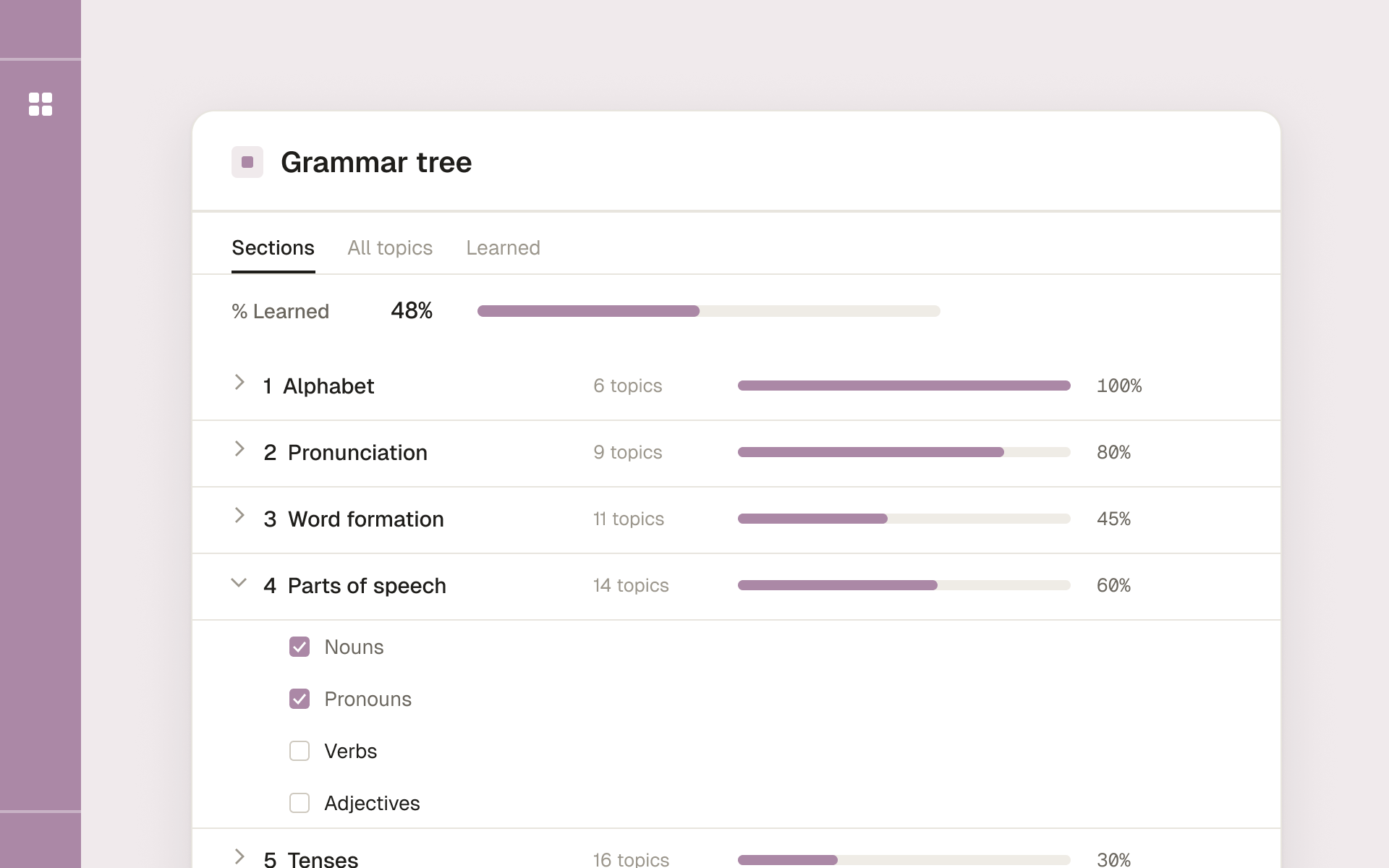
One grammar framework for any language, organized into seven sections from alphabet to punctuation.